
Font size
 Worksheets
Year 9 Revision - Physics
Total questions: 66
Worksheet time: 59mins
Fill in the blank:
Ohm’s law explains the relationship between ……………. in a circuit.
Voltage ,Current and Power
Voltage ,Current and Resistance
Voltage and Current
Only Voltage
How can Ohm's law be written?
R=I/V
V=I×R
V=I/R
What is the definition of "Resistance"?
the pressure from an electrical circuit's power source that pushes current through a conducting loop.
the opposition that a substance offers to the flow of electric current.
The stream of charged particles.
Voltage is measured in __.
Volts.
Watts.
Coulombs.
The energy per unit of charge
what 'stops' electrons
moving electrons
What is voltage?
the sum of potential energy two points in a circuit
the difference in potential energy between two points a circuit
the speed of electrons as they flow around a circuit
the opposition to the flow of current
Which instrument is used to measure the current in circuit?
coulombmeter
ammeter
voltmeter
ohmmeter
Which instrument is used to measure the voltage between two points in a circuit?
coulombmeter
ammeter
voltmeter
ohmmeter
As you continue to add lightbulbs in series, what happens?
The bulbs get brighter
The bulbs get dimmer
The bulbs remain the same brightness
The bulbs explode and shards of glass get everywhere
If one bulb goes out in a series circuit, the remaining bulbs...
also go out
get brighter
get dimmer
explode, leaving shards of glass everywhere
Current is measured in
Volts
Watts
Seconds
Amps

If the switch was opened, what would happen?
the ammeter would measure a current flowing
current would no longer flow, so everything would be off
the bulbs would stay on because they're connected to the cell
the bulbs would burn out and catch fire
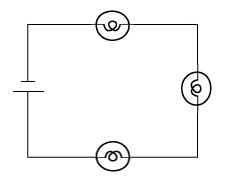

The picture shows an electrical circuit. This circuit is a series circuit because:
It has 3 light bulbs.
The same current flows through all three light bulbs.
It uses a single battery.
The electrical current is divided between the three light bulbs.

This is an example of a _______ circuit
open
series
parallel
switch

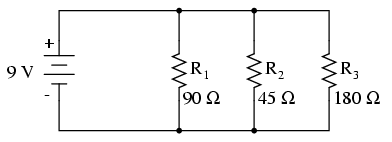
A parallel circuit
has only one path for current to travel
has more than one path for current to travel
does not allow electricity to travel through it
has magnets that cause electric current

What is this symbol?
Cell
Switch
Bulb
2 cell battery

What is this symbol?
Cell
Switch
Bulb
Resistor

What is this symbol?
Switch
Fuse
Bulb
2 cell battery

This switch is open.
True
False


If the battery produced 12.6 Volts what would be the current flow for a 6 Ohm resistor?
2.1 Amps
2.4 Amps
1.71 Amps
15 Amps
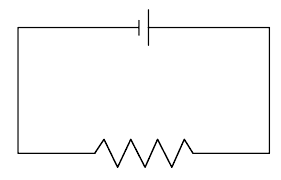
If the switch was opened, what would happen?
the ammeter would measure a current flowing
current would no longer flow, so everything would be off
the bulbs would stay on because they're connected to the cell
the bulbs would burn out and catch fire

All the lamps in this circuit have the same resistance. What is the reading of voltmeter V2?
2.5V
1.0V
0.5V

All the lamps in this circuit have the same resistance. What is the reading of voltmeter V1?
1.0V
2.0V
3.0V

All the lamps in this circuit have the same resistance. What is the reading of voltmeter V0?
2.5V
0.5V
1.5V

All the lamps in this circuit have the same resistance. What is the reading of voltmeter V1?
3.7V
7.3V
0.1V

All the lamps in this circuit have the same resistance. What are the readings of ammeters A1 and A2?
A1 = 0.5A A2 = 1.0A
A1 = 1.0A and A2 = 1.5A
A1 = 0.5A and A2 = 0.5A

All the lamps in this circuit have the same resistance. What are the readings of ammeters A1 and A3?
A1 = 3.7A and A3 = 3.7A
A1 = 3.7A and A3 = 7.4A
A1 = 7.4A and A3 = 3.7A

All the lamps in this circuit have the same resistance. What are the readings of ammeters A2 and A3?
A2 = 3.0A and A3 = 3.0A
A2 = 1.5A and A3 = 1.5A
A2 = 6.0A and A3 = 3.0A

All the lamps in this circuit have the same resistance. What are the readings of ammeters A1 and A2?
A1 = 4A and A2 = 2A
A1 = 2A and A2 = 2A
A1 = 2A and A2 = 4A

All the lamps in this circuit have the same resistance. What are the readings of ammeters A1 and A3?
A1 = 2.5A and A3 = 2.5A
A1 = 5A and A3 = 2.5A
A1 = 5A and A3 = 7.5A

All the lamps in this circuit have the same resistance. What are the readings of voltmeters V2 and V3?
V2 = 3.0V and V3 = 1.5V
V2 = 1.5V and V3 = 3.0V
V2 = 1.5V and V3 = 1.5V

All the lamps in this circuit have the same resistance. What are the readings of voltmeters V1 and V2?
V1 = 2.0V and V2 = 2.0V
V1 = 4.0V and V2 = 2.0V
V1 = 2.0V and V2 = 4.0V

All the lamps in this circuit have the same resistance. What are the readings of voltmeters V1 and V3?
V1 = 2.0V and V3 = 1.0V
V1 = 2.0V and V3 = 2.0V
V1 = 1.0V and V3 = 1.0V

A student performed an experiment to determine the number of paper clips that are attracted to an electromagnet as the amount of current changes. The data collected is displayed in the table.
Which graph best describes the relationship between magnetism and electrical current?


If there is a current of 2A and a resistance of 24 ohms, what voltage will there be?
26 V
48 V
12 V
22 V

An alarm clock draws 0.5 A of current when connected to a 120 volt circuit. Calculate its resistance.
60Ω
120Ω
180Ω
240Ω

Which statement fully describes the graph shown.
As current increases voltage decreases (inversely proportional). This graph does not follow Ohm's law, it is for a non-ohmic component.
As voltage increases current increases (directly proportional). This graph follows Ohm's law, it is for a non-ohmic component.
As voltage decreases current increases (inversely proportional). This graph does not follow Ohm's law, it is for an ohmic component.
As voltage increases current increases (directly proportional). This graph follows Ohm's law, it is for an ohmic component.

This graph is for a filament lamp. What is the reason for the shape of the line shown on the graph?
Filament lamps are variable resistors. So we can use a sliding scale to change their resistance, which will change the current going through them.
Filament lamps cool down when current runs through them, their resistance increases causing the current to decrease over time.
Filament lamps heat up as current runs through them, this increases resistance causing the current to decrease over time.
Filament lamps heat up as current runs through them, this increases resistance causing the current to increase over time.

1. What will happen when these magnets are brought close together?
They will attract each other.
They will repel each other.
Both magnets will turn to the left
Both magnets will turn to the right



