Wayground logo

Free Printable Worksheets

Font size

S
M
L
XL
Worksheets

Unit: Mechanics

Total questions: 60

Worksheet time: 1hrs 4mins

Name
Class
Date
1.

Isaac Newton developed these 3 laws concerning ______________.

a)

Velocity.

b)

Mass

c)

Acceleration.

d)

Motion

2.

What explains why objects resist changes in their state of motion?

a)

gravity

b)

inertia

c)

force

d)

friction

3.

What explains a quantity that has BOTH speed and direction?

a)

Inertia

b)

Force

c)

Speed

d)

Velocity

4.

The force that prevents a ball rolling on the ground from continuing on it's path forever is...

a)

Friction

b)

Gravity

c)

Inertia

5.
A person steps out of the boat and onto the dock.  As the person moves forward onto the dock, the boat moves backward.  Which statement best describes the backward motion of the boat as the person steps forward?
a)
For every action there is an equal and opposite reaction.
b)
Every mass exerts a force on every other mass.
c)
An object at rest tends to stay at rest.
d)
Friction opposes the motion of an object.
6.
An empty truck and a fully loaded truck are next to each other at a traffic light. When the light turns green, the lighter truck increases speed more quickly. Which of these best explains this situations
a)
Newton's first law
b)
Newton's second law
c)
Newton's third law
d)
Conservation of momentum
7.
The combination of all the forces acting on an object is the...
a)
net force
b)
action force
c)
reaction force
d)
balance force
8.
What two measurements are necessary for calculating speed?
a)
Mass and time
b)
Temperature and mass
c)
Mass and distance
d)
Distance and time
9.
What is the speed of an object that travels 60 meters in 4 seconds?
a)
240 m/s
b)
15 m/s
c)
0.067 m/s
d)
15 mph
10.
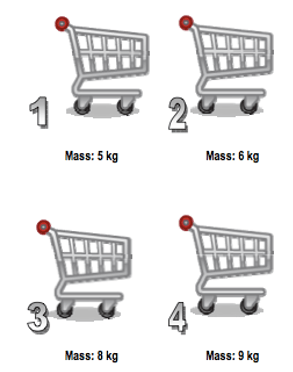
A force of 90N is applied to each cart below, which one will accelerate the fastest?
a)
Cart 1
b)
Cart 2
c)
Cart 3 
d)
Cart 4
11.
If a 10 kilogram object had a force of 50 newton's applied to it, what would its acceleration be?
a)
15 m/s^2
b)
5 m/s^2
c)
.5 m/s^2
d)
10 m/s^2
12.

An inflated balloon released from rest moves horizontally.

The law that best explains this event is

a)

Newton's 1st Law

b)

Newton's 2nd Law

c)

Newton's 3rd Law

d)

Law of Gravity

13.

True or False: objects with greater mass require more force to accelerate when compared to objects with less mass.

a)

True

b)

False

14.
What is the formula for force?
a)
F=M/A
b)
F=A/M
c)
F=M*A
d)
F=M*F
15.

A force is:

a)

a push

b)

a pull

c)

both

d)

neither

16.

Which force causes an object to speed up or slow down (accelerate or decelerate)?

a)
unbalanced force
b)
balanced force
17.

Newton's Second Law is also known as the Law of _______

a)

Inertia

b)

Acceleration

c)

Action - Reaction

d)

Gravitation

18.

Which of the following is the correct position - time graph for an object moving with a constant velocity?

a)
b)
c)
d)
19.

A dictionary weighing 15 Newtons is placed on a desk.

What is the force that the desk exerts on the dictionary?

a)

none

b)

15 N

c)

1.5 N

d)

150 N

20.

Isaac Newton stated for every action there is an

_________ and _________ reaction.

a)

equal and same

b)

equal and opposite

c)

unequal and same

d)

unequal and opposite

21.
What kind of energy is in a rock at the edge of a cliff?
a)
Potential
b)
Kinetic
22.
What kind of energy is in a moving skateboard?
a)
Potential
b)
Kinetic
23.

What is needed to calculate work?

a)

time and distance

b)

speed and distance

c)

force and direction

d)

acceleration and velocity

24.

What is the unit of measurement for work?

a)

meters

b)

newtons

c)

m/s

d)

Joules

25.

You have to push with 15 N of force to move it 10 meters. How much work do you do?

a)

15 Joules

b)

150 Joules

c)

1.5 Joules

d)

.67 Joules

26.

Newtons are the unit for _____________.

a)

Work

b)

Distance

c)

Acceleration

d)

Force

27.

A push or a pull

a)

Work

b)

Force

c)

Acceleration

d)

Speed

28.

You exert 200 J of work by pulling on an object with 20 N of force. What distance is the object moved?

a)

.01 m

b)

10 m

c)

10 J

d)

4,000 m

29.
gravitational potential energy is defined as
a)
the energy an object has due to its height above the ground
b)
the energy an object has due to its motion
c)
the energy a spring has due to its stretch
d)
the chemical energy stored in the molecules of atoms
30.
Kinetic Energy is defined as
a)
Energy stored due to its location
b)
Energy of motion
c)
Energy stored in the bonds of molecules
d)
Heat energy
31.
What are the two types of Mechanical Energy? (ME)
a)
Kinetic and Potential Energy
b)
Kinetic and Nuclear Energy
c)
Potential and Chemical Energy
d)
Thermal and Kinetic Energy
32.
What would have the greatest kinetic energy?
a)
A car driving down a hill.
b)
A person running down a hill. 
c)
A ball rolling down a hill. 
33.
Calculate the kinetic energy of a moving 4 kg object travelling at a velocity of 3 m/s.
a)
18 J
b)
36 J
c)
12 J
d)
6 J
34.
How much kinetic energy does a moving 6 kg object have if it moves with a velocity of 3 m/s?
a)
27 J
b)
18 J
c)
9 J
d)
2 J
35.

The faster an object moves, the ________ kinetic energy it has.

a)

more

b)

less

c)

none of the above

d)

same

36.

Which of the following is the correct equation for calculating an object's gravitational potential energy?

a)

PE = mgh

b)

PE = mg / h

c)

PE = mg + h

d)

PE = gh

37.

In the equation PE = mgh, what does the “g” mean?

a)

Acceleration due to gravity

b)

Force of gravity

c)

Weight of the object

38.
Explain what happens to the potential energy of a rock as it falls off the side of a cliff.
a)
The kinetic energy decreases as the potential energy increases.
b)
The kinetic energy decreases as the potential energy decreases.
c)
The potential energy decreases as the kinetic energy increases.
d)
The potential energy decreases as the kinetic energy decreases. 
39.
A battery converts what type of energy to another?
a)
sound to kinetic
b)
light to heat
c)
mechanical to electrical
d)
chemical to electrical
40.
What is the formula for Kinetic Energy?
a)

PE = m*g*h

b)

KE=12mv2KE=\frac{1}{2}mv^2  

c)

W = F*d

d)

P = W/t

41.
What is the net force?
a)
20 N 
b)
0 N 
c)
400 N 
d)
40 N 
42.

What is the unit to MEASURE force?

a)

Kilogram

b)

Meter

c)

Pounds

d)

Newton

43.
What is the net force?
a)
10 N
b)
0 N
c)
25 N
d)
1 N
44.
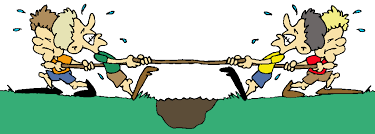
If these teams are pulling with the same amount of force what will happen?
a)
The boy in blue will win.
b)
They will not move at all.
c)
The boy in red will win.
d)
Both will fall down.
45.
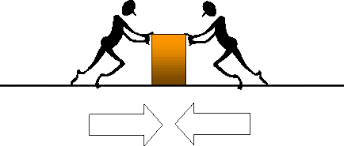
Balanced or unbalanced?
a)
balanced
b)
unbalanced
46.
What will cause an object to move?
a)
Applied forces
b)
Balanced forces
c)
Unbalanced forces
47.
What force holds the planets in motion around the sun?
a)
Magnetic
b)
Electrical
c)
Gravitational
d)
Air Resistance
48.
What force ultimately slows the roller coaster to a stop?
a)
Applied
b)
Normal
c)
Friction
d)
Magnetic
49.

When an object is moving, friction acts in the _______ direction as the motion.

a)

perpendicular

b)

same

c)

opposite

d)

precise

50.

A type of friction that occurs when air pushes against a moving object it to decelerate.

a)

surface area

b)

air resistance

c)

velocity

d)

gravity

51.

A contact force is from

a)

objects physically touching

b)

far apart objects

c)

not touching object

d)

always a pull

52.

The three examples pictured are of

a)

Non-contact Forces

b)

Contact Forces

53.
Any object with mass has gravity.
a)
True
b)
Sometimes
c)
False
d)
Never
54.
A person would weigh less on on the Moon than on the Earth because . . .
a)
Moon has more mass, and therefore more gravity
b)
Moon has less mass, and therefore more gravity
c)
Moon has more mass, and therefore less gravity
d)
Moon has less mass and therefore less gravity
55.
What is a PUSH or PULL of an object?
a)
Motion
b)
Force
c)
Friction
d)
Gravity
56.
For every action, there is an equal and opposite reaction.
a)
Newton's
1st
Law of Motion
b)
Newton's
2nd
Law of Motion
c)
Newton's
3rd
Law of Motion
57.
If an object is stationary (not moving) the forces acting upon it are _____________
a)
unbalanced
b)
weak
c)
balanced
d)
Hulk Smash!
58.

The more mass an object has, the _______ force it takes to accelerate it.

a)

more

b)

less

59.
Rougher surfaces have ...
a)
greater friction
b)
less friction
c)
the same level of friction
60.

When is having less friction useful?

a)

walking

b)

driving

c)

ice skating

d)

climbing