
Font size
 Worksheets
ADV CIA#2 Review
Total questions: 67
Worksheet time: 43mins
MgCl2 --> Mg4+ Cl2

A student pours 5.49 g hydrochloric acid (HCl) into an open beaker that contains a piece of magnesium (Mg). The Total mass of the product is 5.73 g. What was the mass of the magnesium?
5.71 g
11.22 g
0.24 g

A student pours hydrochloric acid (HCl) into an open beaker that contains a piece of magnesium (Mg). A chemical reaction occurs, and the data for the reaction is shown in the image. Was there a total mass increase or a total mass decrease for this experiment?
There was a increase in mass.
There was a decrease in mass.
There was no change in mass.
A student heated a 10 gram sample of a chemical in an open container. A chemical reaction occurred, and the mass of the sample was measured again. The mass of the sample was found to be less than before the reaction. Which of the following best explains the decrease in mass of the sample?
The heat caused the chemical to become less dense.
The reaction gave off more heat than was added.
Some of the lighter particles were destroyed.
Some of the particles escaped as a gas formed.
What reaction has the following general formula:
A + CD --> C + AD
Combination
Decomposition
Single Replacement
Double Replacement
Combustion
What reaction has the following general formula:
A + B --> AB
Combination
Decomposition
Single Replacement
Double Replacement
Combustion
What reaction has the following general formula:
AB + CD --> CB + AD
Combination
Decomposition
Single Replacement
Double Replacement
Combustion
What type of reaction is the following:
2KI −> 2K + I2
Combination
Decomposition
Single Replacement
Double Replacement
Combustion

What type of reaction involves 2 substances combining to form 1 new compound?
Decomposition Reaction
Single Displacement Reaction
Double Displacement Reaction
Synthesis Reaction

During A to B what phase of matter is the substance?
Solid
Liquid
Gas
Plasma

During which phase of matter are the particles the closest together?
Solid
Liquid
Gas
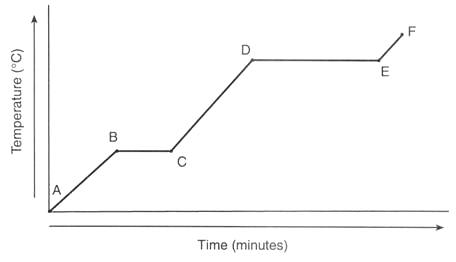
Between which points is the temperature of the substance remaining constant? (Diagram F)
A-B only.
A-B, C-D, E-F
B-C only.
B-C, D-E

On which parts of the graph does the temperature remain the same?
Between C and D
Between D and E
At C, D, or E
On both flat sections

Where on the graph are phase changes taking place?
1
2
3
4
5
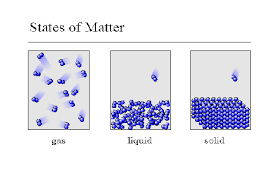
The change of one state of matter to another is called
Osmosis
Phase Change
Matter
Energy
Transition from a liquid to a solid
Freezing
Sublimation
Melting
Evaporation
Which of the following is plasma?
Book
Lightning
Air
Water
Particles of a liquid are...
Are tightly packed together and stay in a fixed position.
Are free to move around one another but still touch.

What state of matter does the picture below represent?
solid
liquid
gas
plasma
Which of these particle diagrams represents a solid?


Why do particles come closer together when they lose energy?
...the attractive forces between the particles pull them back together.
...they dissolve.
...they become a solid.
...they are more attracted to the solvent than the solute.
Boyle's Law states that if the volume of a give gas increases, then....
the pressure of that gas increases
the pressure of that gas decreases
the temperature of that gas decreases
the temperature of that gas increases
Charles' Law says that if the temperature of a given gas increases, then....
the volume of the gas increases
the volume of the gas decreases
the volume of the gas stays the same

You move a substance from a small container to a larger container. Which state of matter would that substance be if it spread out in all directions to completely fill the larger container?
Gas
Solid
Liquid
All of these.

What phase change is the image showing?
Plasma to Gas
Solid to a Liquid.
Liquid to a Gas.
Gas to a Solid.
When you have added as much solute as can dissolve in the solvent, the solution is called:
concentrated
supersaturated
saturated
unsaturated
A mixture with more solute dissolved in the solvent than is usually soluble is called:
concentrated
supersaturated
saturated
unsaturated
Explain what happens when a strong acid and a strong base are poured into the same container.
they form separate layers
they mix physically but not chemically
they break apart into separate elements
they react to form a salt and water
A solution that contains a relatively small amount of solute is a ..................
concentrated solution
dilute solution
A dilution is when
solute is added to the volume of solution
water is added to the volume of solution
solute is removed from the volume of solution
water is removed from the volume of solution

What relationship is shown in this graph?
As pressure increases, volume also increases
As temperature increases, volume decreases
As pressure increases, volume decreases
As temperature decreases, volume decreases

Which gas law is this a graph of?
Charles' Law
Boyle's Law
Avogadro's Law
Gravity Law

If we decrease the pressure on this gas, what will happen to the volume?
The volume will decrease
The volume will increase
The volume will not be affected

Which gas law is represented by this graph?
Ideal Gas Law
Boyle' Law
Dalton's Law
Charles' Law
Stirring the solution increases the rate of dissolution (rate of dissolving).
True
False
The smaller the particle size the faster the rate of dissolution (rate of dissolving).
True
False

30 grams of KClO3 would dissolve in 100mL of water at what temperature?
50°C
40°C
70°C
20°C

How many grams of KNO3 can dissolve in 100mL of water at about 33 °C
40
17
50
30
A substance that conducts an electrical current when dissolved in water is called
catalyst
metalloid
electrolyte
nonelectrolyte
When the ends of two wires, from a circuit containing a battery and a lightbulb, are placed into a beaker containing an aqueous solution the light bulb glows brightly. From this observation, you can conclude the solution is probably —
a concentrated but weak base
a strong acid
a pH neutral sample of a polar compound
an acid added to a base
what does the pH scale measure?
the amount of hydronium
the amount of hydroxide
the amount of base
the amount of bass
Bases are slippery or soapy.
TRUE
FALSE
MAYBE
Bases are usually identified by their sweet taste and
are known to turn blue litmus into red.
TRUE
FALSE
MAYBE
Acidic substances are usually identified by their sour taste and are known to turn blue litmus into red.
TRUE
FALSE
MAYBE
The the lower the pH of a substance, the ___ H+/H3O+ ions it has in it and the ___ OH- ions it has in it.
more / less
less / more
Forms hydroxide ions (OH-) in water.
Acids
Bases
Both

If the substance is neutral, what would the pH be?
3
5
7
9
11
If an acid is combined with a base of equal strength, the result will most likely be
a neutral solution.
a stronger acid.
impossible to tell without testing the pH.
a stronger base
Which of the following are the best conductors?
Strong Acid
Weak Acid
Strong Base
Weak Base
We can measure how easily a solute will dissolve in a certain solvent. This measurement is called _______
solubility
solvation
solution
solvent
This solution dissolves maximum amount of solute at a specific temperature.
unsaturated
saturated
supersaturated
solvation
This solution can solve more solute at a specific temperature
unsaturated
saturated
supersaturated
solvation
This solution contains more solute than their capacity.
unsaturated
saturated
supersaturated
solvation
What factor of solubility explains fishing early morning and late afternoon, in terms of less oxygen dissolved in water?
nature of solute and solvent
temperature
pressure

