NEW
Font size
 Worksheets
electricity 1 test
Total questions: 60
Worksheet time: 2hrs 30mins

Solve for the voltage drop at resistor 1
38 volts
60 Kvolts
50 volts
25 volts
This circuit has only one path for current to flow
series
parallel
combination
split
__________ remains the same in a series circuit.
Resistance
Voltage
Current
Power

solve for the voltage drop across R2
15 v
50 v
25 v
33 v

If another bulb is added in a parallel circuit, each bulb would
stay the same
get dimmer
In which direction do electrons move around a circuit with a cell?
From the positive to negative end
From the negative to positive end
Both directions
From both ends
Materials that allow electrical energy to flow through are called...?
Circuits
Insulators
Resistors
Conductors
Allows the flow of electricity to be stopped or started by breaking or completing the circuit.
Switch
Electricity
Battery
Lamp
What word or phrase best describes the NEC requirements for the installation of electrical systems?
Minimum
Most Stringent
Design Specification
Complete
An electrician should use a ________ ladder when working around electrical wiring.
Aluminum
Wood
Fiberglass
Wood or Fiberglass
_________ is a combination of rules and devices that prevent the energizing
of a circuit that could injure a worker.
National Electrical Code
Lockout/Tagout
EPA Regulations
OSHA Regulations
The safe way to get to the top of scaffolding is to...
Climb the bracing.
Climb the outside.
Use a ladder.
All answers are safe
The two types of burns an electrician can normally be exposed to are _______.
Arc Flash & Electrical burns
Electrical Burns & Chemical Burns
Chemical Burns and Arc Flash
Contact burns and friction burns.
You are an electrician working in a new building and you come across an installation that is not safe and is not acceptable under local electrical code. What should you do?
Call the building inspector.
Tell your supervisor after work.
Tell your supervisor immediately
Keep a close eye on it and continue your work.
The minimum service entrance rating for a single-family home permitted by the NEC® is __________ amperes.
60
75
100
120
When cables or conductors are physically tied, wrapped, or taped together, they are considered to be__________.
bundled
supported
mess
all of the above
According to the NEC®, the unit load used to calculate the minimum number of general lighting circuits in a dwelling is __________ volt-amperes per square foot.
2
3
4
5
Common symbols used on blueprints are usually based on the symbols developed by the _____.
National Electrical Code®
National Fire Protection Association
American National Standards Institute
all of the above
The _________ is a drawing that shows building detail from a view directly above the house.
floor plan
sectional drawing
elevation drawing
all of the above
The comfort grip handles on screwdrivers are designed for comfort and to provide a secure grip, and not to act as an insulator from electrical shock.
a. True b. False
True
False
You should never use a power tool before you have received the proper training on how to use it and have read its owner's manual.
a. True b. False
True
False
OSHA 1910.335 requires __________ tools to be used whenever an electrician is working on exposed energized circuits or equipment.
clean
covered
insulated
Always follow OSHA 1910 S and NFPA 70E safety requirements when working on energized parts. This includes wearing the proper __________.
tool belt
personal protective equipment (PPE)
T-shirt
Another name for a Skilsaw® is a __________ saw
circular
reciprocating
jig
______ are used to cut cables, cut conductors, form large conductors, and pull and hold conductors.
Diagonal pliers
Long-nose pliers
Lineman pliers
A ____________ is usually 9 inches long and is used to level or plumb conduit, equipment, and appliances.
lineman pliers
torpedo level
plumb bob
When a warning ribbon is required to mark the location of buried underground service conductors, it must be placed at least __________ above the buried conductors.
12 inches
24 inches
18 inches
8 inches
Ground rods must be at least __________ feet long.
10
8
12
6
According to NEC Table 250.66, the minimum size copper grounding electrode conductor for a service entrance installed with 4/0 copper conductors is __________.
2AWG
8AWG
6AWG
4AWG
Overhead service conductors are not permitted to be attached to trees for support
True
False
A(n) __________ is a plastic or fiber fitting designed to screw onto the ends of a conduit or cable connector to provide protection to the conductors.
insulated bushing
connector nut
threaded hub
bushing
Where underground service cables exit the trench and run up a utility pole to the transformer, the conductors must be protected from physical damage to a height of __________ feet above final grade.
10
12
8
3
The grounding electrode conductor must be attached to a metal water pipe grounding electrode no more than __________ feet from the point where the metal water pipe enters the house.
5
9
7
3
The working space in front of residential service equipment as stated in NEC Section 110.26 is __________ feet.
2
3
5
4
An instrument used to measure values of resistance is called a(n) __________.
Ohmmeter
Voltmeter
Ammeter
A(n) __________ is designed to measure the amount of current flowing in a circuit
Ammeter
Voltmeter
Ohmmeter
Safety glasses are always required when using test and measurement instruments.
True
False
What is electricity?
Wires, bulbs, lamp holders and tools.
The flow of electrons through a conductor.
It's an undesired path for current to flow.
Has no path for current to flow.
Which of the following is an insulator?
an eraser
a wire
a penny
a metal spoon
If the light bulb turns ON in a circuit, that means the circuit is
open
closed
What is the formula for ohms law?
1+2=3
R X E = I
V =I x R
E= MC squared
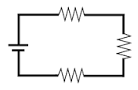

An alarm clock draws 0.5 A of current when connected to a 120 volt circuit. Calculate its resistance.
60Ω
120Ω
180Ω
240Ω

turn off the power source
call 999
What is the take up for a 90 degree bend on 1/2" emt
3 inches
5 inches
6 inches
7 inches
What is the measurement for a 30 degree offset that needs span 14 1/4"?
7 1/8 " between marks
14 1/4" between marks
28" between marks
28 1/2 between marks
In an electrical generator, the energy transformation begins as ___________ and becomes ____________.
mechanical; electrical
electrical; mechanical
electrical; chemical
mechanical; chemical
How can you use a magnet and wire coil to produce electricty?
Put them near each other
Place the magnet inside the coil and not move
Move the magnet in and out of the coil
Hold them next to each other and shake
In North America, power is generated at a frequency of ? .
25 Hz
50 Hz
60 Hz
120 Hz
A stronger magnetic field, more turns, and faster rotation produce a higher voltage from a generator.
True
False
In A.C generator,by increasing the no. of turns in the coil,
Decrease the Electromotive force (EMF)
Electromotive force (EMF) remains the same
Increases the Electromotive force (EMF)
Electromotive force (EMF) becomes zero
A generator transforms __________ energy into _______ energy.
electrical, mechanical
mechanical, electrical
electrical, nuclear
mechanical, chemical
Which of the following is NOT an example of a generator?
Wind power spinning turbines to produce electricity
A fan transforming electrical energy into mechanical energy
Moving water spinning turbines to produce electricity
Burning fossil fuels to create steam to spin turbines to produce electricity