
 Worksheets
IAPS Semester 1 Review (2223)
Total questions: 80
Worksheet time: 4hrs 0mins
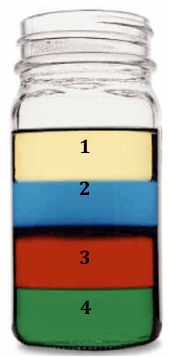
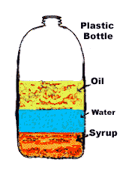
Mineral oil is less dense than water. Iron Nitrate solution, (Liquid B), is denser than water. If mineral oil, Iron Nitrate solution, and water were mixed together, which liquid would float to the top?
Mineral oil
Iron Nitrate solution
water
both Iron Nitrate solution and mineral oil would float to the top
A large, unlabeled solid is put through several tests. The solid does not dissolve in water and has a pH of 7. When acid is dropped onto the solid it bubbles and forms a gas. Based on this information only, which one of the following conclusions can be made?
the solid conducts electricity.
the solid floats in ethanol.
the solid reacts with acid.
the solid is toxic.
Which of the following is an example of a mixture that can be separated using a magnet?
water and alcohol
iron filings and pepper
saltwater
sand and water

You must identify an unknown substance using only the information shown in the table. According to the chart, which test could help you narrow down the identity of the substance?
Observing the physical state
Using a magnet
Observing the color
Measuring density relative to water
Camila is testing the thermal conductivity of different materials. She places four spoons in a bowl. One spoon is plastic, one is stainless steel, and one is silver. She touches the handle of each spoon after 60 seconds. How would she describe the thermal
conductivity of each spoon?
All spoons are equally conductive.
Only the plastic spoon is thermally conductive.
Only the silver spoon is thermally conductive.
Both the silver spoon and the stainless steel spoon are thermally conductive.
Darius is comparing five thin sheets that are the same size but are made of different materials. One of the sheets is made of iron. Which of the other sheets has an electrical conductivity most similar to iron?
Aluminum
Glass
Paper
Wood
Lyric has a purple balloon and a pink balloon that are the same size but filled with different gases. The pink balloon floats in air, but the purple balloon does not float and sits on the ground. How does the density of the gas in the balloons compare to the density of the surrounding air?
the purple balloon is less dense than the air
the purple balloon is more dense than the air
the pink balloon is more dense than the air
the balloons have equal density to the air
Jacob collects some ocean water in a jar when he goes to the beach. The jar contains a solution of water and salt with some sand sitting at the bottom. How could the contents of the jar be changed to have only solution?
by evaporating the water
by heating the contents of the jar
by stirring the contents of the jar
by filtering out the sand
The density of water is 1.00 g/cm3. The density of ethanol is 0.80 g/cm3. What is the volume of ethanol, in cm3 that has the same mass as 100 cm3 of water?
80
100
125
180


15 g/mL
5 g/mL
10 g/mL
20 g/mL

A mystery substance has a volume of 2.3 mL and a mass of 3.657 grams. What substance in the data table is most likely the mystery substance?
Salt
Sugar
Baking Soda
Why is Hydrogen on top of the first column of the periodic table?
Hydrogen would combine with other elements in the same way elements from the first column would
Hydrogen is a gas
Hydrogen is a metal
Hydrogen would form diatomic molecules with itself
Table sugar has the chemical formula C12H22O11. If you were able to take sugar and separate it into carbon, hydrogen, and oxygen, what would the smallest unit of each component be?
a molecule of carbon, a molecule of hydrogen, and a molecule of oxygen
an atom of carbon, an atom of hydrogen, and an atom of oxygen.
a molecule of carbon, an atom of hydrogen, and a molecule of oxygen
an atom of carbon, a molecule of hydrogen, and an atom of oxygen
When you heat baking soda, it breaks down into a gas and a new solid. The gas and new solid are both pure substances. Based on this information only, what would you classify baking soda as?
element
compound
mixture
Why do different scientists do the same experiment?
To read everyone's results
To have multiple trials for each experiment that they can average together
To make sure everyone's results looked the same
To check the data and see if it was correct
Bubbling and temperature change are observed in a test tube. After a period, a new substance is observed in the test tube. What type of change can you conclude has occurred in the test tube due to the formation of the precipitate?
Chemical change
Physical change
No change
Not enough information
Many first aid kits have instant cold packs in them. When you shake one, the temperature of the cold pack changes from 75°F to 33°F. What type of reaction is this?
Endothermic
Exothermic
Physical change
Magnesium (Mg) has two valence electrons. What would be the chemical formula for Magnesium combining with the element Chlorine?
Mg2Cl
MgCl
MgCl2
Mg4Cl2

Using the image from the periodic table shown, how many protons does the element have?
20
40
40.05
60.05
Lorenzo was observing a piece of aluminum foil. He wrote down the following observations in his binder: "The foil reflects a lot of light and bend very easily." What was Lorenzo observing?
The chemical properties of luster and flexibility
The chemical property of luster and the physical property of flexibility
The physical properties of luster and flexibility
The chemical property of flexibility and the physical property of luster.

What is the benefit provided by the model shown above?
It provides information about the structure of an atom
It provides information about the ways atoms are arranged in a compound
It provides information about the actual size of the substance
It provides information about the abundance of the substance

The first 2 columns of the periodic table are shown above. Check the two elements that are likely to have similar properties.
lithium (Li)
helium (He)
barium (Ba)
francium (Fr)

The last four columns of the periodic table are shown. Why is Helium (He) placed in the last column with the Noble Gases?
It is a solid like the rest of the Noble Gases
It is smaller than the Noble Gases
It needed to balance out hydrogen that sits on top of the first column
It has a full electron shell and is unreactive like the rest of the Noble Gases

How many valence electrons does the element shown have?
(a)

How many valence electrons does this atom have?
(a)

How many valence electrons does the element shown have?
(a)
The first 2 columns of the periodic table are shown above. Check the two elements that are likely to have similar properties.
beryllium (Be)
helium (He)
lithium (Li)
radium (Ra)
The last four columns of the periodic table are shown. Check the two elements that are likely to have the same properties.
selenium (Se)
helium (He)
krypton (Kr)
nitrogen (N)
A chemical reaction happens. The temperature goes from 75 degrees down to 65 degrees. What type of reaction is this?
endothermic
exothermic
A chemical reaction happens. The temperature goes from 75 degrees up to 85 degrees. What type of reaction is this?
endothermic
exothermic
A chemical reaction happens. The temperature goes from 70 degrees up to 90 degrees. What type of reaction is this?
endothermic
exothermic

What part of the image shown determines the number of protons in an element?
14
Si
28.0855
Silicon
Calcium (Ca) has two valence electrons. What would be the chemical formula for Calcium combining with the element Chlorine?
Ca2Cl
CaCl
CaCl2
Ca4Cl2
Barium (Ba) has two valence electrons. What would be the chemical formula for Barium combining with the element Chlorine?
Ba2Cl
BaCl
BaCl2
Ba4Cl2
Ms. Langsdale masses a sample of playdough on a balance. She successfully creates it into the shape of a sphere, a cube, and a flat circle massing the playdough after each creation. Which playdough creation will have the greatest mass?
sphere
cube
Flat circle
The mass will be the same for all
In the chemical reaction below, how many different elements are used on the product side the equation?
1 element
2 elements
3 elements
4 elements
In the chemical reaction below, what is the total number of atoms on the product side the equation?
7 atoms
24 atoms
36 atoms
42 atoms
Copper is a reddish-brown metal that is an excellent conductor. Copper tarnishes and becomes black when exposed to air and light. The density of copper is 8.96 g/cm3 . The melting point is 1,085oC and the boiling point is 2562oC. Check all of the physical properties of copper.
tarnishing
melting point
boiling point
density
A chemical reaction occurs in a closed system. What conclusion can you make about the mass of the substances involved before and after the reaction?
The mass will not change
The mass will go down because some gas will escape
The mass will go up because some gas will escape
The mass will go up because new substances will be made
Sam wants to test the effect that different concentrations of acid will have on the dissolution of a particular kind of candy. As she sets up and completes her experiment, which of the following experimental designs would be most likely to help her answer her question?
Allow several pieces of candy to soak in different amounts of acid of a single concentration and then measure the amount of dissolution on each.
Prepare solutions of different acid concentrations, measure 50 milliliters of each into different beakers, and place the same number and type of candy into each of the beakers.
After allowing a piece of candy to be exposed to one acid concentration, place it in different acid concentrations, and then measure the surface area that is dissolved.
Prepare solutions of different acid concentrations, measure 50 milliliters of each into different beakers, and place different types and amounts of candies into the beakers.
Barry is convinced that he discovered a new element after only one experiment, but he is frustrated that the Science Journal would not publish his work. What advice could you provide Barry to get his work published in the future?
Conduct multiple trials to verify his findings (repetition)
Add more data tables and graphs to his report
Scrap the whole idea and start over
Send an email to a well respected scientist asking if they will publish the findings under their name
Alkali metals are in column 1 of the periodic table. What property do they share? Check all that apply.
Each element has 1 proton
Each element has 1 electron
Each element has 1 valence electron
Each element has an atomic mass of 1
Fluorine (Fl), Chlorine (Cl), Bromine (Br), and Iodine (I) are all in the same column of the periodic table. Why are these elements in the same column of the periodic table? Check all that apply.
They are the same size
They react with each other
They have similar properties
They have the same number of protons

Which statement correctly describes an element based on its position in the periodic table?
Element Y is a Noble Gas that will lose electrons to form compounds
Element Z is a halogen with 7 valence electrons
Element W is a reactive alkaline earth metal
Element X will lose electrons and form a negative ion

Between what two letters is the substance melting?
Between D & E
Between E & F
Between A & B
Between B & C
Between C & D
Between what two letters is the substance completely solid?
Between D & E
Between E & F
Between A & B
Between B & C
Between C & D

What type of a solution is 60g NaNO3 at 40ºC in 100g H2O?
Saturated
Unsaturated
Supersaturated
What type of a solution is 100g KNO3 at 40ºC in 100g H2O?
Saturated
Unsaturated
Supersaturated

When 50 grams of KCl is dissolved at 50 ºC, the solution can be correctly described as:
supersaturated
unsaturated
saturated

Which of the following is a way to increase the solubility of a substance?
adding more solute
stiring
cooling
heating


Which of these substances has the highest melting point?
Oxygen
Sugar
Water
All of them are the same

During what interval is the substance entirely a liquid?
A
B
C
D
E

What is the boiling point of the substance?
-100 °C
0 °C
100 °C
140 °C

What is the melting point of the substance?
-100 °C
0 °C
100 °C
140 °C

Which beaker represents the particles in a solid?
1
2
3
Which beaker represents the particles in a gas?
1
2
3
Which beaker represents the particles in a liquid?
1
2
3

The solubility of two solids, A and B, in three liquids, X, Y, and Z, is shown. Which of the five substances could be the same? (Check all that apply)
A & B
Liquid X & Y
Liquids X, Y, & Z
Liquid X & Z
Liquid Y & Z
If something is labeled as a weak base what must be true of its pH?
A very low pH number
A very high pH number
A number slightly less than but close to 7
A number slightly greater then but close to 7
If something is labeled as a weak acid what must be true of its pH?
A very low pH number
A very high pH number
A number slightly less than but close to 7
A number slightly greater then but close to 7
Which of the following pH values represents a base?
2.1
4.6
6.8
8.1

The image shows Helium combining with Oxygen to form water. Which substance shown is a pure substance?
Water only
Helium Only
Oxygen only
All of them
Which of the following has the highest concentration?
50 ppm
100 ppm
50 ppb
100 ppb
A student mixed vinegar (an acid) with baking soda (a base) to make water and one other neutral substance. What describes this neutralization reaction?
Two acids reacted to form water and a salt
Two bases reacted to form water and a salt.
An acid and a salt reacted to form water and a base.
An acid and a base reacted to form water and salt.

