wayground logo

Free Printable Worksheets

NEW

Font size

S
M
L
XL
Worksheets

Honors Biology Genetics Review

Total questions: 72

Worksheet time: 50mins

Name
Class
Date
1.

What shape is DNA?

a)

A double helix

b)

A single strand

c)

A pleated sheet

d)

An omega helix

2.

What does DNA stand for?

a)

Deoxyribonucleic acid

b)

Ribonucleic acid

c)

Deoxynucleic acid

d)

Nucleic acid

3.

What does RNA stand for?

a)

Deoxyribonucleic acid

b)

Ribonucleic acid

c)

Deoxynucleic acid

d)

Nucleic acid

4.

What four nitrogen base pairs make up DNA?

a)

Adenine, Thymine, Guanine, Cytosine

b)

Adenine, Uracil, Guanine, Cytosine

c)

Adenine, Thymine, Glucose, Cytosine

d)

Adenine, Thymine, Guanine, Fructose

5.

What four nitrogen base pairs make up RNA?

a)

Adenine, Thymine, Guanine, Cytosine

b)

Adenine, Uracil, Guanine, Cytosine

c)

Adenine, Thymine, Glucose, Cytosine

d)

Adenine, Thymine, Guanine, Fructose

6.

What base pair does Adenine (A) bind with in DNA?

a)

Guanine

b)

Cytosine

c)

Thymine

d)

Uracil

7.

What base pair does Guanine (G) bind with in both DNA and RNA?

a)

Guanine

b)

Cytosine

c)

Thymine

d)

Uracil

8.

What base pair does Adenine (A) bind with in RNA?

a)

Guanine

b)

Cytosine

c)

Thymine

d)

Uracil

9.

How would you read the second strand to this first strand? 5'-ATTGACC-3’

a)

3’-TAACTGG-5’

b)

5’-TAACTGG-3’

c)

3'-CGGTCAA-5'

d)

5'-CGGTCAA-3'

10.

What are the building blocks of RNA and DNA?

a)

monosaccharides

b)

amino acids

c)

fatty acids

d)

nucleotides

11.

What is a nucleotide made of?

a)

one glycerol and three fatty acids molecules

b)

an amino group and a carboxyl group

c)

monosaccharides and disaccharides

d)

a 5-carbon sugar, a phosphate group and a nitrogen base

12.

DNA _____________________________________ and RNA ____________________________.

a)

is involved in actual protein synthesis, holds coded hereditary information

b)

transports amino acids to the ribosome, transports finished proteins to tissues

c)

holds coded hereditary information, is involved in actual protein synthesis.
13.
I am found ONLY in the nucleus of eukaryotic cells.
a)
DNA
b)
RNA
c)
Both DNA and RNA
14.
Why is DNA important?
a)
it is very small and very complicated
b)
it's in everything
c)
it serves as the blueprint for traits of all living things
d)
because we eat it every day for energy
15.
How does RNA differ from DNA?
a)
RNA contains uracil and deoxyribose
b)
RNA contains ribose and thymine
c)
RNA contains uracil and ribose
d)
RNA contains adenine and ribose
16.
Nitrogenous bases are joined by which type of bond?
a)
polar bonds
b)
ionic bonds
c)
covalent bonds
d)
hydrogen bonds
17.
In a strand of DNA, if it contains 20% of Thymine, then how much Guanine would be present?
a)
30%
b)
20%
c)
80%
d)
10%
18.
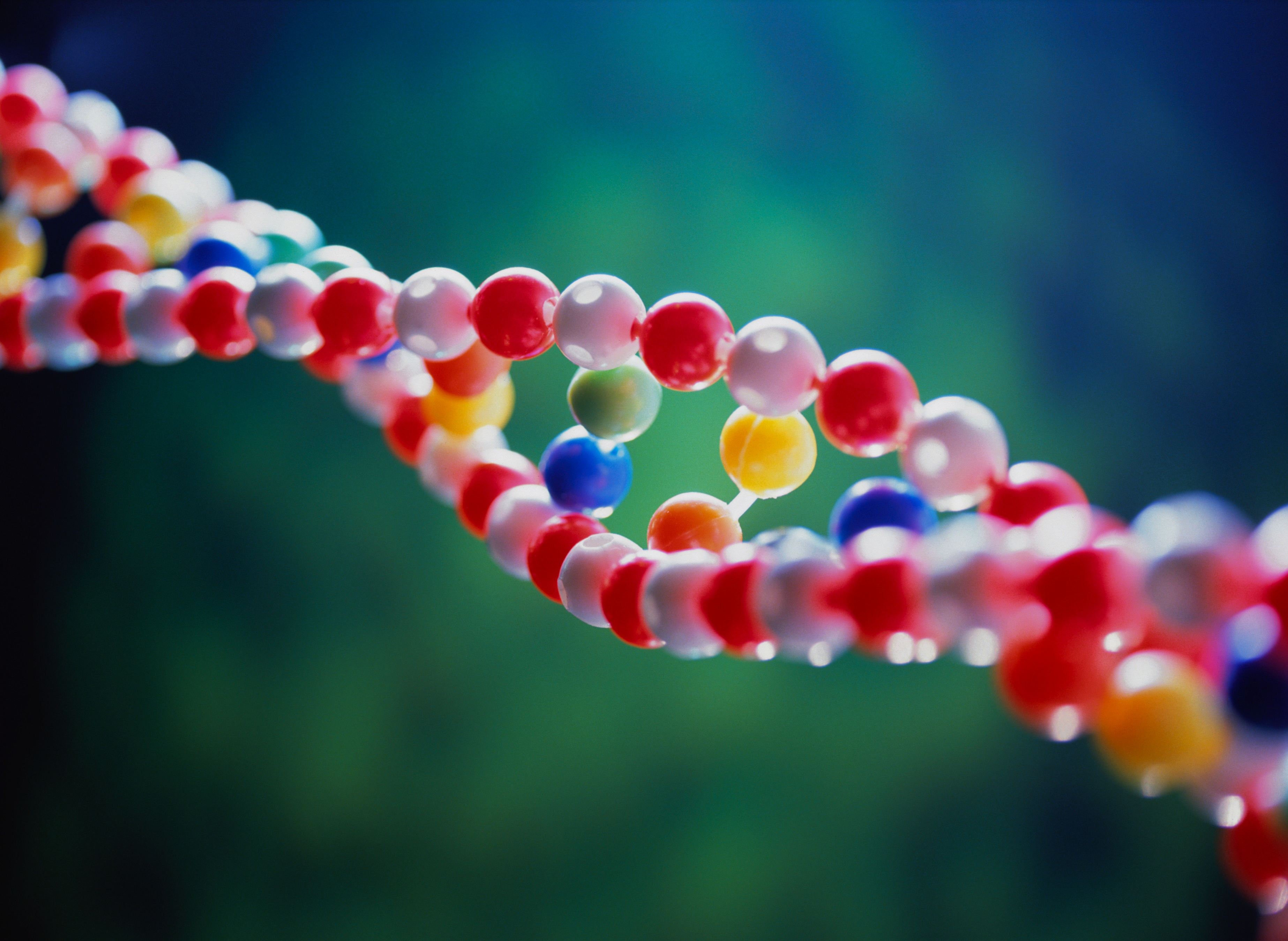
The following picture must be
a)
DNA because it's double stranded
b)
RNA because it's single stranded
c)
DNA because it's single stranded
d)
RNA because it's double stranded
19.
The enzyme that unwinds the DNA to prepare for replication
a)
helicase
b)
replicase
c)
polymerase
d)
synthase
20.

DNA replication results in two DNA molecules that are semi-conservative,

a)

each one with two original strands

b)

each one with two new strands

c)

each one with one new strand and one original strand

d)

one with two new strands and the other with two original strands

21.
order of replication
a)
3, 4, 2, 1
b)
3, 1, 4, 2
c)
2, 1, 4, 3
d)
3, 4, 1, 2
22.
A process in which DNA has the unique ability to make an exact copy of itself.
a)
Replication
b)
Translation
c)
Transcription
23.
Why does DNA replicate?
a)
To create another copy for the new cell
b)
To create a duplicate copy in case the original gets damaged
c)
To create a new copy to replace the damaged original
24.
Why would it be important to replicate DNA before a cell divides in mitosis or meiosis?
a)
In order for genetic information to be transferred into daughter cells.
b)
In order for the cell to be able to increase in size.
c)
In order for the DNA to be contained in the nucleus.
d)
In order for the cell to re-order the DNA sequencing in the new cells.
25.
Meiosis produces different types of cells than mitosis. If there was a "meiosis club," all of these cells could be included EXCEPT
(Which cell type is not produced in meiosis?)
a)
gametes
b)
body cells
c)
sperm cells
d)
egg cells
26.

The new DNA strand formed after DNA replication is an exact copy of its parent strand

a)

True

b)

False

27.
Which enzyme "re-zips" the strands by reforming the hydrogen bonds between bases? 
a)
helicase
b)
RNA primase
c)
DNA polymerase
d)
ligase
28.
What strand is copied faster?
a)
Leading
b)
Lagging
29.
Which of the following is required for DNA replication to occur?
a)
DNA helicase
b)
DNA ligase
c)
DNA polymerase
d)
all of these
30.

A biological process of producing two identical replicas of DNA from one original DNA molecule is

a)

Transcription

b)

Translation

c)

DNA Replication

d)

Protein Synthesis

31.

________________________ unzips the 2 strands of the double helix by breaking the weak hydrogen bonds that hold the nitrogen base pairs together

a)

Topoisomerase

b)

Helicase

c)

Ligase

d)

Primase

32.

Which enzyme can we relate to "glue" because it facilitates the joining of DNA strands together?

a)

Helicase

b)

DNA Polymerase

c)

DNA Primase

d)

DNA Ligase

33.

DNA ______________________ joins new nucleotides to the original strand to make a new polymer

a)

Polymerase

b)

Topoisomerase

c)

Ligase

d)

Primase

34.

Where in a Eukaryotic cell does DNA Replication take place?

a)

Cytoplasm

b)

Ribosomes

c)

Nucleus

d)

Cell Membrane

35.

Which letter in the picture below depicts the lagging strand in DNA replication?

a)

A

b)

C

c)

B

d)

None of the above

36.

Which letter in the picture below depicts the replication fork in DNA replication?

a)

A

b)

C

c)

B

d)

None of the above

37.

During transcription, this type of ribonucleic acid is responsible for copying the DNA and brining it out of the nucleus.

a)

tRNA

b)

mRNA

c)

rRNA

d)

dRNA

38.

When these bond together, they form a protein

a)

Amino Acids

b)

Peptide Bonds

c)

Ribose

d)

Nucleotides

39.

During translation, this type of ribonucleic acid is responsible for delivering amino acids to help make a protein.

a)

mRNA

b)

rRNA

c)

tRNA

d)

dRNA

40.
This is the triplet of bases on the end of a tRNA molecule
a)
Anticodon
b)
Codon
c)
Protein
41.
The function of ______ is to combine with proteins to form ribosomes.
a)
rRNA
b)
tRNA
c)
mRNA
d)
DNA
42.
The process where mRNA is read and made into an amino acid chain.
a)
Transcription
b)
Translation
c)
Transportation
d)
Transient
43.
What is the three base sequence of mRNA that codes for a single amino acid?
a)
Anticodon
b)
Codon
c)
Protein
44.
What is the mRNA strand that would result from the DNA template strand CCTA?
a)
GGAT
b)
CCAT
c)
GGAU
d)
CCAU
45.

What happens during the process of translation?

a)

mRNA is made from DNA

b)

mRNA attaches o tRNA and makes protein

c)

copies of DNA molecules are made

d)

transfer RNA is made from mRNA

46.

In protein synthesis, amino acids are brought to the ribosome by:

a)

DNA

b)

mRNA

c)

tRNA

d)

rRNA

47.

DNA controls our heredity by coding for what substance in our body?

a)

fats

b)

carbohydrates

c)

proteins

d)

lipids

48.

How many nitrogen bases are needed to specify 3 amino acids?

a)

3

b)

6

c)

9

d)

12

49.

Why must transcription occur in the nucleus?

a)

because DNA can't leave the nucleus

b)

because ribosomes are in the nucleus

c)

because DNA polymerase is found there

d)

because helicase unzips the DNA

50.

Which organelle contains rRNA and reads the mRNA to synthesize a protein?

a)

Ribosome

b)

Nucleus

c)

Cytoplasm

d)

Nucleotide

51.

What brings the amino acids to the ribosome to assemble a protein?

a)
mRNA
b)
tRNA
c)
rRNA
d)

DNA

52.

When these bond together, they form a protein

a)

Amino Acids

b)

Peptide Bonds

c)

Ribose

d)

Nucleotides

53.

Which process does this diagram illustrate?

a)

transcription

b)

DNA replication

c)

translation

54.

How can a mutation in the DNA sequence result in NO change to the protein that is made?

a)

There are multiple codons that can code for the same amino acid and result in the same protein

b)

There is always a change in the protein when a mutation occurs

c)

Only the mRNA is used in protein synthesis so a mutation in the DNA would have no effect on the protein

55.
What causes genetic variation in meiosis?
a)
chromosomes lining up
b)
crossing over of chromosomes
c)
separation of chromosomes
d)
chromosomes pulling apart
56.
What kind of cells are made in MEIOSIS?
a)
Haploid cells
b)
Diploid Cells
c)
Skin Cells
d)
Liver Cells
57.
The process of crossing over occurs in what phase of meiosis?
a)
anaphase 1
b)
prophase 1
c)
prophase 2
d)
telophase 1
58.
The chromosomes that pair up during meiosis, are called __________ chromosomes.  
a)
homozygous 
b)
asexual
c)
homologous
d)
genes
59.
Crossing over creates
a)
male genotype
b)
genetic variation (differences)
c)
DNA replication
d)
mitosis
60.
Which cellular process is shown?
a)
meiosis
b)
endocytosis
c)
mitosis
d)
phagocytosis
61.
Which of the following best describes meiosis?
a)
It is carried out in all tissues theat require cell replacement
b)
It occurs only in cells in the reproductive structures of an organism
c)
It happens in all of the tissues except the brain and spinal cord
d)
It is the first stage of mitosis
62.
What phase is represented?
a)
metaphase 1
b)
metaphase 2
c)
anaphase 1
d)
anaphase 2
63.
What phase is  shown in the picture?
a)
metaphase 2
b)
anaphase 2
c)
metaphase 1
d)
telophase 1
64.
products of meiosis are genetically
a)
different
b)
identical
65.
A human zygote should have _____ chromosomes inside.
a)
46
b)
23
c)
92
d)
64
66.
How many daughter cells does Meiosis create?
a)
2
b)
4
c)
8
d)
1
67.
Which of the following cells is a gamete?
a)
egg
b)
bone
c)
heart
d)
muscle
68.
In mitosis cells are genetically _______, but in meiosis cells are genetically ______.
a)
diverse, identical
b)
identical, diverse/different
69.
The cells produced via meiosis are called:
a)
sex cells
b)
somatic cells
c)
body cells
d)
skin cells
70.
If a somatic cell in a butterfly contains 24 chromosomes, a butterfly egg would contain
a)
3
b)
6
c)
12
d)
24
71.

At which stage of meiosis are sister chromatids separated from each other?

a)

Prophase I

b)

Prophase II

c)

Anaphase I

d)

Anaphase II

72.

What part of the cell disappears during Prophase and reappears in Telophase?

a)

nuclear membrane

b)

cell membrane

c)

chromosomes