Wayground logo

Free Printable Worksheets

Font size

S
M
L
XL
Worksheets

Protein Synthesis and Genetics/Heredity

Total questions: 73

Worksheet time: 1hrs 13mins

Name
Class
Date
1.

Where does Transcription occur

a)

Nucleus

b)

Ribosome

c)

ER

d)

Mitochondria

2.

What is the mRNA for the following DNA strand?

TAC GTA

a)

GCT AGC

b)

ATG CAT

c)

AUG CAU

3.

Where does Translation occur?

a)

Nucleus

b)

Ribosome

c)

ER

d)

Chloroplast

4.

What is the end product of translation?

a)

mRNA that can leave the nucleus

b)

Amino acid chain

c)

monosaccharide chain

d)

Anticodon

5.

mRNA occurs during this process

a)

Translation

b)

Transcription

c)

Replication

d)

Delivery

6.

How many amino acids are found on one tRNA?

a)

20

b)

4

c)

1

d)

3

7.
The process where DNA is transcribed to mRNA happens in what part of the cell?
a)
Nucleus
b)
Mitochondria
c)
Cytoplasm
d)
Endoplasmic Reticulum
8.
The function of ______ is to combine with proteins to form ribosomes.
a)
rRNA
b)
tRNA
c)
mRNA
d)
DNA
9.
The process where mRNA is read and made into an amino acid chain.
a)
Transcription
b)
Translation
c)
Transportation
d)
Transient
10.
What is the three base sequence of mRNA that codes for a single amino acid?
a)
Anticodon
b)
Codon
c)
Protein
11.
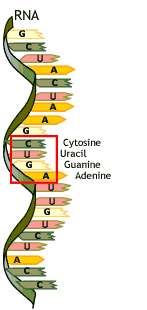
Which of these nitrogenous bases is NOT in RNA?
a)
Uracil
b)
Thymine
c)
Cytosine
d)
Guanine
12.
In RNA, Uracil pairs with ______. 
a)
cytosine
b)
adenine
c)
guanine
d)
thymine
13.

When these bond together, they form a protein

a)

Amino Acids

b)

Peptide Bonds

c)

Ribose

d)

Nucleotides

14.

Which of the following is the complementary mRNA sequence to this DNA strand: AACTGAA

a)

UUGACUU

b)

TTGACTT

c)

AACTGAA

d)

AACUGAA

15.

What brings the amino acids to the ribosome to assemble a protein?

a)
mRNA
b)
tRNA
c)
rRNA
d)

DNA

16.

How are DNA and RNA different? (CHECK ALL THAT APPLY)

a)

Only DNA can leave the nucleus

b)

RNA contains Thymine; DNA contains Uracil

c)

DNA is double stranded, RNA is a single stranded

d)

DNA contains Thymine, RNA contains Uracil

17.

Which process does this diagram illustrate?

a)

transcription

b)

DNA replication

c)

translation

18.

Use your codon chart to match the mRNA CUU to the correct amino acid

a)

VAL

b)

TYR

c)

LEU

d)

PHE

19.

Use your codon chart to match the mRNA ACU to the correct amino acid.

a)

Thr

b)

Ala

c)

Val

d)

Gly

20.

Amino acids form a polypeptide chain that is then folded up to form a protein, what type of bond holds together a polypeptide chain?

a)

Hydrogen Bonds

b)

Polypeptide Bonds

c)

Nitrogen Bonds

d)

Carbon Bonds

21.

Use your codon chart to find the amino acid that codes for AGU

a)

Tyr

b)

Gly

c)

Arg

d)

Ser

22.

Use your codon chart to find the amino acid that codes for the mRNA codon GCA

a)

Thr

b)

Ala

c)

Pro

d)

Ser

23.

Use your codon chart and find the amino acid that codes for the mRNA codon UAA

a)

Phe

b)

Tyr

c)

START

d)

STOP

24.
Which of the following is incorrect regarding RNA?
a)
RNA contains uracil
b)
RNA can only be found inside the nucleus
c)
RNA is single stranded
d)
RNA contains genetic information
25.
What is occurring in this picture?
a)
Translation
b)
DNA Replication
c)
Polymerase is unzipping the DNA
d)
Transcription
26.
The diagram shows the process of
a)
Transcription
b)
Translation
c)
Replication
d)
Mitosis
27.
What does Letter C indicate?
a)
Polypeptide Chain
b)
Anticodon
c)
Codon
d)
Amino Acid
28.
What process is occurring in the diagram?
a)
Transcription
b)
Translation
c)
Replication
d)
Mitosis
29.
What does Letter E Indicate?
a)
Codons
b)
Amino Acids
c)
An Anticodon
d)
Ribosome
30.
What is occurring in this diagram?
a)
Translation
b)
Transcription
c)
Dehydration Synthesis
d)
Hydrolysis
31.
What does Letter A indicate?
a)
amino acids being brought to the ribosome by tRNA
b)
ribosomes translating DNA
c)
A growing polypeptide chain
d)
new mRNA being formed
32.

In RNA, Adenine (A) pairs with...

a)

T

b)

U

c)

C

d)

G

33.
How many chromosomes are in a normal human body cell?
a)
23
b)
46
c)
92
34.
How many chromosomes are in a human egg cell and passed down from a mother to her child?
a)
23
b)
46
c)
92
35.
Which is a heterozygous or hybrid genotype?
a)
Bb
b)
BB
c)
bb
36.
Which describes a genotype with two identical alleles for a trait, such as PP?
a)
heterozygous
b)
homozygous
37.
Which is a phenotype?
a)
Purple
b)
Pp
38.
Which of the following would show a dominate trait?
a)
B
b)
b
39.
Which of the following would show a recessive trait?
a)
B
b)
b
40.
Which of the following shows homozygous alleles?
a)
Ww
b)
ww
41.
Which of the following describes how the genes are described?
a)
genotype
b)
phenotype
42.
Which of the following describes how the organism looks?
a)
genotype
b)
phenotype
43.
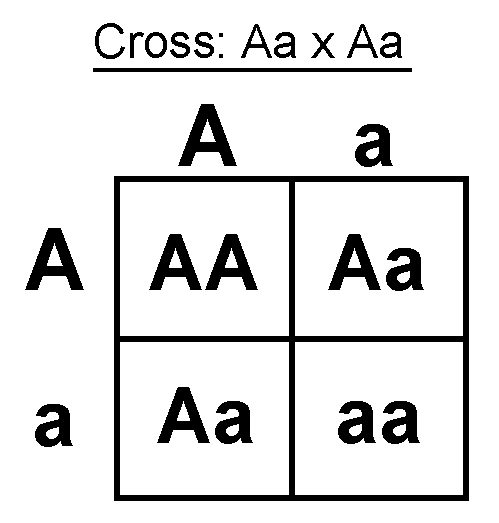
Two brown eyed parents (Bb) have a baby. What is the chance the baby is blue eyed?
a)
0 %
b)
25%
c)
50%
d)
75%
44.
Snapdragon flowers come in red, pink and white.  What type of inheritance is this?
a)
Complete Dominance
b)
Incomplete Dominance
c)
Codominance
d)
Polygenic Inheritance
45.
Incomplete dominance means that the traits are
a)
expressed equally
b)
dominant
c)
recessive
d)
blended
46.
If green is dominant over purple, then what is the genotype for this individual?
a)
Purple
b)
Green
c)
GG
d)
gg
47.
Brown fur color is dominant over black fur color. Which of the following is the actual genotype of ALL of the offspring in the next generation of this cross for fur color?
AA x aa
a)
AA
b)
Aa
c)
aa
d)
brown fur
48.
this image is an example of
a)
codominance
b)
dominance
c)
incomplete dominance
49.
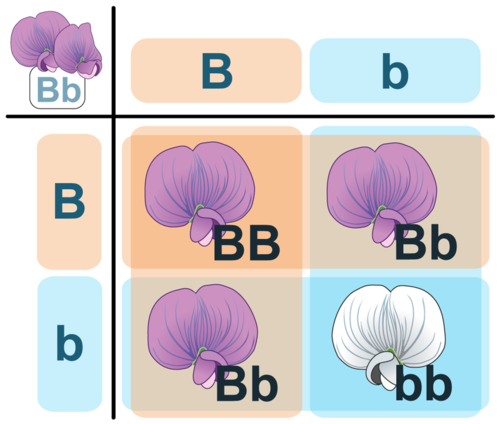
In this punnett square, which is the dominant trait?
The B stands for bud.
a)
purple flower bud
b)
white flower bud
c)
dominant
d)
recessive
50.
What is the phenotype of the offspring? (A-Brown hair; a-blond hair) 
a)
50 % Brown Hair and 50% Blond Hair 
b)
25 % Brown Hair and 75% Blond Hair 
c)
75 % Brown Hair and 25% Blond Hair 
d)
0% Brown Hair and 100% Blond Hair 
51.

What belongs in the last box?

a)

RR

b)

Rr

c)

rr

d)

ff

52.

Look at the punnett square shown. What allele pair would replace the "?"

a)

WW

b)

Ww

c)

ww

53.
What goes in box 3
a)
Aabb
b)
AABB
c)
AAbb
d)
aaBb
54.

What goes in box 15

a)

aabb

b)

AABB

c)

aaBB

d)

AAbb

55.

Based off this punnett square, what fraction of the offspring will have wrinkled, yellow seeds?

a)

9/16

b)

3/16

c)

1/16

d)

16/16

56.

Based off this punnett square, what fraction of the offspring will have wrinkled, green seeds?

a)

9/16

b)

3/16

c)

1/16

d)

16/16

57.

True or False? Before cells undergo meiosis they pass through interphase first.

a)

true

b)

false

58.

Which of the following are CORRECT observations about the differences between MITOSIS and MEIOSIS? (Check all that apply.)

a)

Mitosis produces cells that identical to the parent cell.

b)

Meiosis produces cells that have half the number of chromosomes as the parent cell.

c)

All cells go through INTERPHASE as part of the cell cycle, whether it goes to mitosis or meiosis next.

d)

In both types of cell division, the chromosomes are only duplicated once.

e)

Only in Mitosis, do you see chromosomes pair up to form a tetrad.

59.

The products of MEIOSIS have _______ number of chromosomes.

a)

haploid

b)

diploid

60.

What is the scientific term that refers to sex cells?

a)

autosome

b)

gamete

c)

karyotype

d)

chromosome

61.

The exchange of genetic information that insures that every gamete is unique is referred to as

a)

mitosis

b)

meiosis

c)

reduction division

d)

crossing over

62.

What is another term for body cells?

a)

somatic cells

b)

gamete

c)

stem cell

d)

neural cell

63.
What does a filled in square represent?
a)
Not affected Female
b)
Not affected Male
c)
Affected Male
d)
Affected Female
64.
How many generations are shown in this pedigree?
a)
1
b)
2
c)
3
d)
4
65.
What does an open circle represent?
a)
Not Affected Male
b)
Not Affected Female
c)
Affected Male
d)
Affected Female
66.
Is this trait (the shaded individuals) dominant or recessive?
a)
dominant
b)
recessive
67.

The trait this pedigree traces is recessive because it skips a generation and individuals can be carriers. What is the most likely genotype for person III-3?

a)

GG

b)

Gg

c)

gg

68.

If this pedigree shows a recessive disorder, what MUST the genotype of individual 4 be?

a)

HH

b)

Hh

c)

hh

69.
Huntington's Disease is a dominant trait.
What is the correct genotype for individual I-2?
a)
HH
b)
Hh
c)
hh
d)
H_
70.
What is the genotype of the mother?
a)
BB
b)
bb
c)
Bb
d)
BB or Bb
71.

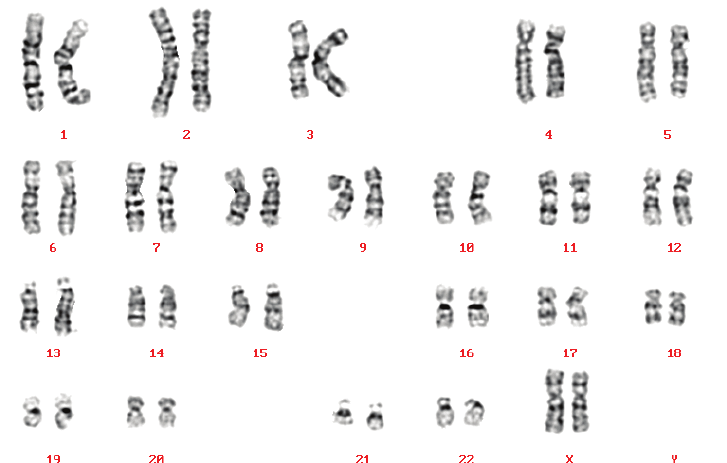
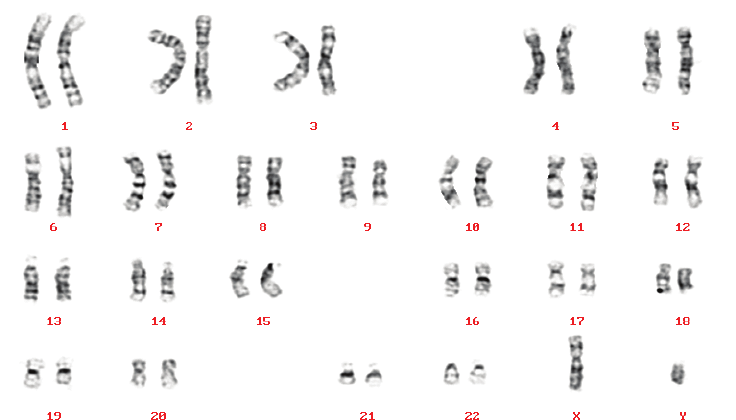
By looking at the chromosomes how can you tell that this person is biologically female?

a)

Because there are two X chromosomes

b)

Because there are more chromosomes than in a male
72.

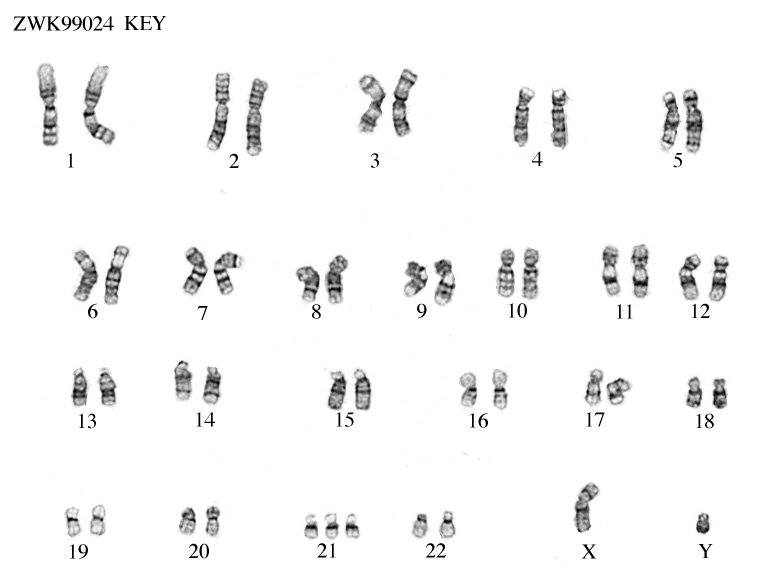
By looking at the chromosomes is this individual biologically male or female? How do you know?

a)

Female, because they have two X chromosomes

b)

Male, because they have one X and one Y chromosome
73.

What is the mutation in this persons chromosomes?

a)

There is only one X

b)

7 is shaped like a hockey stick

c)

There's an extra 21

d)

1 is too curved