
 Worksheets
Unit 4- energy 25-26
Total questions: 163
Worksheet time: 3hrs 33mins
What energy transformations take place when a battery operated radio is in use?
electrical to chemical to sound
thermal to nuclear to electrical
chemical to electrical to sound
chemical to sound to thermal

What type of energy is represented in the picture?
potential
chemical
thermal
mechanical
Which of the following energy transformations occur when a lamp that is plugged in the wall outlet is working properly?
electrical to light
chemical to light
chemical to electrical
electrical to thermal
Which of the following device transforms electrical energy into mechanical energy?
a fan
a manually operated pencil sharpener
an apple ipod
a apple iPhone X

What type of energy transformation in an electric hot plate is plugged in?
electrical to light
mechanical to electrical to light
thermal to mechanical to light
electrical to thermal
A hairdryer converts-
chemical to electrical
electrical to thermal
electrical to solar
thermal to mechanical to light

Animals eating food?
The law of Conservation of Energy states ..
Energy can created or destroyed but not transformed
Energy cannot be created or destroyed, it can only transformed
Energy can't be created, destroyed or transformed

Which shows light energy transforming into chemical energy?
a battery turning on a fan
a broken glow stick
a plant making its own food in the sunlight
Choose the answer that has the most ELASTIC POTENTIAL energy.
a rubber band pulled back all the way
a rubber band pulled back part of the way
a rubber band laying on a table
Waves transfer
matter
energy
particles
water

What kind of wave is pictured below?
compressional wave
transverse wave
sound wave
mechanical wave

An example of this wave is ocean waves, what type of wave is it?
transverse
longitudinal
A disturbance that carries energy through a medium is called what?
energy
wave
medium
crest
a wave in which the particles of the medium move perpendicular to the direction the wave is traveling
Longitudinal Wave
Transverse Wave
A wave in which the particles of the medium vibrate parallel to the direction of the wave motion
Transverse Wave
Longitudinal Wave
elastic potential
chemical potential
gravitational potential

When you compress a spring, you are storing __________ energy.
chemical potential
elastic potential
gravitational potential
kinetic
How could you increase the gravitational potential energy of an object without changing its mass and gravity?
Make the object larger
Lower the object towards the ground
Raise the object farther off the ground
Allow the object to roll on the ground

gravitational potential
elastic potential
chemical potential
kinetic

elastic potential
Kinetik
chemical potential
gravitational potential
Medium, or media, means what when talking about waves?
Energy the wave carries.
Material the wave travels through.
When energy is released, it disappears.
True
False
Sound is produced by -----
Heat energy
Low temperatures
Vibrations
Friction

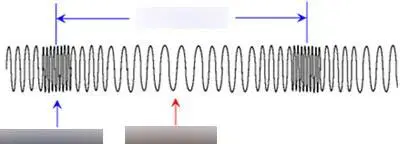
All waves carry ______________.
Sound
Light
Water
Energy


All waves carry ________ as they travel from one place to another.
matter
space
energy
water


What type of wave is pictured?
Transverse wave
Longitudinal wave
Wave, what wave?
Slinky wave


Which statement is correct about the wave shown in the diagram?
It is a transverse wave because the particles are moving perpendicular to the motion of the wave.
It is a transverse wave because the particles are moving parallel to the motion of the wave.
It is a longitudinal wave because the particles are moving perpendicular to the motion of the wave.
It is a longitudinal wave because the particles are moving parallel to the motion of the wave.

The wave shown in the diagram is an example of a
longitudinal wave
mechanical wave
P-wave
transverse wave

A student creates this model using a rope between two students to show energy moving through a
system:
Student A moves the rope while Student B holds their end steady.
Which statement best explains how this model shows energy transfer?
The energy causes each part of the rope to move up and down as it travels from Student A to
Student B
The energy makes the rope move sideways toward Student B.
The energy stays only where Student A moves the rope.
The energy makes the rope stretch longer.

Which diagram shows a longitudinal wave?
Top diagram because the coils move back and forth in the same direction as the wave
Bottom diagram, because the coils move back and forth in the same direction as the wave
Bottom diagram, because the coils move up and down perpendicular to the wave direction

A student flicks a line of dominoes as shown in the diagram:
Which type of wave is this model demonstrating?
A longitudinal wave because the dominoes move up and down as they fall.
A transverse wave because the energy moves forward as dominoes push in the same direction.
A longitudinal wave because the energy moves forward as dominoes push in the same direction.
A transverse wave is caused by the dominoes moving up and down as they fall.
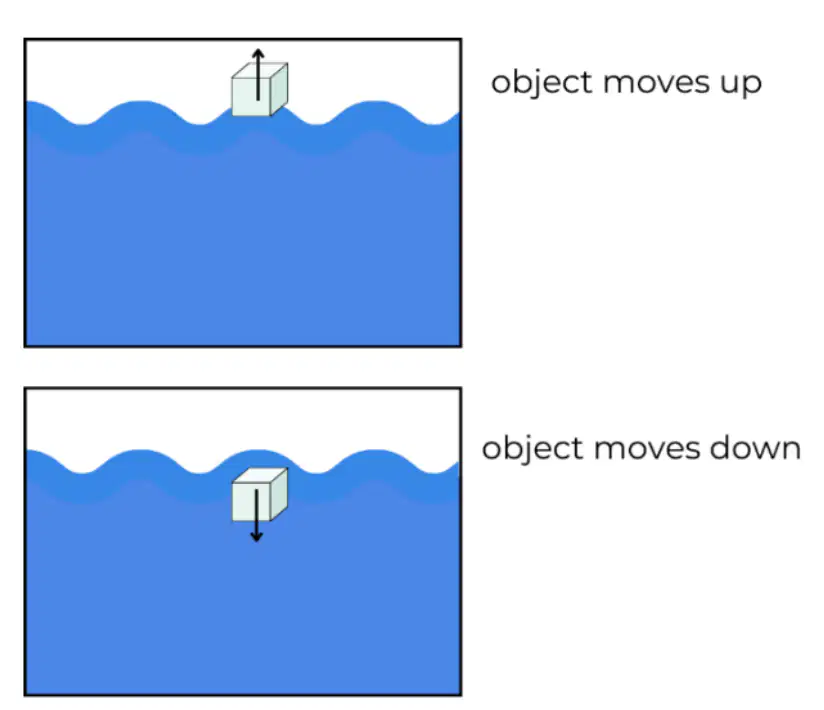
A student observes a small cube floating on water to show how energy moves through the system:
Select TWO statements that correctly explain how this model shows energy transfer.
The energy only works when the cube moves up.
The cube moves up and down as energy passes through the water.
The energy moves through the water while making the cube move up and down.
The cube stays in one spot on the water.

A student creates a model using a slinky. Points a, b, and c are marked along the slinky as shown:
How will point b move when energy passes through this point in the system?
Forward along the slinky
In circles
Up and down while energy moves through
Remain still
What causes waves to be produced?
Gravity
Vibrations
Heat
Light
What do waves carry?
Molecules
Energy
Matter
Water
How is energy transferred through longitudinal waves?
Particles move side to side, away from the starting point.
Particles move perpendicular to the wave motion.
Particles must be transmitted through a vacuum.
Particles move parallel to the wave motion.
How is energy transferred through transverse waves?
Movement of particles perpendicular to the direction of the wave
Giving off light in the direction of the wave
Giving off sound in the direction of the wave
Movement of particles parallel to the direction of the wave

What type of wave is demonstrated in the model below? How is energy transferred through it?
Transverse wave; energy travels in the same direction, and particles vibrate.
Transverse wave; energy travels up and down in the direction of the wave.
Longitudinal wave; energy travels in the same direction, and particles vibrate.
Longitudinal wave; energy travels up and down in the direction of the wave.
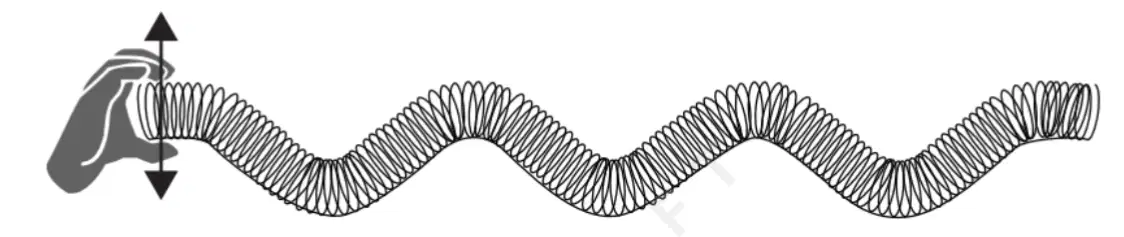
What kind of wave is represented in the image below?
Longitudinal wave
Transverse wave
Ultraviolet wave
Radio wave
Which type of waves are longitudinal waves?
Sound waves
Ultraviolet waves
Infrared waves
Radio waves

The picture shows an image of two different types of waves. Which statement correctly identifies each of the waves?
Wave A is transverse. Wave B is longitudinal. In transverse waves, the medium moves parallel to the direction of the wave, and in longitudinal waves, the medium moves perpendicular to the direction of the wave.
Wave A is longitudinal. Wave B is transverse. In transverse waves, the medium moves perpendicular to the direction of the wave, and in longitudinal waves, the medium moves parallel to the direction of the wave.
Wave A is longitudinal. Wave B is transverse. In transverse waves, the medium moves parallel to the direction of the wave and in longitudinal waves, the medium moves perpendicular to the direction of the wave.
Wave A is transverse. Wave B is longitudinal. In transverse waves, the medium moves perpendicular to the direction of the wave and in longitudinal waves, the medium moves parallel to the direction of the wave.

The diagram shows a transverse wave generated in a rope. How does the particle (P) indicated on the rope move relative to the energy transferred through this transverse wave?
The particle moves back and forth as the energy is transferred to the right.
The particle moves back and forth as the energy is transferred upward.
The particle moves up and down as the energy is transferred to the right.
The particle moves up and down as the energy is transferred upward.
Which is an example of energy being transferred by a longitudinal wave?
A. A child shakes the free end of a skipping rope that is tied to a tree.
B. A pebble falls in water and ripples travel along the surface.
C. Two students hold a spring at either end, and one student shakes the end of the spring up and down.
D. Two students hold a spring at either end, and one student pushes and pulls the spring back and forth.

The diagram shows how a sound wave transfers sound energy from place to place. Which type of wave is a sound wave?
transverse wave
longitudinal wave
electromagnetic wave
seismic wave
Which is an example of energy being transferred by a wave?
An electric current in a copper wire transfers energy to a toaster.
Energy from a vibrating drumhead is transferred to the ear of a listener.
To make it move, a rider transfers energy to a bicycle by pedaling.
A child transfers energy to a pinwheel by blowing on it.
Which is an example of the transfer of energy by a longitudinal wave?
A. A large ocean wave knocks a person down.
B. A guitar string vibrates after being plucked.
C. S-waves cause the ground to move up and down during an earthquake.
D. A door slams, and someone in the next room hears the sound.
A wave transfers ...
Matter
Particles
Water
Energy
How does sound travel through the air?
Sound causes air particles to travel in one direction as longitudinal waves.
Sound causes energy and air particles to travel in one direction as longitudinal waves.
Sound causes energy to travel through the air in all directions as transverse waves.
Sound causes energy to travel away from a vibrating object as a longitudinal wave moving through the air.
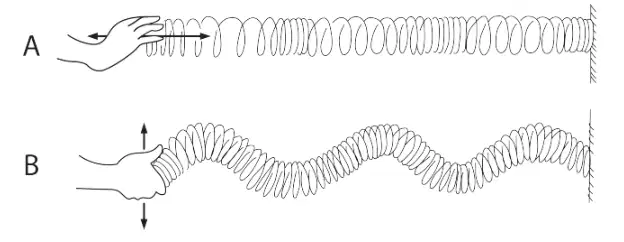
Which diagram represents the direction of vibration that is perpendicular to the direction of motion of the wave energy?
Diagram A because the direction of vibration is the same as the direction of motion of the wave energy.
Diagram B because the direction of vibration is the same as the direction of motion of the wave energy.
Diagram A because the direction of vibration is perpendicular to the direction of motion of the wave energy.
Diagram B because the direction of vibration is perpendicular to the direction of motion of the wave energy.
Unlike a transverse wave, the motion of medium particles in a longitudinal wave is
in a circular motion.
parallel to the wave motion.
perpendicular to the wave motion.
in the opposite direction of the wave motion
What type of wave is a sound wave?
Longitudinal
Transverse
Electromagnetic
Light
Which type of wave moves particles perpendicular to the direction the wave travels?
Transverse
Longitudinal
Mechanical
Thermal
What kind of wave is created when you flick a rope up and down?
Transverse
Longitudinal
Circular
Radio

You can't hear sounds in outer space because there is no
medium
light
energy
heat

Water waves are __________ waves because the wave moves up and down.
transverse
inverse
longitudinal
flat

Define wave.
a disturbance in matter that transfers energy
A medium that vibrates at a right angle
A disturbance that causes earthquakes
Individual particles of medium moving in a circle
How is energy transferred through transverse waves?
Movement of particles perpendicular to the direction of the wave
Giving off light in the direction of the wave
Giving off sound in the direction of the wave
Movement of particles parallel to the direction of the wave

What type of wave is demonstrated in the model below? How is energy transferred through it?
Transverse wave; energy travels in the same direction, and particles vibrate.
Transverse wave; energy travels up and down in the direction of the wave.
Longitudinal wave; energy travels in the same direction, and particles vibrate.
Longitudinal wave; energy travels up and down in the direction of the wave.

What type of waves are these?
Transverse waves
Longitudinal waves

Light waves are
longitudinal waves.
transverse waves.

Sound waves are produced by
radio stations.
vibrating objects.
soft objects.
objects under pressure.

Longitudinal and transverse waves transfer _____
energy ONLY
matter ONLY
BOTH matter and energy
NEITHER matter or energy
Animals eating food?
Burning coal or carbon-based fuel at a powerplant?
An electrical circuit?
Stretched bow and arrow?
Running?
Energy is the ability to do____?
to do work
to move object
to turn on a light
to power things
When something is dropped, what type of energy transfer takes place?
Kinetic-Potential
Electrical- Chemical
Gravitational Potential- Kinetic- Sound
Heat- Nuclear
The law of Conservation of Energy states ..
Energy can created or destroyed but not transformed
Energy cannot be created or destroyed, it can only transformed
Energy can't be created, destroyed or transformed

At which point does potential energy greatest
W
X
Y
Z
The faster an object moves, the ________ kinetic energy it has.
more
less
all of the above
none of the above
___________ is stored energy
Potential
Kinetic
none of the above
all of the above

At which point kinetic energy is greatest?
W
X
Y
Z
Most of the energy that is used on Earth's surface comes from which of the following sources?
Radioactivity
Chemicals
The Sun
Wind
Gravitational potential energy depends on...
Height
Speed
Light
Time
As height increases, so does...
Thermal energy
Mechanical energy
Kinetic energy
Potential energy
These are all examples of kinetic energy, EXCEPT
A ball rolling down a hill
A car driving uphill
Someone kicking a soccer ball
A book sitting on a shelf
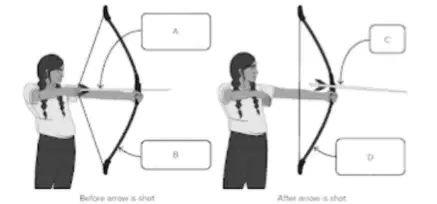
Which location in the diagram does the bow have elastic potential energy and which location does the arrow have kinetic energy?
Elastic potential energy: C; Kinetic energy: B
Elastic potential energy: A; Kinetic energy: D
Elastic potential energy: B; Kinetic energy: C
Elastic potential energy: D; Kinetic energy: A
People climb into inflated tubes at the top of a water park ride. They then ride on a steep flow of water to the bottom of the ride. How can you describe the change in energy of the tubes from the top to the bottom of the ride?
All of the gravitational potential energy transforms into kinetic energy.
All of the kinetic energy transforms into gravitational potential energy.
Some of the gravitational potential energy transfers into kinetic energy.
Some of the kinetic energy transfers into gravitational potential energy.
Which is an example of an energy transformation from chemical to electrical to light energy?
A bolt of lightning causing thunder
A candle lighting up a room
A campfire warming up and illuminating an area
A battery causing a flashlight to shine

Which of the following is not true?

What are the 2 products of photosynthesis? The products are the things made in the process of photosynthesis.
water, sunlight
glucose, carbon dioxide
oxygen, glucose
sunlight, oxygen
What is the main purpose of photosynthesis?
To make food
To create energy
To release oxygen
To absorb sunlight

__________ energy from the sun is changed into __________ energy during photosynthesis
What happens to the solar energy absorbed by plants during photosynthesis?
It is recycled by the plant and returned to the atmosphere.
It is converted into oxygen and glucose.
It is stored as heat within the plant for cellular functions.
It is transformed into chemical energy.
What process in the natural world converts radiant energy into chemical energy?
respiration
condensation
diffusion
photosynthesis
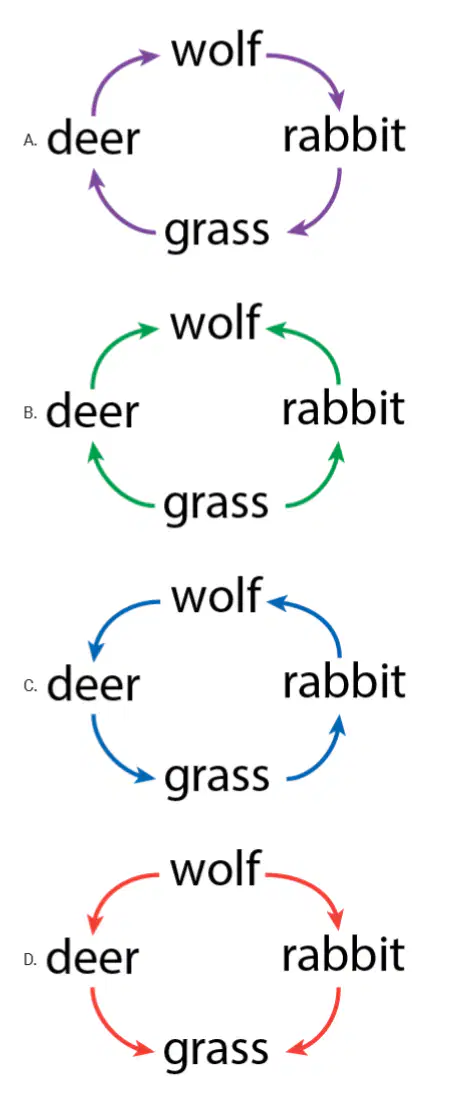
These organisms live in the same ecosystem. The wolf is a carnivore whereas the deer and rabbit are herbivores. Use the picture to determine which food web depicts the energy flow through the ecosystem?
A
B
C
D
The path that a ball takes after it is dropped is shown in the image below. At which position in the ball's path does the ball have the greatest potential energy? Select the correct answer.
Position A
Position B
Position C
Position D
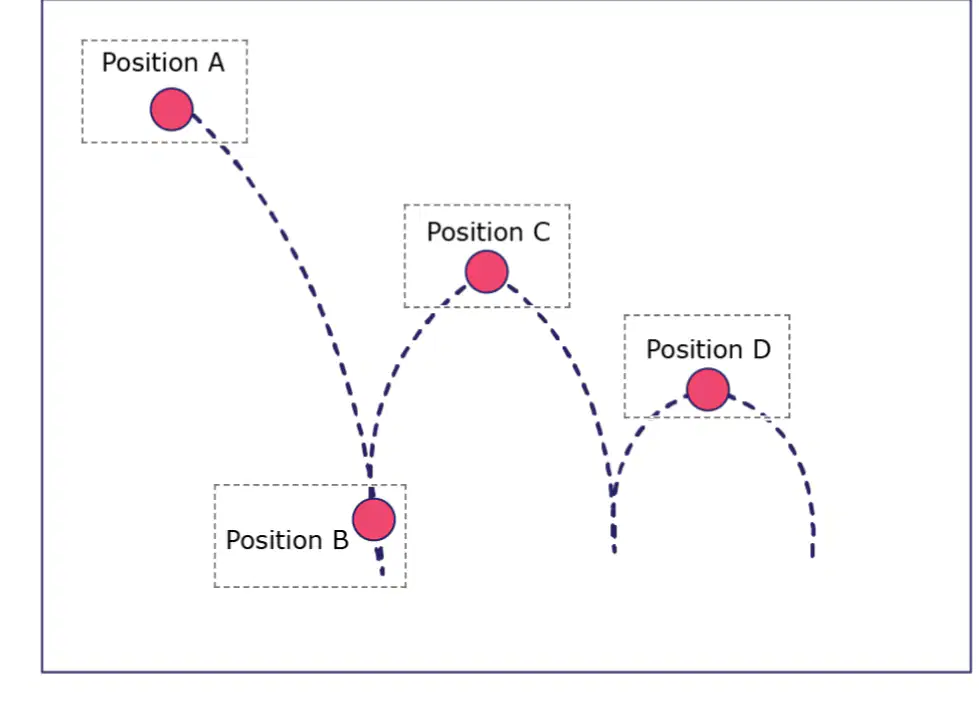
The path that a ball takes after it is dropped is shown in the image below. At which position in the ball's path does the ball have the greatest kinetic energy? Select the correct answer.
Position A
Position B
Position C
Position D
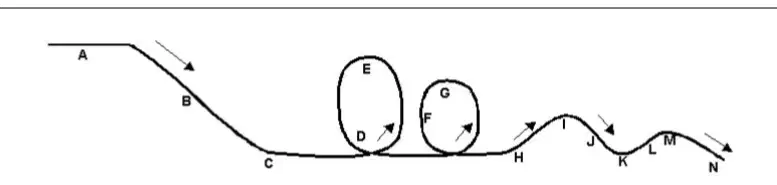
Roller coasters use potential and kinetic energy to move carts around the track. Which position on the roller coaster has the most potential energy?
E
G
A
C
What kind of energy is stored in food?
thermal
chemical
mechanical
electrical
What kind of energy is made during photosynthesis?
mechanical
electrical
Complete the table below. Move the correct forms of energy to the correct boxes. Object: Photosynthesis Converts: ______ energy Into: ______ energy
light into electrical
chemical into light
light into chemical
electrical into kinetic
Complete the table below. Move the correct forms of energy to the correct boxes. Object: Ceiling Fan in motion
Converts: ______ energy Into: ______ energy
light into electrical
chemical into light
light into chemical
electrical into kinetic
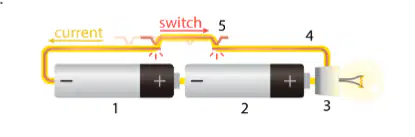
Students in a 6th grade science class are designing an experiment using two batteries as shown in the diagram. What is one possible purpose of the students' experiment?
To demonstrate how chemical energy is transformed into electrical energy
To show the effect of light on batteries
To determine how radiant energy is affected by battery size
To test the side effects of using batteries to power home appliances
Plants get their energy from the Sun through photosynthesis. This energy is trapped in the bonds of the complex compounds the plants create from carbon dioxide and water. The plants are then eaten by animals, and the energy is used for heat and movement. Which of the following is an energy transfer that is conducted inside an animal in the above scenario?
radiant energy to mechanical energy
radiant energy to chemical energy
chemical energy to mechanical energy
chemical energy to radiant energy
Describe how energy is conserved in an electrical circuit when a light bulb is turned on.
Energy is created in the light bulb.
Energy is transferred from the battery to the light bulb, where it is transformed into light and heat.
Energy is destroyed in the light bulb.
Energy is stored in the light bulb.
Discuss how energy is conserved during the process of photosynthesis.
Energy is created by the plant.
Energy from sunlight is transformed into chemical energy stored in glucose.
Energy is lost entirely during photosynthesis.
Energy is stored as heat in the plant.
Evaluate the energy transformations that occur in a simple electrical circuit with a battery and a fan.
Energy is created by the fan.
Energy is transferred from the battery to the fan, where it is transformed into mechanical energy.
Energy is destroyed in the circuit.
Energy is stored in the fan.
Explain the energy transformations in a circuit with a battery and a light bulb.
Energy is created by the light bulb.
Energy is transferred from the battery to the light bulb, where it is transformed into light and heat.
Energy is destroyed in the circuit.
Energy is stored in the light bulb.
Evaluate the energy transformations that occur in an amusement park ride, such as a Ferris wheel.
Energy is only present at the start of the ride.
Energy is transformed from electrical energy to mechanical energy as the wheel turns.
Energy is destroyed as the ride progresses.
Energy is created at each rotation of the wheel.
Analyze the energy transformations in a simple electrical circuit with a battery and a motor.
Energy is created by the motor.
Energy is transferred from the battery to the motor, where it is transformed into mechanical energy.
Energy is destroyed in the circuit.
Energy is stored in the motor.

