
 Worksheets
Experience Chemistry Semester 1 Final Exam Practice
Total questions: 75
Worksheet time: 53mins
The study of the composition, structure, and properties of matter; the processes that matter undergoes, and the energy changes that accompany those processes best describes the science of
Biology
Chemistry
Physics
astronomy

The molecule BrO3- has which molecular geometry?
trigonal pyramidal
trigonal planar
tetrahedral
Linear
When working in the Flame Test lab, which statement was true?
every element burned with the same color
each element could be put on the wire without having previously cleaned it
every color was found-red, orange, green, blue, purple, white, brown, and black
the copper wire had to be rinsed with HCl between samples
The melting points of ionic compounds are higher than the melting points of molecular compounds because
ionic substances tend to vaporize at room temperature
ionic substances are brittle
attractive forces between ions are greater than the attractive forces between molecules
the numbers of positive and negative charges are equal in an ionic compound
Which is the correct attire for lab work?
Flip Flops
Loose Hair
Contact Lenses
Safety Goggles
The branch of science that deals with substances containing carbon is called
physical chemistry
analytical chemistry
organic chemistry
biochemistry
A covalent bond is formed when two atoms
share a nucleus with one another
share one or more pairs of electrons with each other
gain electrons
loose electrons
A change in a substance that does not involve a change in the identity of the substance is called a(n)
chemical change
physical change
extensive property
intensive property
Which type of bonding is characterized by overlapping orbitals that allow outer electrons of atoms to move about freely throughout the entire compound?
ionic
Covalent
Metallic
Multiple
An ionic bond results from the electrical attraction between
Cations & Anions
Atoms
Dipoles
Orbitals
An atom of Fluorine has 9 protons and 10 neutrons. Its mass number is
9
10
1
19
The principle that states that atoms tend to form compounds in which each atom has eight electrons in its highest occupied energy level is called the
rule of eights
configuration rule
Avogadro principle
octet rule
Which intermolecular force is a force that involves a hydrogen atom and atoms of other elements?
London dispersion
hydrogen bond
dipole
polar
The orbital notation below represents the ground state of which element? ↑↓ ↑↓ ↑↓ ↑↓ ↑↓ ↑↓
1s 2s 2p 2p 2p 3s
Mg
Na
C
Ca
Mendeleev organized his periodic table based on chemical properties and
symbols
atomic mass
atomic numbers
charges
Which element is NOT in its correct block?
Strontium, s-block
Krypton, p-block
Chromium, f-block
Iron, d-block
The electron configurations of main-group elements end in
d and f
s and p
s and d
p and d
Which periodic group or family is NOT correctly matched with its common family name?
Group 2: alkaline-earth metals
Group 3: alkali metals
Group 17: halogens
Group 18: noble gases
The average atomic mass of an element is 150.36. While doing a chemistry experiment, you calculate the molar mass to be 149.68. What is your percent error?
0.0045%
0.45%
-0.0045%
-0.45%
A long Repeating chain of molecules is a
Colloid
Suspension
Polymer
Alloy
This is a combination of two or more atoms
an element
a molecule
a system
a surrounding
This is a portion of the universe that a scientist studies
an element
a molecule
a system
a surrounding
This philosopher was the first to come up with the idea of the atom
Dalton
Democritus
Aristotle
Find the element with the atomic number of 8
Oxygen
Sulfur
Beryllium
Lithium
Find the element with 16 electrons
Oxygen
Sulfur
Beryllium
Lithium
How many protons does Fluorine have
(a)
How many Protons are in Chlorine-37
(a)
How many electrons are in Chlorine-37
(a)
How many neutrons are in Chlorine-37
(a)
All matter has ___ and occupies space
mass
particle
element
molecule
What 2000 mm equal to in meters?
(a)
What is the lowest possible energy level that an electron can occupy?
Excited state
Fundamental state
Ground state
Outermost state
"The amount of energy required to jump an electron from one energy level to another" is known as what?
Electron excitement
Quantum
Spectral energy
Isotopic power
Where does the Kinetic Energy of a Molecule Come from?
The Strength of the bonds in a molecule
the shape of the molecule
The Motion of a Molecule
The Number of atoms in a molecule
Standard Temperature and pressure (STP) are what conditions?
32° F and 10 kPa
0° C and 10 atm
32 °C and 1 atm
0 ° C and 1 atm
Pressure is equal to
areaforce
force × area
1 forcearea
(force + area)/2
If the particles in a sample of matter are attracted to each other but can move past each other easily, the matter is a
Solid
Liquid
Gas
Plasma

Based on the phase diagram shown, the kinetic energy of the particles is changing in which of the segments?
A, C, E
B, D
B, C, D
In all the segments
In the absence of any external forces, the shape of a drop of water is determined by which of the following?
Density
Viscosity
Surface Tension
Boiling Point
The strength of hydrogen bonds in water (H2O) is greater than those in ammonia (NH3) which is greater than the strength of the hydrogen bond in hydrogen fluoride (HF). Which of the compounds will have the highest boiling point.
Water
Ammonia
Hydrogen Flouride
They will all have he same boiling point
Which of the following is an example of a Solution?
A bag of trail mix
A bottle of Salt Water
A bowl of Fruit Salad
A chocolate chip cookie
PSI, torr, mmHG, atm all are units for....
Temperature
Force
Pressure
Area
Which of the following defines an ionic bond?
a metal bonded to a nonmetal
a nonmetal bonded to a nonmetal
Any compound containing carbon
any compound containing sodium
This type of Solids contains materials such as plastics and glass
Crystalline Network Solids
Amorphous Solids
Breakable Solids
Molding Solids
If the amount of dissolved solute in a solution at a given temperature is greater than the amount that can permanently remain in solution at that temperature, the solution is said to be
Saturated
Unsaturated
Supersaturated
DIluted
To conduct electricity, a solution must contain
nonpolar molecules.
polar molecules.
Nonelectrolytes
electrolytes
A mixture that appears to be uniform while being stirred but separates into different phases when agitation ceases is a
Solvent
Suspension
Colloid
Solute
A long Repeating chain of molecules is a
Colloid
Suspension
Polymer
Alloy
Match the changes in state to their name
Solid to Gas
Sublimation
Gas to Solid
Deposition
Liquid to Gas
Vaporization
Gas to Liquid
Condensation
Liquid to Solid
Freezing
1,976 torr is how many atmospheres? (atm)
(a)
A container has a pressure 233 kPa in it. What is the atmospheric pressure?
(a)
Convert 540 mmHg to kPa
71.976 kPa
72 kPa
4051 kPa
4100 kPa
Convert 242 kPa to atm
2.4 atm
2.39 atm
24500 atm
24515 atm

Complete the following sentence:
"The finer the size of the grain, the _____________the solute dissolves."
slower
faster
more time
the same time
The substance able to dissolve in a liquid is called the...
solution
solvent
solute
soluble

Grandma wants to drink a cup of sweet tea. Which way is the fastest to dissolve sugar in water?
Add sugar to hot cup of tea.
Add sugar to a hot cup of tea and stir.
Add brown sugar to a cold cup of tea.
Add sugar to a cold cup of tea.
CO2 gas is more soluble in hot water than in cold water.
True
False
Affects the solubility of gases - Increase air pressure
More soluble
less soluble
no effect
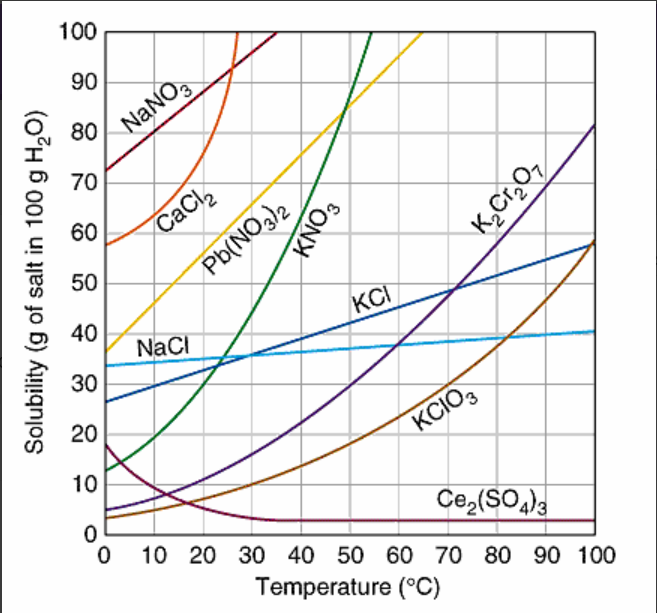
How many grams of K2Cr2O7, are soluble in 100 g of water at 95oC?
83 grams
75 grams
40 grams
12 grams
Match the description to the correct particle motion
The particle moves around an axis
Rotation
The particle stays in one place while moving
Vibration
The particle moves in space
Translation
Match the phase change to it's name
Condensation
Gas → liquid
Vaporization
Liquid → Gas
Melting
Solid → Liquid
Freezing
Liquid → Solid
You can tell a chemical is an ionic compound because it contains a (a) bonded with a non-metal
Match the point defect to its description
Interstital
An Extra atom is in a spot it doesn't belong
Substitution
An atom is in the wrong spot
Vacancy
An atom is missing
What do we call the 'skin like' surface on water?
Nervous Tension
Conflict Tension
Surface Tension
Base Tension
Shampoo is a ...
Electrolyte
Solvent
Carbohydrate
Surfactant

the ability of a material to bend or be hammered into other shapes without breaking.
Ductility
Malleability
Toxicity
Solubility
Steel generally speaking is made of
iron and carbon
copper and iron
tin and carbon
aluminum and nickel
Match the point defect to its description
Interstital
An Extra atom is in a spot it doesn't belong
Substitution
An atom is in the wrong spot
Vacancy
An atom is missing
"Chemical compounds tend to form so that each atom has an octet (8) electrons in their highest occupied energy level" is known as what
The Octet Rule
The rule of 8
An Electron Flush
The Balanced Charge Law
When naming an ionic compound, which of the atoms is written first?
The Metal
The Nonmetal
The Anion
The Cation
When an atom loses an electron, it becomes a
positive ion
negative ion

What is the BASE SI Unit for time?
Hours
Parsecs
Seconds
Microts
An atom that has gained or lost an electron is called a(n) _____.
ion
particle
atom
A positive ion is called a
Cation
Anion
Match the following Group Numbers to their ionic Charge
1
+1
2
+2
15
-3
16
-2
17
-1

