
Font size
 Worksheets
Unit 7 Review
Total questions: 68
Worksheet time: 3hrs 24mins
What are valence electrons?
The innermost electrons
The outermost electrons
How many valence electrons does Carbon have
1
4
How many valence electrons does Argon have
8
11
What is the correct Lewis Dot Structure for ammonia NH3


Which is the correct molecular structure for carbon dioxide?


Which of the following compounds has only single bonds?
I only
II only
III only
I and III
III and IV
NH3 has how many lone pairs?
0
1
2
3
CCl4 has how many double bonds?
0
1
2
3
In HCN (Carbon is usually the central atom) what kind of bond is between the C and N
Single
Double
Triple
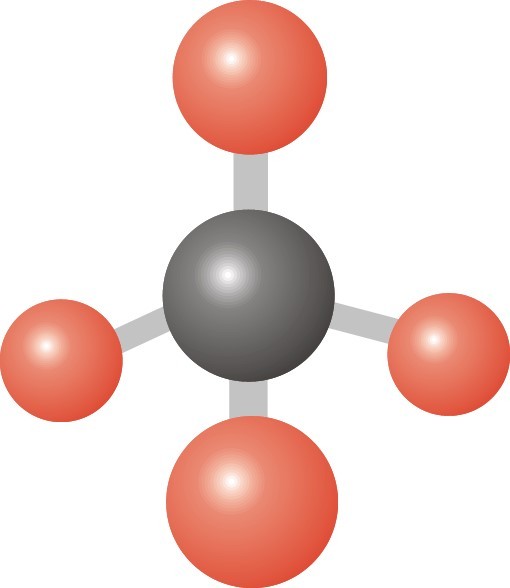
What would be the bond angle between atoms in this molecule?
180
120
90
109.5

What would be the bond angle between atoms in this molecule?
109.5
120
180
90

What is the name of this molecule's shape?
Bent
Linear
Tetrahedral
Trigonal pyramidal

What 3-D shape would this molecule have: H2S ?
bent
tetrahedral
linear
trigonal pyramidal

What is the name of this molecular shape?
trigonal pyramid
tetrahedral
bent
trigonal planar

What 3-D shape would this molecule have?
Trigonal planar
Pyramidal
Tetrahedral
Bent

What 3-D shape would this molecule have?
tetrahedral
trigonal planar
pyramidal
bent
Which Lewis Dot Model drawing correctly shows an O2 molecule?


What shape would a molecule have if it has 4 bonded pairs around its central atom? (It may help if you sketch this out)
Linear
Trigonal planar
Tetrahedral
Bent
All molecules have London dispersion forces between them, but dipole-dipole and hydrogen bonding are so much stronger that when they are present we can ignore London dispersion forces. Which of these has ONLY London dispersion forces?
I2
NH3
OCl2
SH2
Which substance would have the weakest intermolecular forces of attraction?
CH4
NaCl
H2O
MgF2

Intermolecular forces for: NH3
Dispersion Force
Dipole dipole
Hydrogen bonding
Which substance has the weakest intermolecular forces?
Substance A, boiling point of 75 °C
Substance B, boiling point of 105 °C
Substance C, boiling point of 25 °C
Substance d, boiling point of 45 °C
The weaker the intermolecular forces of a substance the _____________ the boiling point
higher
lower

Intermolecular forces for: CO2
Dispersion Force
Dipole dipole
Hydrogen bonding
Which is an example of an ionic crystal?
Graphite (lead in a lead pencil)
Sodium Chloride (NaCl)
Ammonia (NH3)
Iron (Fe)
Which type of solid is hard, brittle, has a high melting point, but ONLY conducts electricity if dissolved in H2O or melted.
Ionic Crystal
Covalent Molecular Crystal
Metallic Crystal
Covalent Network Crystal
Which type of solid has very strong covalent bonds between neighboring atoms?
Ionic Crystal
Covalent Molecular Crystal
Metallic Crystal
Covalent Network Crystal
Identify the covalent molecular solid crystal.
Diamond (Carbon)
Sodium chloride (NaCl)
Ammonia (NH3)
Iron (Fe)
Identify the metallic crystal.
Graphite (carbon)
NaCl
Ammonia (NH3)
Iron (Fe)
High melting points, good conductors of electricity in the solid state, does not dissolve in water.
Ionic
Metallic
Covalent Network
Covalent Molecular
Very hard, very high melting point, nonconductors of electricity, low density.
Ionic
Metallic
Covalent Network
Covalent Molecular
Identify the property that gives metallic solids the ability to conduct electricity well, but not covalent network solids.
Electrons in metallic solids are strongly bound in place
Electrons in covalent network solids are freely moving around
Covalent network solids are not bound to other atoms
Metallic solids have a sea of electrons that are not bound and can move about the solid freely.
Which of the following is an example of covalent network solid.
Diamond (carbon)
Graphite (carbon in a lead pencil)
copper
silver chloride
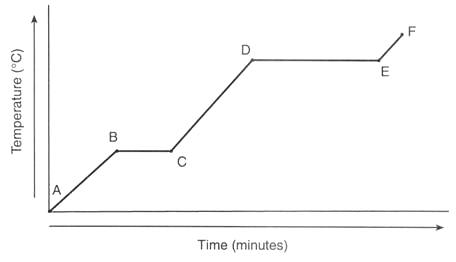
Between which points is the temperature of the substance remaining constant?
A-B only
A-B, C-D, and E-F
B-C only
B-C and D-E
__________ show the change in state of matter as heat is added.
Phase diagrams
Heating curves
Density graphs
Temperature plots

The melting point of the sample is
-60 ºC
20 ºC
60 ºC
100 ºC

Which letter indicates where water is in both the solid and liquid phase at the same time?
A
B
C
D
E
A measure of the average kinetic energy of the particles in an object is called
Heat
Temperature
Kinetic energy
Enthalpy

In which region(s) does temperature increase?
Region C only
Regions B and D
Regions A, C, and E
Regions A and B
____________, or temperature, does not chance during a ____________.
Kinetic energy, phase change
Potential energy, phase change
Kinetic energy, heat addition
Potential energy, heat addition
When heat is added to water, temperature increases until
the power of heat expires
the water is hotter than anything else
the water reaches its boiling point
Liquids with very high viscosity flow very _______________________.
fast
not at all
slow
whenever it wants
The best example of high viscosity would be?
Honey
Soap
Marbles
Water
Surface tension is the property of water in which...
water molecules at the surface tend to stick together.
water spills easily.
water tends to be see-through.

Which type of IMF is responsible for the attraction pictured above?
Dipole-Dipole Interaction
Ion-Dipole Interaction
Hydrogen Bonds
Covalent Bond
Ionic Bond
Intermolecular forces are attractions between ______.
Cations and anions
Atoms within a molecule
Neighboring molecules
Protons and electrons
Liquids with high volatility will
probably not have an odor
have weak intermolecular forces
have strong intermolecular forces
have high surface tension

