
 Worksheets
Force and Motion Review
Total questions: 59
Worksheet time: 30mins
An object that is at rest will begin to move if which of the following is true?
The surface on which it rests is frictionless.
The mass of the object is sufficient.
Unbalanced forces act on the object.
D
Gravity on the object can be reduced.

The forces acting on a box are illustrated.
The result of these forces will be that the box will –
move to the right at a constant speed.
accelerate to the right.
move to the left at a constant speed.
accelerate to the left.
A student claims that unbalanced forces acting on an object in motion can cause all of the following results:
* The object could stop moving
* The object could speed up
* The object could change directions
The best evaluation of this student’s claims is that -
none of the claims is true.
one of the claims is true.
wo of the claims are true.
all of the claims are true.
Which two measurements are needed in order to calculate the speed of an object in motion?
Distance and time
Time and mass
Force and distance
Volume and time

The simplified graph shows the motion of an object as measured and recorded in consistent units of time and distance. From the graph, it can be concluded that the object was moving -
in an upward direction.
faster as time went on.
at a constant speed.
or a short amount of time.

Time and distance data for a bicycle is provided in the graph.
According to the data in the graph, what was the average speed of the bicycle?
1 meter/second
4 meters/second
5 meters/second
20 meters/second
It takes five hours to drive from Fort Worth to Midland, which is a distance of 300 miles. What would be the average speed for this trip?
20 miles/hour
40 miles/hour
60 miles/hour
80 miles/hour
States that if the net force acting on an object is zero,the motion of the object does not change
air resistance
acceleration
position
Newton's First Law of Motion
The starting point you choose to describe the location or position of an object
position
motion
reference point
speed
States that if the net force acting on an object is zero,the motion of the object does not change
air resistance
acceleration
position
Newton's First Law of Motion
The frictional force between air and objects moving through it
air resistance
motion
acceleration
contact force
Desribes an object's distance and direction from a reference point
contact force
position
reference point
motion
A contact force that one resists the sliding motion of two surfaces that are touching
contact force
velocity
motion
friction
The process of changing position
reference point
motion
displacement
velocity
A force that one object applies to another object without touching
contact force
motion
reference point
noncontact force
The difference between the initial, or starting point and it's final position
point of reference
position
displacement
motion
The distance an object moves in a unit of time
velocity
speed
acceleration
motion
A push or pull one object applies to another object that is touching it
velocity
distance-time graph
contact force
noncontact force
The speed and direction of a moving object
velocity
speed
motion
acceleration
Shows how distance and time are related
speed-time graph
motion
distance-time graph
acceleration
A measure of how quickly the velocity of an object changes
speed
velocity
motion
acceleration
States that acceleration of an object is equal to the net force exerted on the object divided by the object’s mass
Newton's First Law of Motion
Newton's Second Law of Motion
Newton's Third Law of Motion
motion
States that for every action, there is an equal and opposite reaction
Newton’s First law of motion
Newton’s second law of motion
Newton’s third law of motion
friction
The ability to cause change
motion
friction
energy
work
Energy due to motion
kinetic energy
potential energy
work
thermal energy
Stored energy due to the interactions between objects or particles
kinetic energy
sound energy
potential energy
mechanical energy
The transfer of energy that occurs when a force is applied over a distance...
energy
force
work
joule
Energy carried by electromagnetic waves
sound energy
radiant energy
nuclear energy
thermal energy
The energy that an electric current carries is a form of kinetic energy
electric energy
potential energy
balanced forces
nuclear energy
Energy carried by sound waves
thermal energy
seismic energy
radiant energy
sound energy
a force that is applied to an object by a person or another object.
acceleration
applied force
balanced force
cause
two forces acting in opposite directions on an object, and equal in size
acceleration
applied force
balanced force
cause
an event or process that leads to a result or change
acceleration
applied force
balanced force
cause
the moment when two objects hit each other
energy
collision
direction
effect
the straight path an object can move along
energy
collision
direction
effect
the ability to do work; the ability to move or cause change in matter
energy
collision
direction
effect
the same in quantity, size, degree, or value
equal
exert
force
friction
a push or a pull that causes an object to stop, move or change direction
equal
exert
force
friction
a force between an object and the surface it is moving over; the force that causes a moving object to slow down when it touches another object
equal
exert
force
friction
the force that attracts an object toward the center of the earth, or toward any other physical body having mass
gravity
inertia
infer
kinetic energy
the tendency of an object to do nothing or remain unchanged
gravity
inertia
infer
kinetic energy
to reach a conclusion using evidence and reasoning
gravity
inertia
infer
kinetic energy
the amount of matter that makes up an object
mass
matter
momentum
motion
anything that has mass and takes up space
mass
matter
momentum
motion
the sum of all forces acting on an object; measured in Newtons
net force
Newton
Newton's first law of motion
the SI unit of force
net force
Newton
Newton's first law of motion
an object at rest stays at rest (or an object in motion stays in motion) unless acted on by an unbalanced force; the Law of Inertia
net force
Newton
Newton's first law of motion
Newton's second law of motion
the greater the mass of an object being accelerated, the greater the amount of force needed to accelerate the object; the Law of Force and Acceleration
net force
Newton
Newton's first law of motion
Newton's Second Law of Motion
for every action, there is an equal and opposite reaction; the Law of Action/Reaction
Newton's third law of motion
normal force
opposite
pod
acting or going in the reverse direction
Newton's third law of motion
normal force
opposite
pod
Which inclined plane requires the most force to push the ball to the top?
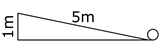
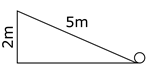
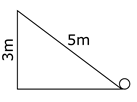
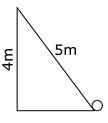

A student is helping his neighbor move a new dishwasher into their house. The house has three steps on the front porch that cause the porch to be 2 meters above the ground. Which method requires the least amount of force to get the dishwasher from the ground to the porch?
Lift the dishwasher up one step at a time with a partner, and rest one minute between steps.
Place an inclined plane that is 10 meters long over the stairs, and roll the dishwasher up the inclined plane with a partner.
Place an inclined plane that is 5 meters long over the stairs, and roll the dishwasher up the inclined plane with a partner.
Use a fixed pulley attached to the roof of the porch to lift the dishwasher with a partner.
Students want to raise a large crate from the ground to a deck several feet above the ground. They know it will be easier to move the crate along an inclined plane because the inclined plane will —
A. reduce the work needed to raise the crate.
B. increase the force applied to the crate.
C. increase the work done on the crate.
D. reduce the force necessary to raise the crate.
All of the following are examples of inclined planes except —
A. a ramp
B. a screw
C. a slide
D. a seesaw
Which of the following inclined planes would require the least amount of force to lift a box?
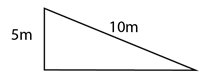
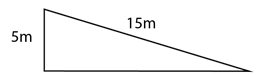
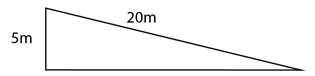
They all require the same amount of force.
Robert is using an inclined plane to move a heavy box into a truck bed that is two meters off the ground. Which of the inclined planes should Robert use to get the greatest mechanical advantage?


Which simple machine increases the distance over which a load travels and reduces the needed force?
wheel and axle
wedge
pulley
inclined plane
A worker needs to load a heavy box onto a truck. The worker uses a ramp to move the box because the ramp...
increases the weight of the box.
reduces the gravitational force on the box.
increases the amount of friction on the box.
reduces the amount of force applied to the box.

The diagram shows two ramps that a person could use to raise a 10-kilogram cardboard box to a height of 1 meter. Which statement correctly describes the force required to raise the box using the ramps?
A. The same amount of force will be required when using either ramp because both boxes have a mass of 10 kg.
B. The same amount of force will be required when using either ramp because both ramps are 1 meter high.
C. More force will be required to raise the box using Ramp X because Ramp X is steeper than Ramp Y.
D. More force will be required to raise the box using Ramp Y because Ramp Y is longer than Ramp X.

