wayground logo

Free Printable Worksheets

Font size

S
M
L
XL
Worksheets

Chemistry CSA Practice ACC

Total questions: 85

Worksheet time: 52mins

Name
Class
Date
1.
Look at this image.  Which object has the LOWEST density in water? How
a)
The Ping Pong Ball because it floats to the top 
b)
The bolt because it has sunk to the bottom
c)
The soda cap because it is not just full of air like the Ping Pong ball
2.
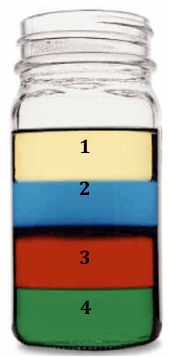
Put the liquids in order from most dense to least dense?
a)
4, 3, 2, 1
b)
1, 2, 3, 4
c)
3, 4, 2, 1, 
d)
4, 3, 1, 2
3.
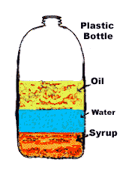
Which liquid is the least dense?
a)
oil
b)
water
c)
syrup 
d)
plastic bottle
4.
Which of the following atomic symbols is written correctly?
a)
ee
b)
hE
c)
C
d)
CL
5.
Which of the following chemical formulas represents a compound? 
a)
C3
b)
O2
c)
CH3CHO
d)
H2
6.
Carbon is considered an element while carbon dioxide is considered a compound. This is because carbon dioxide is –
a)
a gas at room temperature.
b)
made of two different elements.
c)
given off by green plants.
7.
This picture represents which of the following?
a)
element
b)
compound
c)
mixture
8.
This picture represents which of the following?
a)
element
b)
compound
c)
mixture
9.
What is the term for combining 2 or more atoms together?
a)
atoms
b)
elements
c)
molecules
d)
compounds
10.
What is the name of a single type of atom?
a)
cell
b)
proton
c)
element
d)
atom
11.
What is the term for combining 2 or more DIFFERENT atoms together?
a)
atoms
b)
elements
c)
molecules
d)
compounds
12.
Are these molecules also compounds?
a)
YES
b)
NO
13.
Are these molecules also compounds?
a)
YES
b)
NO
14.
What is the tiniest particle in the entire universe?
a)
cells
b)
gases
c)
atoms
d)
liquids
15.
What kind of properties can only be observed when a substance changes into a different substance?
a)
physical properties
b)
chemical properties
16.
Properties that can be observed without changing the identity of the substance.
a)
Physical
b)
Chemical
17.
Example for physical property
a)
odor
b)
burns in air
c)
reacts with water to create hydrogen gas
d)
rust
18.
Example for chemical property
a)
color
b)
hardness
c)
toxicity
d)
solubility
19.
Example for physical property
a)
reacts with an acid
b)
explodes
c)
flammibility
d)
taste
20.
Example for chemical property
a)
malleability
b)
texture
c)
combustion
d)
sour taste
21.
Which of the following is NOT an example of a physical change?
a)
crumpled paper
b)
pencil sharpening
c)
shrunken clothing
d)
rust
22.

How many atoms of Hydrogen are in H2O

a)

1

b)

2

c)

3

d)

more than 3

23.

Calculate the number of Oxygen atoms in Al(OH)3

a)

1

b)

2

c)

3

d)

4

24.

The ______ are numbers found on the lower right-hand side of an element symbol.

a)

Coefficient

b)

Exponent

c)

Multiplier

d)

Subscript

25.

4CF2Cl2

a)

C = 4, F = 4, Cl = 2

b)

C = 1, F = 8, Cl = 8

c)

C = 4, F = 8, Cl = 8

d)

C = 1, F = 4, Cl = 8

26.

H2SO4

a)

H = 2, S = 4, O = 4

b)

H = 2, S = 1, O = 4

c)

H = 8, S = 4, O = 4

d)

H = 2, SO = 4

27.

A ______ is a number written in front of a chemical formula.

a)

Coefficient

b)

Subscript

c)

Exponent

d)

Coordinator

28.

How many CARBONs are in this formula?

a)

1

b)

4

c)

8

d)

12

29.

How many CARBON are in this formula?

a)

5

b)

2

c)

10

d)

20

30.

How many atoms of hydrogen are in a molecule of glucose (C6H12O6)?

a)

12

b)

6

c)

18

d)

4

31.

Which of the following molecules has the formula CH2O?

a)
b)
c)
d)
32.
Element or compound?
H2O
a)
element
b)
compound
33.
Which is the correct formula for:
 three hydrogen (H)
one sulfur (S)
four oxygen (O)
a)
H3SO4
b)
HSO4
c)
H4S3O
d)
H2O
34.
If there is no subscript, there is ______ atom(s) of that element.
a)
0
b)
2
c)
only 1
d)
1 million
35.
Which is the correct formula for:
one carbon (C)
two oxygen (O)
a)
CO2
b)
CO
c)
C2O
d)
2CO
36.
Which of these models best represents water, H2O?
a)
A
b)
B
c)
C
d)
D
37.
Which of the following properties uniquely identifies every element?
a)
Number of valence electrons
b)
Phase at room temperature
c)
Number of protons
d)
Charge of the atom
38.
a)
2
b)
4
c)
6
d)
8
39.
a)
A
b)
B
c)
C
d)
D
40.
a)
A
b)
B
c)
C
d)
D
41.
According to the Law of Conservation of Mass,
a)
matter is always created in a chemical reaction.
b)
matter is always destroyed in a chemical reaction.
c)
matter is created and then destroyed in a chemical reaction
d)
matter is not created or destroyed in a chemical reaction.
42.

How many oxygen atoms are in the products in the chemical equation below, 2Mg + O2 ------> 2MgO

a)

0

b)

1

c)

2

d)

4

43.
In which of the following examples has a chemical reaction occurred?
a)
After putting liquid batter into a hot pan, the batter solidifies and begins to turn brown.
b)
After turning on a blender filled with fruits, the fruit is chopped up and mixed together.
c)
After taking a tray filled with ice cubes out of the freezer, the cubes begin to melt.
d)
After adding a spoonful of sugar to a mug of hot coffee, the sugar dissolves completely.
44.
When vinegar and baking soda are combined, bubbles begin to formBubbles are evidence of a chemical reaction because they
a)
pop when they are touched.
b)
show that a gas is forming.
c)
form at a fast rate.
d)
are generally transparent.
45.

Which of the following substances are elements?

a)

water

b)

salt

c)

carbon dioxide

d)

hydrogen

46.

How many elements are in this Carbon dioxide molecule?

a)

3

b)

2

c)

1

d)

0

47.

Which of the following is an element?

a)

A

b)

B

48.

Whys is B considered to be a compound?

a)

It is made of more than one element.

b)

It can be broken down into the elements that comprise it.

c)

It's a pure substance composed of 2 kinds of atoms.

d)

All are true

49.

How many elements are in this potassium chloride (KClO3) molecule?

a)

3

b)

4

c)

5

d)

6

50.

Evaporating, dissolving, & melting are all examples of

a)

elements

b)

compounds

c)

physical changes

d)

chemical reactions

51.

Gas production, turning solid, & gaining heat are evidence that

a)

physical changes occur

b)

a new substance formed

52.

Which of the following is not evidence of chemical change?

a)

gas production

b)

temperature change

c)

dissolving

d)

color change

53.
Which of the following is a chemical change?
a)
Iron rusting 
b)
Glass breaking
c)
Clothing ripping
d)
Hair cut
54.
Is this equation balanced?
a)
Yes
b)
No
c)
Not enough information
55.
Which of the following is evidence of a chemical change?  
a)
Change in state
b)
No new substance is formed
c)
Bubbles forming
d)
Change in shape
56.
Which of the following is an example of a physical change, and why? 
a)
Fire burns in fireplace, because a new substance is formed. 
b)
Clothes are folded, because there is a color change. 
c)
A mirror is broken, because there is a change in shape/size.
d)
cookies are baked, because there is a change in temperature
57.
How many hydrogen atoms are in this chemical formula: 
a)
4 hydrogen atoms
b)
1 hydrogen atom
c)
2 hydrogen atoms
d)
3 hydrogen atoms
58.

A substance that is formed as the result of a chemical reaction is a __________________

a)

Product

b)

Reactant

c)

Starters

d)

Enders

59.

A change in the shape of an object is an example of _________________.

a)

a chemical change

b)

energy

c)

an endothermic change

d)

a physical change

60.
Which of the following is an example of a chemical change?
a)
rusting of a bicycle
b)
painting a house
c)
washing a dog
d)
tearing up a newspaper
61.

A substance that is formed as the result of a chemical reaction is a __________________

a)

Product

b)

Reactant

c)

Starters

d)

Enders

62.

A change in the shape of an object is an example of _________________.

a)

a chemical change

b)

energy

c)

an endothermic change

d)

a physical change

63.
Which of the following is an example of a chemical change?
a)
rusting of a bicycle
b)
painting a house
c)
washing a dog
d)
tearing up a newspaper
64.
What type of change occurs when a new substance is formed that has different properties from the original substances?
a)
chemical change
b)
nuclear change
c)
physical change
d)
mutation
65.

What is the BEST definition of a chemical reaction?

a)

A change in matter that produces one or more NEW substances

b)

When two things combine and EXPLODE.

66.
the starting materials in a chemical reaction
a)
Products
b)
Reactants
c)
Starters
d)
Enders
67.
What is the left part of a chemical equation called?
2H2 + O2 --> 2H2O
a)
Reactants
b)
Products 
c)
Yields 
d)
Chemical Equation 
68.
What is the right part of a chemical equation called...
2H2 + O2 --> 2H2O
a)
Reactants
b)
Products 
c)
Yields 
d)
Chemical Equation 
69.
How many Sodium (Na) are in 6NaCl?
a)
1
b)
12
c)
6
70.

True or False: In a complete chemical equation, there must be the same number of atoms of each element on the reactants and products side.

a)

True

b)

False

71.

In a chemical reaction, atoms (a)   and form new bonds.

72.
In a chemical reaction, bonds are broken and new bonds are formed that create new substances. The bonds that are broken are called what?
a)
Reactants
b)
Products
c)
Atoms
d)
Catalysts
73.
the starting materials in a chemical reaction
a)
Products
b)
Reactants
c)
Starters
d)
Enders
74.
The substances listed on the right side of a chemical equation are the
a)
Yields
b)
Reactants
c)
Products
d)
Precipitates
75.
A change in the shape of an object is an example of _________________.
a)
a chemical change
b)
energy
c)
an endothermic change
d)
a physical change
76.
What is the little number after an element in a chemical equation called.
Example: H2
a)
Coefficient 
b)
Subscript
c)
Atom
d)
Equation
77.
Element or compound?
H2O
a)
Element
b)
Compound
78.

What are the large numbers at the front of a chemical formula that tells the number of molecules in a chemical equation?

a)

Coefficient

b)

Products

c)

Reactants

d)

Subscripts

79.

Identify the Reactants in this equation.

a)

A

b)

B

80.

What are the blue numbers called?

a)

oxidation numbers

b)

subscripts

c)

group numbers

d)

product numbers

81.

How many molecules of KNO3 are shown?

a)

1

b)

2

c)

3

d)

4

82.

How many total molecules is 4NH3?

a)

4

b)

1

c)

3

d)

12

83.

How many total atoms make up 4NH3?

a)

4

b)

16

c)

3

d)

12

84.

What is the arrow part of a chemical equation represent?

2H2 + O2 --> 2H2O

a)

Reactants

b)

Products

c)

Yields

d)

Chemical Equation

85.

Identify the Products in this equation.

a)

A

b)

B