
 Worksheets
22 Chem Fall Sem Exam
Total questions: 67
Worksheet time: 2hrs 42mins

What is a chemical property of paper?
Flammable
White
Light

Is an ice cream cone melting a physical or chemical change?
Physical
Chemical


Which of the following is not a clue that a chemical reaction has taken place?
Changing size
Changing color
A gas being formed
Formation of a precipitate
what is digestion?
physical property
chemical change
physical change

N2 will form a covalent _____ bond
triple
double
single

Transition element Iron forms different ions:
Fe2 and Fe3.
[Fe]2+ and [Cl]- combine to form FeCl2.
The correct name is
Fe (I) Chlorine
Iron (II) Chloride
Iron Dichloride

Elements that have the same characteristics, # of valence electrons, and react similarly are grouped in the same
family
period
class

These two elements have the similar chemical properties and reactions
Cl and F
CL and S
F and Ne

Intensive and extensive properties are
real estate proerties
chemical properties
physical properties

Which property depends on the amount of the substance and therefore can change?
intensive
extensive
both intensive and extensive

element
homogenous mixture
compound
heterogeneous mixture

element
homogenous mixture
compound
heterogeneous mixture

element
homogenous mixture
compound
heterogeneous mixture

element
homogenous mixture
compound
heterogeneous mixture

This could be the dot diagram of
Mg
Cl
C
O
What is the goal of the Lewis Dot Structure?
To determine the electron position.
To show the element's valence electrons & bonding capabilities.
To find the atomic mass of an element.
To search for the number of electrons in an individual atom.

This is a correct dot diagram for nitrogen (N)
true
false

This is a correct dot diagram for carbon (C)
true
false
Why are sodium and chlorine attracted to each other?
they have opposite charges
they both have negative charges
they both have positive charges
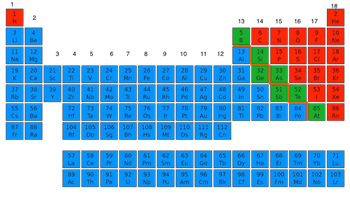
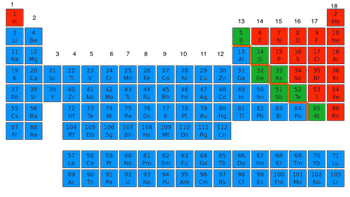

Atomic radius increases moving _____ the family
down
up
across
Atomic radius decreases moving _____ the family
down
up
across
Elements in the same period have the same number of
valence electrons
atoms
energy levels
Atomic radius of atoms will increase as more ____ ____ are needed for their electrons.
valence electrons
atoms
energy levels
Which 3 things are always equal for an atom?
Electrons, protons, and neutrons
Atomic number, protons, electrons
Mass number, atomic number, protons
Atomic number, neutrons, electrons

How many protons are in this element?
12
8
7
6
What is the mass number for this element?
12
8
7
6

How many neutrons are in this element?
39
19
20
40

Which element does this model represent?
Nitrogen
Hydrogen
Carbon
Boron
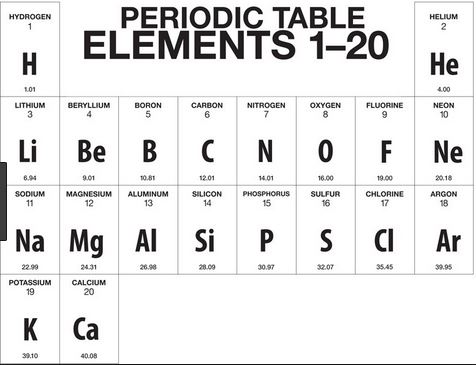
How many valence electrons does Nitrogen Have?
1 Valence electron
2 Valence electron
3 Valence electron
4 Valence electron
5 Valence electron
USE THE PERIODIC TABLE
Find the element that has 3 Valence Electrons and 2 energy levels (hint: row 2)
Magnesium - Mg
Lithium - Li
Aluminum - Al
Boron - B
USE THE PERIODIC TABLE
Find the element that has 5 Valence Electrons and 4 energy levels (hint: row 4).
Arsenic - As
Selenium - Se
Calcium - Ca
Vanadium - V


A model of orbiting electrons around a positive nucleus
Bohr model
Planck model
Rutherford model
The correct formula for calcium + chlorine is
CaCl
CaCl2
Ca2Cl
An ionic compound formula is written with the ______ first and the ____ second.
metal
nonmetal
nonmetal
metal
metalloids only.
The Roman numeral often seen when naming transition metals tells the
charge (oxidation state) of the metal.
number of metal atoms needed.
group number.
LiBr is called
lithium bromine
lithium (I) bromine
lithium bromide
When naming a compound, which of these is written first?
Nonmetal
Anion
Cation
Na1+ F1-
NaF
Na3F
Na1F2
What is the charge of Cobalt (III)
3+
2+
8+
What is the charge and symbol for Lead (IV)
Pb4+
Ld4+
Pb4-
Which of these describes the arrangement of particles in a metal?
Closely packed electrons with delocalised ions
Alternating layers of metal ions and electrons
Layers of metal ions surrounded by delocalised electrons
Which of the following is NOT a property of a typical metal?
Poor conductor of electricity
High melting point
Shiny
Why do metals conduct electricity?
They are shiny
The electrons are delocalised and able to move
The electrons are held tightly within the lattice
The electrons are shared between two metal ions
Which of these are considered properties of metals? (choose ALL that apply)
brittleness
low melting point
luster (shininess)
malleability
ductility
SO₃
sulfate
sulfur oxide
sulfur trioxide
monosulfur trioxide
What is the OFFICIAL name for H2O? Hint.. This is a trick question so choose carefully!
Hydrogen Oxide
Oxygen Dinitride
Water
Dihydrogen Monoxide


Using the model for the formation of Scandium Fluoride (an ionic compound), write the chemical formula.
Sc3F
Sc3F3
Sc+3F-1
ScF3

How many single bonding pair does NH3 share?
1
2
3

The picture demonstrates an ionic bond because
Na transfers its valence electrons
Na shares its valence electrons
Na gains its valence electrons

