
 Worksheets
Nuclear Chemistry
Total questions: 70
Worksheet time: 35mins



After one ____________ of a radioactive element, half of the original radioactive material remains.
half-life
cycle
decay
In ___ _____reactions, small nuclei combine, producing a large nucleus and releasing large amounts of energy.
nuclear fission
nuclear fusion
spontaneous emission from the nucleus of an atom
positron
radioactivity
alpha particle
gamma radiation
beta particle
emitted helium nucleus
positron
radioactivity
alpha particle
gamma radiation
beta particle
energetic electron from decomposed neutron
positron
radioactivity
alpha particle
gamma radiation
beta particle
high-energy photons emitted by a radioisotope
positron
radioactivity
alpha particle
gamma radiation
beta particle
What process is described by the splitting of a nucleus into smaller nuclei?
fusion
fission
half-life
gamma radiation
What process describes two small nuclei combining into a larger nucleus?
fission
fusion
alpha decay
beta decay
How do nuclear power-plants work?
Fusion
Half-life
Fission
Fusion or fission

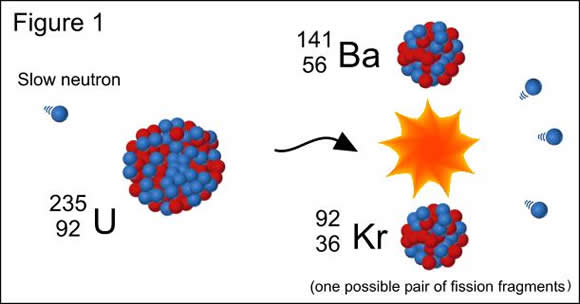
What nuclear process is shown in the picture?
alpha decay
gamma emission
fusion
fission

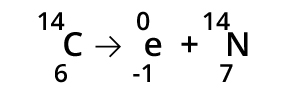
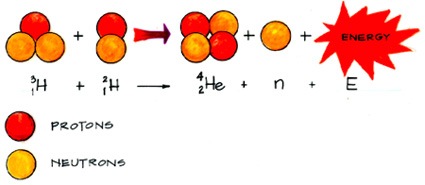
Which nuclear process if shown in the picture?
alpha decay
beta decay
fusion
fission
One disadvantage of nuclear energy produced through fission is ___.
it is a fossil fuel
it leaves behind radioactive waste
it emits large amounts of pollution into the atmosphere
there are no disadvantages

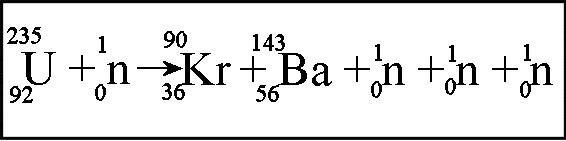
Which material is responsible for initiating and continuing the chain reaction?
neutron, 01n
Uranium - 235, 23592U
Krypton - 90, 9036Kr
Barium - 144, 14456Ba
Which of the following is NOT a true statement about nuclear fission?
big atoms split apart
it occurs naturally
it produces radioactive waste
it releases less energy than fusion
Hydrogen bombs are created from which process?
Fusion
Fission
Atomic bombs are created from which process?
Fusion
Fission
In the equation E=mc2, which of the following correctly represents one or constants?
M=the sum of the masses
E= the amount of energy absorbed
C2= the speed of light
All of the above
In nuclear reactions--
a large amount of matter produces a small amount of energy.
a small amount of matter produces a large amount of energy.
One type of radioactive device that indicates the intensity of radiation with a clicking sound that increases in frequency as more radiation is present is a(n) ____.
bubble chamber
cloud chamber
electroscope
Geiger counter

Which risk is associated with using nuclear fission to produce energy in a power plant?
depletion of hydrocarbons
depletion of atmospheric oxygen
exposure of workers to radiation
exposure of workers to sulfur dioxide
A serious risk factor associated with the operation of a nuclear power plant is the production of
acid rain
helium gas
greenhouse gases, such as CO2
radioisotopes with long half-lives
Chemical reaction or nuclear reaction: involves only electrons
chemical
nuclear
Chemical reaction or nuclear reaction: involves protons and neutrons
chemical
nuclear
Chemical reaction or nuclear reaction: the mass does not change
chemical
nuclear
Chemical reaction or nuclear reaction: some mass is converted to energy
chemical
nuclear
Chemical reaction or nuclear reaction: small amounts of energy are released
chemical
nuclear
Chemical reaction or nuclear reaction: enormous amounts of energy are released
chemical
nuclear

Chemical reaction or nuclear reaction:
chemical
nuclear

Chemical reaction or nuclear reaction:
chemical
nuclear
Chemical reaction or nuclear reaction: The same elements are present before and after a reaction
chemical
nuclear
Chemical reaction or nuclear reaction: Entirely new elements are formed in the reaction
chemical
nuclear
Chemical reaction or nuclear reaction: The sun
chemical
nuclear
Chemical reaction or nuclear reaction: Baking cookies
chemical
nuclear

