
Font size
 Worksheets
Final Exam Review
Total questions: 59
Worksheet time: 55mins
Which of the following is a chemical change?
Melting of candle wax
Cutting of trees
Boiling of water
Digestion
A change is a chemical change when it is accompanied by:
energy charge
formation of new substances
change in chemical properties
all of the above
452.159 meters.
Round to the nearest thousandth.
An ionic bond is between
metal and metal
metal and nonmetal
nonmetal and nonmetal
A covalent bond is between
metal and metal
metal and nonmetal
nonmetal and nonmetal
What is the oxidation number for Nitrogen?
+4 and -4
-3
+1

Is this the correct lewis dot for Chlorine?
yes
no

Is this the correct lewis dot for Sodium?
yes
no
Which Lewis dot matched the configuration:
1s2 2s2 2p2 2p6 3s1


Which Lewis dot matched the configuration:
1s2 2s2 2p2
The name of FeCl₂ is
iron chloride
iron (II) chloride
iron (I) chloride
iron dichloride
What is the name of the compound Na2(SO4)?
Sodium sulfate
Sodium sulfide
Sodium sulfite
Sodium sulfuroxide
What is a negatively charged atom called?
Anion
Cation
Ion
What is a valence electron?
an electron that is found in the outermost shell of an atom.
an electron found in the innermost shell of an atom.
an electron found in the middle shell.
Alkali metals have...
1 valence electron, +1 charge
2 valence electrons, +2 charge
1 valence electrons, -1 charge
What is required when a number is written in scientific notation?
mantissa
a power of 10
a number between 1 and 10 or equal to 1
any decimal number multiplied by any power
In the year 2000, there were approximately one billion people living in India. What is this number expressed in scientific notation?
1×10¹⁰
10×1010
1×10⁹
10×109
A small electronic scale in Mr. Dell’s chemistry classroom has a precision of 4.5 × 10⁻⁴ grams. Express this precision as a number using standard notation.
0.00045 grams
4.5 grams
0.0045 grams
45,000 grams
protons
negative charge, nucleus
positive charge, shells
positive charge , nucleus
neutral charge, nucleus
neutrons
no charge, shells
positive charge, nucleus
neutral, no charge, nucleus
negative charge, shells
electrons
no charge, nucleus
positive charge, nucleus
negative charge, shells
negative charge, nucleus
atomic number
number of protons/stands for an element
number of neutrons
number of electrons
number of protons and neutrons
mass number
number of protons
number of electrons
number of protons and electrons
number of protons and neutrons
atomic symbol
capital letter
lowercase letter
2 capital letters
2 lowercase leters
lst shell holds
2
8
18
32
2nd shell holds
2
8
18
32
3rd shell holds
2
8
18
32
a charged atom
neutral
isotope
ion
nucleus
How are ions formed?
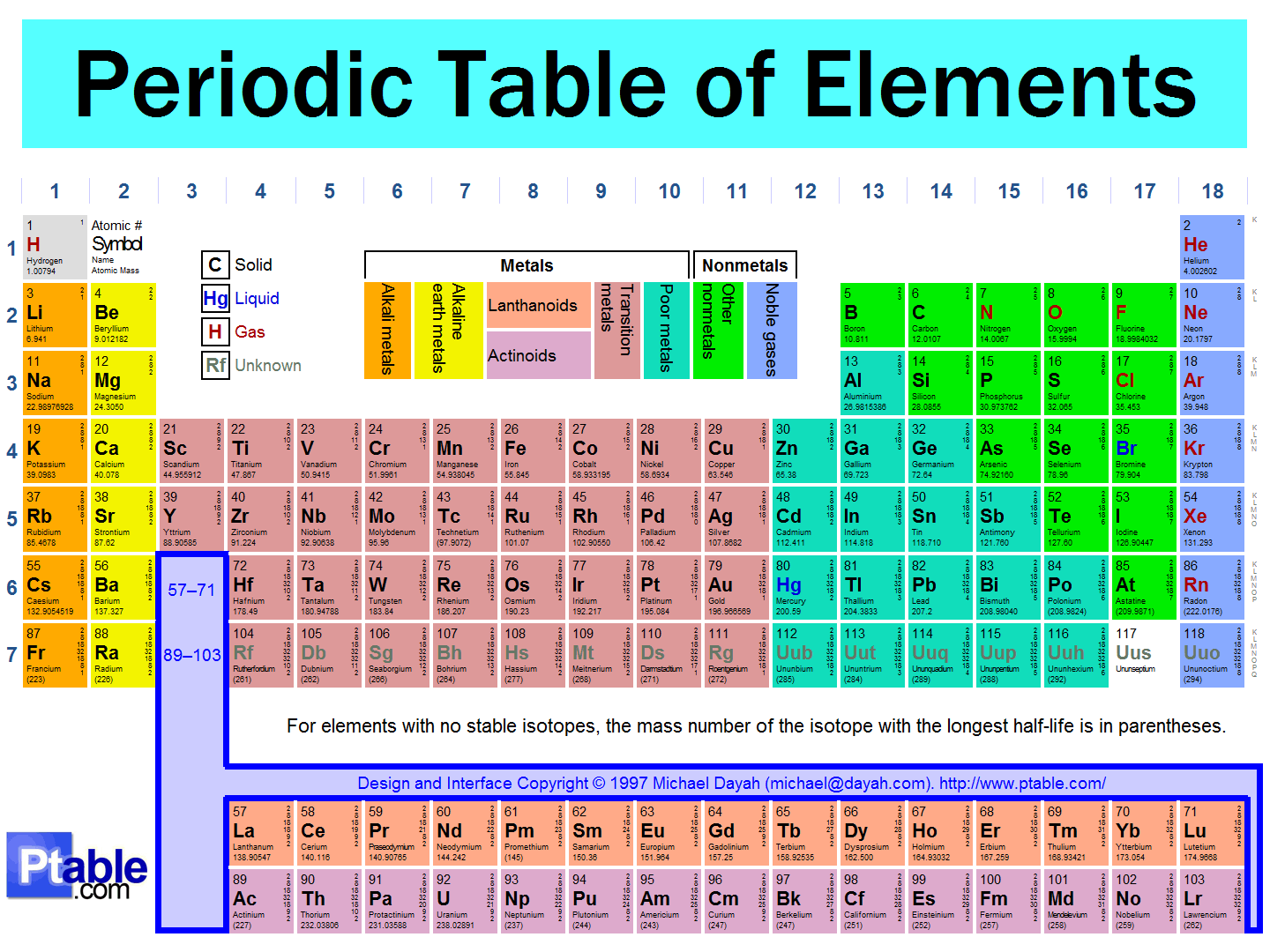
The vertical (up and down) columns in the Periodic Table are called
groups
towers
periods
atomic numbers
The letter, C, is a ... of carbon.
Name
Nickname
Chemical Symbol
Pseudonym
True or False: The reactivity of metals tends to decrease as you move from left to right across the periodic table.
True
False
Name this group: These metals are the most reactive.


Name this group: These metals are the second most reactive.


Name this group: These metals are the second most reactive.
Name this group: These metals contain familiar metals such as gold, iron, and copper.


I am a metal
I am in group 2
I am in period 6
I am…
Mo
Re
S
Ba
The trends on the periodic table are dependent on..
how attracted a valence electron is to the nucleus
how attracted valence electrons are to each other
how attracted a valence electrons is to a non valence electron
how attracted a non valence electron is to the nucleus
What makes a valence electron more attracted to the nucleus?
less distance between the nucleus and having less protons
less distance between the nucleus and having more protons
more distance between the nucleus and having less protons
more distance between the nucleus and having more protons
less distance and having more valence electrons
What is the tendency of an atom to attract electrons towards itself in a bond?
atomic radius
ionization energy
shielding
Electronegativity
The higher the ionization energy...
the more attracted the valence electron is to the nucleus so it is harder to remove
the less attracted the valence electron is to the nucleus so it is easier to remove
the more attracted the valence electron is to another electron, so it is harder to remove
the more repelled a valence electron is to another electron, so it is easier to remove
Why does ionization energy decrease going down a group?
Adding more energy levels makes the ve- further from the nucleus so it is easier to remove
There are more valence electrons in the outer shell so the ve- is easier to remove
There are more protons in the nucleus so the ve- is easier to remove
There are less protons in the nucleus so the ve- is easier to remove
P, Cs, Co, Sr
P, Cs, Co, Sr
Why doesn't having more protons increase the attraction down a column?
there are more valence electrons in the outermost energy level
actually, there aren't more protons in the nucleus down the column
as energy levels are added, non-valence electrons block the extra protons from attracting ve-
more neutrons block the extra protons
What happens to atomic radius across a period?
the atoms get bigger because the nucleus is bigger as more protons are added
the atoms get bigger because there are more ve-
the atoms get smaller because with more attraction to the extra protons, the e- cloud moves closer to the nucleus
the atoms get bigger because there are more energy levels
Nitrogen is a _ so it will _ electrons when forming an ion.
metal, lose
metal, gain
nonmetal, lose
nonmetal, gain
A full valence shell is considered having _ ve-.
0
2
6
8
Which of the following lose all their ve- when forming an ion?
metals
nonmetals
metalloids
depends on how many ve- the element has

