
NEW
Font size
 Worksheets
Physics review
Total questions: 54
Worksheet time: 2hrs 48mins

A constant 15-newton force, F, is applied to a 2.5-kilogram box. The box is accelerating to the right at 2.0 m/s² across a rough horizontal surface. What is the force of friction on the box?
2 N
5 N
10 N
15 N
The Doppler effect is best described as the
bending of waves as they pass by obstacles or through openings
change in speed of a wave as the wave moves from one medium to another
creation of a standing wave from two waves traveling in opposite directions in the same medium
shift in the observed frequency and wavelength of a wave caused by the relative motion between the wave’s source and an observer
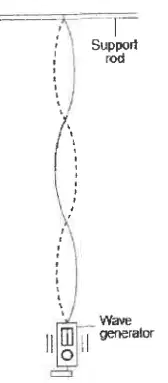
Students are creating standing waves on a string with a wave generator. They start with a very low frequency (1 Hz) and slowly increase the frequency and record the frequency of each standing wave. One of the standing waves they create is shown below. How many antinodes are shown in this standing wave?
1
2
3
4
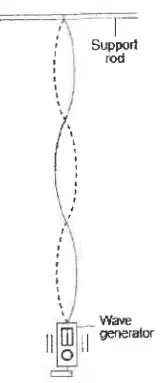
Students are creating standing waves on a string with a wave generator. They start with a very low frequency (1 Hz) and slowly increase the frequency and record the frequency of each standing wave. One of the standing waves they create is shown below. How many standing waves will the students find before they discover the one pictured above?
0
1
2
3
A student is standing in an elevator that travels from the first floor to the tenth floor of a building. The student exerts the greatest force on the floor of the elevator when the elevator is
accelerating upward as it leaves the first floor
slowing down as it approaches the tenth floor
moving upward at constant speed
at rest on the first floor
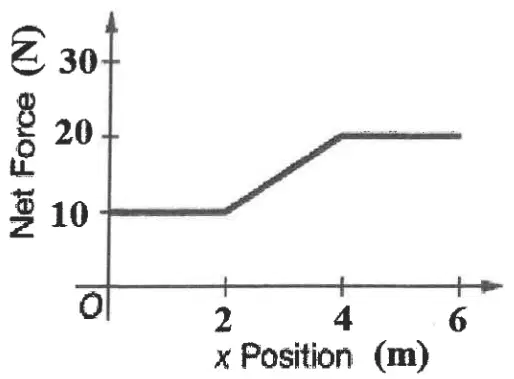
A graph of the net horizontal force F exerted on an object as a function of x position is shown for the object of mass M as it travels a horizontal distance of 6.0 m. What is the change in kinetic energy of this object over this distance?
60 J
70 J
80 J
90 J

The graph below represents the relationship between velocity and time for an object moving along a straight line. What is the magnitude of the object's acceleration?
5.0 m/s²
8.0 m/s²
10.0 m/s²
20.0 m/s²
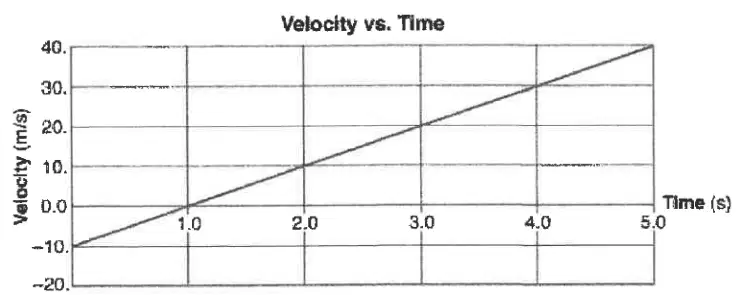
In addition to the data in the graph above, what else would students need to measure to determine the magnitude of the net force on this object?
Mass only
Distance the object travels each second
The direction of the motion
The mass of the object and the distance it travels each second

A projectile is launched from the ground and lands at the same height from which it was launched. For which initial velocity will the projectile be in the air the longest? [Neglect friction.]
v_i = 20 m/s at 60°
v_i = 20 m/s at 45°
v_i = 10 m/s at 45°
v_i = 10 m/s at 30°
A 5.0-kilogram box is sliding across a level floor. The box is acted upon by a force of 25 newtons east and a frictional force of 15 newtons west. What is the magnitude of the acceleration of the box?
0.50 m/s²
2.0 m/s²
3.0 m/s²
5.0 m/s²

Use the diagram below for questions 11-13. The diagram below represents a 2.0-kilogram toy car moving at a constant speed of 3.0 meters per second counterclockwise in a circular path with a radius of 2.0 meters. At the instant shown in the diagram, the centripetal force acting on the car is:
6 N
9 N
12 N
36 N

The diagram below represents a 2.0-kilogram toy car moving at a constant speed of 3.0 meters per second counterclockwise in a circular path with a radius of 2.0 meters. The centripetal force on this toy car at the instant shown in the diagram:
Directed North and is the result of the normal force on the car
Directed West and is the result of the normal force on the car
Directed North and is the result of the friction force on the car
Directed West and is the result of the friction force on the car

Use the diagram below for questions 11-13. The diagram below represents a 2.0-kilogram toy car moving at a constant speed of 3.0 meters per second counterclockwise in a circular path with a radius of 2.0 meters. If the car hits a patch of ice at the instant shown in the diagram what direction will it continue to move?
North
West
Northeast
Northwest

Two pulses approach each other in a uniform medium, which diagram best represents the superposition of the two pulses when the pulses overlap?
+0.30 m
-0.30 m
+0.60 m
-0.60 m
A toy that is used to launch small plastic spheres vertically into the air contains a spring with a spring constant k N/m. The spring is compressed a distance d when the launcher is ready to launch a plastic sphere. The toy launches the plastic sphere a height H into the air. Friction is negligible. The spring inside the toy is replaced with a new spring with spring constant 2k, how high will the toy now launch the plastic sphere?
½H
H
2H
4H
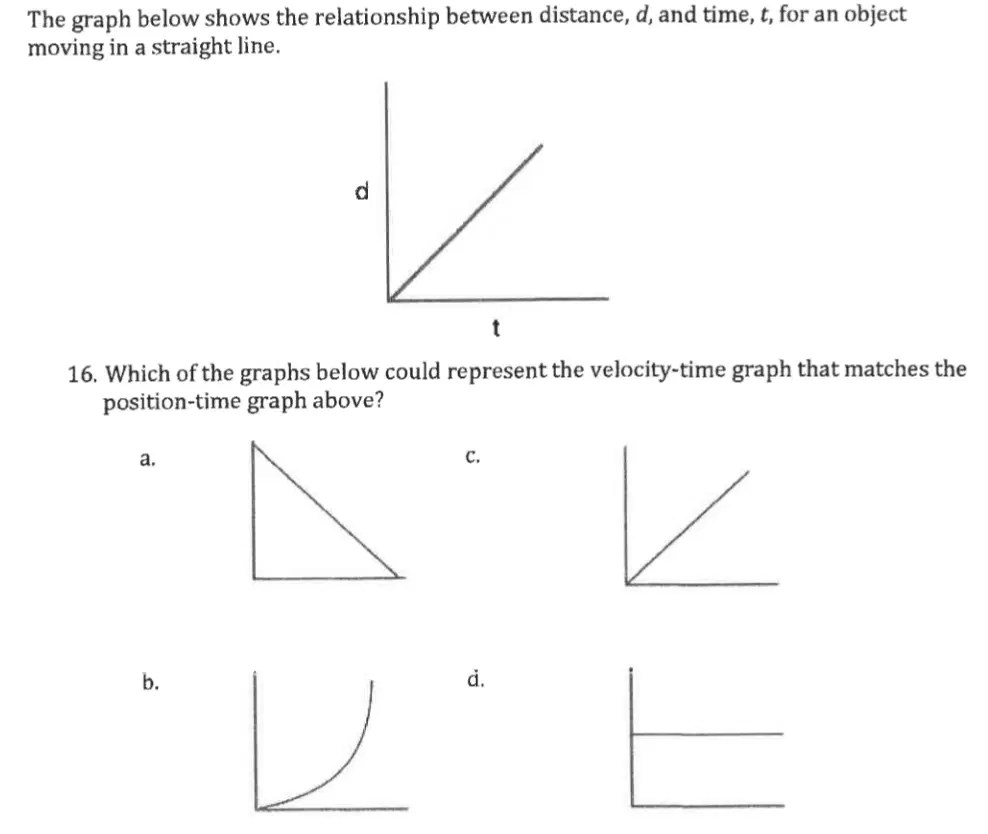
The graph below shows the relationship between distance, d, and time, t, for an object moving in a straight line. Which of the graphs below could represent the velocity-time graph that matches the position-time graph above?
Graph A
Graph B
Graph C
Graph D
A student wishes to record a 7.5-kilogram watermelon colliding with the ground at a speed of 30 m/s. How long must the watermelon fall freely from rest so it would be traveling at 30 m/s the instant it hits the ground?
1 sec
2 sec
3 sec
4 sec

As represented in the diagram below, block A with a mass of 100 grams slides to the right at 4.0 meters per second and hits stationary block B with a mass of 150 grams. After the collision, block B slides to the right and block A rebounds to the left at 1.5 meters per second. [Neglect friction.] What is the speed of block B after the collision?
1.0 m/s
2.7 m/s
3.7 m/s
6.7 m/s

A cart with mass 1 kg travels along a horizontal, frictionless surface. A net force is applied to the cart, as shown in the graph above. The initial and final direction of the cart and the direction of the net force exerted on the cart is unknown. Which of the following diagrams could represent the direction and relative magnitude of the velocity of the cart before the force is applied and after the force is applied? Each grid represents a velocity of 1 m/s.
Diagram a
Diagram b
Diagram c
Diagram d
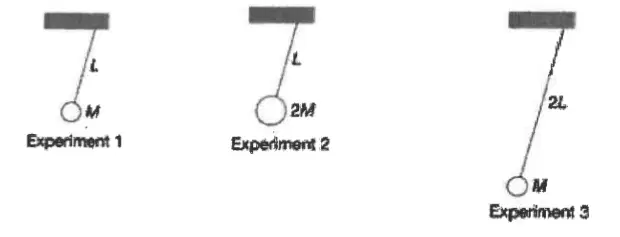
A student conducts three different experiments with a pendulum, as shown in the diagram below. Rank the period of each pendulum from greatest to least.
a. Experiment 1 > Experiment 2 = Experiment 3
b. Experiment 2 > Experiment 1 > Experiment 3
c. Experiment 1 = Experiment 3 > Experiment 3
d. Experiment 3 > Experiment 1 = Experiment 2
A wave generator produces straight, parallel wave fronts in a shallow tank of uniform-depth water. As the frequency of vibration of the generator increases, which characteristic of the wave will always decrease?
Amplitude
Phase
Wavelength
Speed
A student claps his hands once to produce a sudden loud sound that travels through the air. This sound is classified as a
longitudinal mechanical wave
longitudinal electromagnetic wave
transverse mechanical wave
transverse electromagnetic wave
A person on a ledge throws a ball vertically downward, striking the ground below the ledge with 200 joules of kinetic energy. The person then throws an identical ball vertically upward at the same initial speed from the same point. What is the kinetic energy of the second ball when it hits the ground? [Neglect friction.]
Less than 200 J
200 J
More than 200 J
It depends on the initial height of the throw
As a student walks downhill at constant speed, his gravitational potential energy
increases and his kinetic energy increases
increases and his kinetic energy remains the same
decreases and his kinetic energy increases
decreases and his kinetic energy remains the same

Use the scenario and diagram below for questions 25-26. As shown in the diagram below, a rope attached to an 80.0 N crate is used to exert a force of 45 newtons at an angle of 65 degrees above the horizontal (horizontal component = 19 N, vertical component = 41 N). If the crate is moving with constant velocity what is the force of friction between the crate and the floor?
19 N
41 N
45 N
Cannot be determined without the coefficient of friction
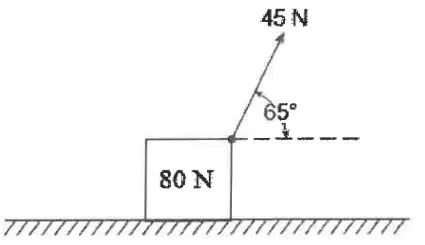
Use the scenario and diagram below for questions 25-26. As shown in the diagram below, a rope attached to an 80.0 N crate is used to exert a force of 45 newtons at an angle of 65 degrees above the horizontal (horizontal component = 19 N, vertical component = 41 N). What is the Normal force on the crate?
35 N
39 N
61 N
80 N
A ball is thrown straight upward from the surface of Earth. Which statement best describes the ball’s velocity and acceleration at the top of its flight?
Both velocity and acceleration are zero.
Velocity is zero and acceleration is nonzero.
Velocity is nonzero and acceleration is zero.
Both velocity and acceleration are not zero.
An object is moving with constant speed in a circular path. The object’s centripetal acceleration remains constant in
magnitude, only
direction, only
both magnitude and direction
neither magnitude nor direction
How would the mass and weight of an object on the Moon compare to the mass and weight of the same object on Earth?
Mass and weight would both be less on the Moon.
Mass would be the same but weight would be less on the Moon.
Mass would be less on the Moon and weight would be the same.
Mass and weight would both be the same on the Moon.

The diagram above shows a box sliding down an incline at constant velocity. Which arrow represents the direction of the frictional force acting on the box?
A
B
C
D
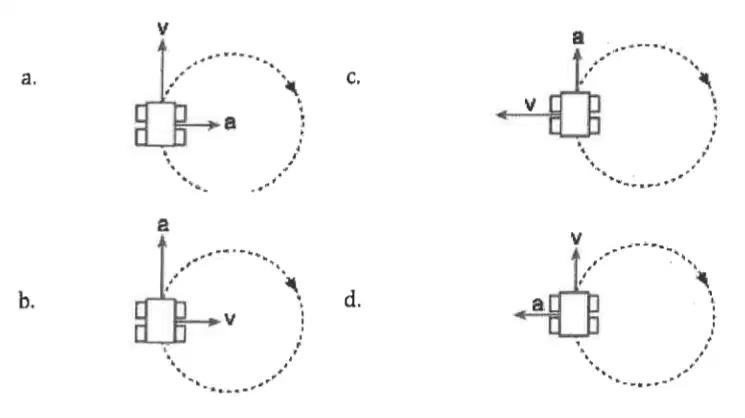
Which diagram represents the directions of the velocity, v, and acceleration, a, of a toy car as it moves in a clockwise, horizontal, circular path at a constant speed?
(Diagram a)
(Diagram b)
(Diagram c)
(Diagram d)

A block is started in simple harmonic motion by pulling it back to x = 0.5 m and releasing it from rest. Students measure the period T and the maximum velocity Vmax of the block during its motion.
The students then repeat the experiment by pulling the block back to 0.8 m and releasing it from rest. How will the new period and maximum velocity compare to the first trial?
Period: remains the same,
Maximum velocity: Increases
Period: remains the same,
Maximum velocity: remains the same
Period: increases, Maximum velocity: remains the same
Period: increases, Maximum velocity: Increases
A swimmer can swim 2.0 m/s in still water. They want to swim across a 40 m wide river that has a current of 4.0 m/s. If they swim straight across the river (perpendicular to the current flow) how far downriver will they have moved when they get to the other side?
5.0 m
10.0 m
20.0 m
80.0 m
A toy airplane, flying in a horizontal, circular path, completes 10.0 complete circles in 30.0 seconds. When the radius of the plane’s circular path is 4.0 meters the plane experiences a centripetal acceleration Ac. If the plane’s circular radius doubles how will the new centripetal acceleration compare to Ac?
½ Ac
¼ Ac
2 Ac
4 Ac

Which pair of graphs represents the vertical motion of an object falling freely from rest?
[Graph a]
[Graph b]
[Graph c]
[Graph d]

An object is thrown straight upward. Which graph best represents the relationship between the object's kinetic energy and the height of the object above its release point? [Neglect friction.]
a
b
c
d

In the diagram below, X represents a single particle of a spring. Which diagram represents the motion of particle X as a longitudinal wave passes through the spring toward the right?
a
b
c
d
Two construction cranes are used to lift different loads of bricks the same vertical distance. The Crane One lifts 800-kilograms of bricks in 20.0 seconds and the Crane Two lifts 1200-kilograms of bricks in 40.0 seconds. Which crane develops more power while lifting the bricks?
Crane One, because it lifts a smaller mass of bricks
Crane One, because it lifts the bricks in a shorter time
Crane Two, because it lifts a larger mass of bricks
Crane Two, because it lifts the bricks in a larger time
A ball is thrown with a velocity of 35 m/s at an angle of 30.0° above the horizontal. Which quantity has a magnitude of zero when the ball is at the highest point in its trajectory? [Neglect Friction]
the acceleration of the ball
the speed of the ball
the horizontal component of the ball’s velocity
the vertical component of the ball’s velocity
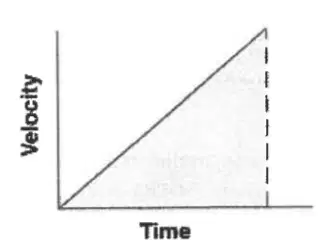
The above below represents the relationship between velocity and time of travel for a toy car moving in a straight line. The shaded area under the line represents the toy car's
acceleration
momentum
displacement
average speed
A child pushes a piece of furniture, mass M, with a horizontal force F across a smooth floor with acceleration a. The child asks an equal strength friend to help push a larger piece of furniture, mass 2M, across the same smooth floor. How will the acceleration of the larger piece of furniture compare to the first? Friction is negligible.
½ a
a
2a
4a
A spring stores 40.0 joules of elastic potential energy when it is compressed 0.20 meter. How much energy will be stored when the spring is compressed by 0.1 meter?
5 J
10 J
20 J
40 J

A student throws a ball horizontally from a cliff at a speed of 10 m/s. The ball travels a distance d from the base of the cliff after some time t.
A second ball is thrown from the cliff at a speed of 20 m/s. What is the horizontal distance the second ball lands from the cliff.
d/2
d
2d
4d

A student throws a ball horizontally from a cliff at a speed of 10 m/s. The ball travels a distance d from the base of the cliff after some time t.
A second ball is thrown from the cliff at a speed of 20 m/s. How long will the second ball be in the air.
t/2
t
2t
4t

A 7 kg cart, A, and a 3 kg cart, B, are initially at rest held together on a horizontal frictionless surface. When a compressed spring is attached to one of the carts and released, it pushes the carts apart. Cart B is launched at 6 m/s.
What is the speed of cart A?
0.9 m/s
2.6 m/s
3.0 m/s
6.0 m/s

A 7 kg cart, A, and a 3 kg cart, B, are initially at rest held together on a horizontal frictionless surface. When a compressed spring is attached to one of the carts and released, it pushes the carts apart. Cart B is launched at 6 m/s.
Which cart experiences a larger average force during the explosion?
Cart A, because it has a larger mass
Cart A, because the spring on cart B pushes on it
Cart B, because it has a smaller mass
Each cart experiences the same average force

A group of students perform an experiment in which object X and object Y have a linear collision on a horizontal frictionless surface. Both objects have a mass of 2 kilogram the data they collect is represented in the graph above.
Which of the objects experience a negative impulse?
Object X
Object Y
Both objects experience a negative impulse
Not enough information

A group of students perform an experiment in which object X and object Y have a linear collision on a horizontal frictionless surface. Both objects have a mass of 2 kilogram the data they collect is represented in the graph above.
Which object experience a larger impulse during the collision?
Object X
Object Y
Both objects experience the same impulse
Not enough information

A group of students perform an experiment in which object X and object Y have a linear collision on a horizontal frictionless surface. Both objects have a mass of 2 kilogram the data they collect is represented in the graph above.
Which of the following are true about the momentum and kinetic energy of the system during the collision
Momentum: conserved
Kinetic energy: Conserved
Momentum: conserved
Kinetic energy: Not conserved
Momentum: Not conserved
Kinetic energy: Conserved
Momentum: Not conserved
Kinetic energy: Not conserved

Which of the following scenarios could the free body diagram above accurately represent?
A box that is moving to the left at constant speed
A box that is moving to the left and slowing down
A box that is moving to the right at constant speed
A box that is moving to the left and speeding up

A 4 kilogram block sits at the top of a rough incline as shown above, a student measures the block's velocity of 5 m/s as it reaches the bottom of the incline, how much mechanical energy is lost as the block slides down the ramp?
0 J
50 J
70 J
120 J
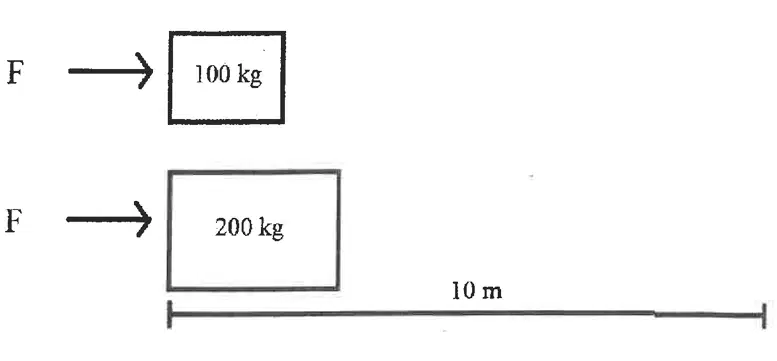
Two students are moving large boxes across a horizontal frictionless floor the students apply horizontal forces of the same magnitude over a distance of 10 meters box a has a mass of 100 kilograms and box B has a mass of 200 kilograms compare the velocities and kinetic energies of the two boxes after traveling to 10 meters.
Box A will have the same velocity and less KE
Box A will have the same velocity and the same KE
Box A will have more velocity and more KE
Box A will have more velocity and the same KE
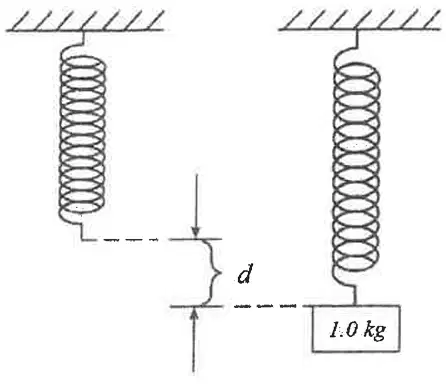
A mass of 1 kilogram is hung vertically from a spring with an unknown spring constant, the spring stretches displacement D, as shown above. What will be the spring displacement when the mass of 2 kilogram is hung from it.
d
2d
4d
It depends on the spring

A transverse wave travels along a stream. The graph above shows the vertical position of the string versus time. If the frequency of the wave is doubled how will this affect the wavelength and speed of this wave?
Wavelength: decrease by half
Wave speed: remain the same
Wavelength: decrease by half
Wave speed: decrease by half
Wavelength: remain the same
Wave speed: remain the same
Wavelength: remain the same
Wave speed: decrease by half

