wayground logo

Free Printable Worksheets

Font size

S
M
L
XL
Worksheets

APES FINAL EXAM SEM 1 REVIEW

Total questions: 106

Worksheet time: 1hrs 24mins

Name
Class
Date
1.
What type of symbiosis?
  * Hummingbirds feed on nectar from flowers.
 * 
Flowers are pollinated by hummingbirds as they move from flower to flower.
a)
commensalism
b)
mutualism
c)
parasitism
d)
predation
2.
What type of symbiosis?
*
The tick lives on dog and feeds on its blood and tissue.
*
  The dog gets skin irritation and can pick up diseases carried by tick.
a)
commensalism
b)
mutualism
c)
parasitism
d)
predfation
3.
What type of symbiosis?
*
  The Red-Chested cuckoo birds find an unattended robin nest, push out the robin eggs, and lay their eggs in the robin’s nest, and leave.
*
 Robin babies die and robin parents feed  and take care of the cuckoo babies.
a)
commensalism
b)
mutualism
c)
parasitism
d)
predation
4.

Chemical process that animals and plants use to obtain energy.

a)

Transpiration

b)

Respiration

c)

Photosynthesis

d)

Percolation

e)

Denitrification

5.

One of the nutrient cycles moves from an atmospheric gaseous form to the soil through both abiotic and biotic processes, moves through the food web, then is returned to the soil or to the atmosphere. Which cycle fits this description?

a)

Nitrogen

b)

Carbon

c)

Phosphorus

d)

Water

6.

What organism is responsible for nitrogen fixation?

a)

plants

b)

humans

c)

bacteria

d)

viruses

e)

mice

7.

Which cycle is shown in this diagram?

a)

Nitrogen

b)

Carbon

c)

Phosphorus

d)

Water

e)

Oxygen

8.
Biotic factors in a biome
a)
sand
b)
water
c)
kinds of birds
d)
air
9.
Abiotic factor in a marine biome
a)
seaweed
b)
water depth
c)
coral
d)
dolphin
10.
Has permafrost; in the Arctic or Antarctic
a)
alpine tundra
b)
savanna
c)
desert
d)
polar tundra
11.

Has clumps of trees and seasonal rains

a)

temperate deciduous forest

b)

coniferous forest

c)

savanna

12.
The farther a biome is from the equator, the more we would expect it to be 
a)
warmer & wetter
b)
warmer & drier
c)
cooler & wetter
d)
cooler & drier
13.
The closer a biome is to the equator, the more we would expect it to be
a)
warmer & wetter
b)
warmer & drier
c)
cooler & wetter
d)
cooler & drier
14.
Abiotic factors: hot and wet year-round; thin, nutrient-poor soils • Dominant plants: broad-leaved evergreen trees; ferns; large woody vines and climbing plants;  orchids and bromeliads
a)
Taiga 
b)
Temperate Rain Forest
c)
Temperate Deciduous Forest
d)
Tropical Rain forest
15.
Abiotic factors: low precipitation, variable temperatures; soils rich in minerals but poor in organic material • Dominant plants: cacti and other succulents; creosote bush and other plants with short growth cycles
a)
Desert
b)
Tundra
c)
Tropical grassland
d)
Temperate grassland
16.
The biome known for trees with broad leaves that fall off the trees in the winter.
a)
Coniferous Forests
b)
Temperate Deciduous Forests
c)
Deserts
d)
Tundra
17.
The efficiency of energy transfer from a lower trophic level to the next highest level is roughly
a)
1%
b)
10%
c)
100%
d)
1000%
18.
Trophic levels are represented by 
a)
squares
b)
circles
c)
pyramids
d)
lines
19.
Which animal is the apex predator?
a)
hawk
b)
lizard
c)
snake
d)
grass
20.
In the energy pyramid here, how much of the energy in each level gets lost as heat or used by the organism for survival?
a)
80%
b)
90%
c)
10%
d)
20%
21.
The arrows in a food chain or web represents what?
a)
They point to the organism that is being eaten.
b)
It shows how sunlight flows within an ecosystem.
c)
They show what direction the energy is flowing between organisms. 
d)
They represent how water is transferred within a habitat.
22.
An organism that gets energy from breaking down dead organisms, non-living material or waste is a(an) ___________.
a)
producer
b)
consumer
c)
decomposer
d)
autotroph
23.
__________ primary productivity is the total amount of energy that producers convert to chemical energy in organic molecules per unit of time.   
a)
Net
b)
Total
c)
Gross
d)
None of the above
24.
__________productivity = the organic materials that remain after photosynthetic organisms in the ecosystem have used some of these compounds for their cellular energy needs (cellular respiration).
a)
Gross
b)
Primary
c)
Net
d)
Secondary
25.
What term describes the variety of different organisms found in an ecosystem?
a)
population
b)
biodiversity
c)
ecosystem services
26.
What term describes the positive benefits that wildlife or ecosystems provides to people?
a)
ecosystem services
b)
ecosystem
c)
biodiversity
27.

Ecosystems provide the conditions for growing food. This best illustrates which ecosystem service?

a)

Provisioning

b)

Regulating

c)

Supporting

d)

Cultural

28.

Ecosystems and biodiversity play an important role for many kinds of tourism which in turn provides considerable economic benefits and is a vital source of income for many countries. This best illustrates which ecosystem service?

a)

Provisioning

b)

Regulating

c)

Supporting

d)

Cultural

29.

Ecosystems and living organisms create buffers against natural disasters, thereby preventing possible damage. This best illustrates which ecosystem service? This best illustrates which ecosystem service?

a)

Provisioning

b)

Regulating

c)

Supporting

d)

Cultural

30.

Erosion prevention and maintenance of soil fertility: Soil erosion is a key factor in the process of land degradation and desertification. This best illustrates which ecosystem service?

a)

Provisioning

b)

Regulating

c)

Supporting

d)

Cultural

31.

As trees and plants grow, they remove carbon dioxide from the atmosphere and effectively lock it away in their tissues.This best illustrates which ecosystem service?

a)

Provisioning

b)

Regulating

c)

Supporting

d)

Cultural

32.

Each ecosystem provides different habitats that can be essential for a species’ lifecycle. Migratory species including birds, fish, mammals and insects all depend upon different ecosystems during their movements. This best illustrates which ecosystem service?

a)

Provisioning

b)

Regulating

c)

Supporting

d)

Cultural

33.
The most common gas in the atmosphere.
a)
Nitrogen
b)
Oxygen
c)
Carbon Dioxide
d)
Trace gases
34.
What is the goal of the pioneer species in Primary Succession?
a)
To kill the dead materials after a disaster
b)
To rebuild soil
c)
To feed Johnny
d)
To put fresh oxygen into the air
35.
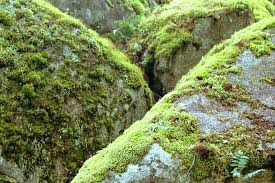
What are examples of pioneer species in a primary succession?
a)
Bushes and Shrubs
b)
Oak trees
c)
Mossess and Lichens 
d)
A rose Bush
36.
After a volcanic eruption, lava covers the land. What is the order that plants grow to repopulate the area?
a)
Lichens → Shrubs → Grasses → Trees
b)
Lichens → tree → shrubs→Grasses
c)
Grasses → Lichens → Shrubs → Trees
d)
Lichens → Grasses → Shrubs → Trees
37.
Reaches a climax community quicker because soil is already present
a)
primary succession 
b)
secondary succession
c)
both types of succession
38.

What type of species/community is a redwood forest?

a)

Climax Community

b)

Pioneer Species

c)

Intermediate Species

d)

Tertiary Community

39.

These animals are not choosy about what they eat or where they live

a)

Endangered

b)

Specialists

c)

Extinct

d)

Generalists

40.

These animals have specific diet and climate requirements

a)

Extinct

b)

Generalists

c)

Specialists

d)

Endangered

41.

Based on the description, the raccoon is a

a)

generalist

b)

specialist

42.

Long life span

a)

K-selected

b)

r-selected

43.

many years to reach reproductive maturity

a)

K-selected

b)

r-selected

44.

many reproductive events

a)

K-selected

b)

r-selected

45.

substantial parental care is given

a)

K-selected

b)

r-selected

46.

population growth rate is fast

a)

K-selected

b)

r-selected

47.

population growth rate is slow

a)

K-selected

b)

r-selected

48.

mosquitos

a)

K-selected

b)

r-selected

49.

bald eagles

a)

K-selected

b)

r-selected

50.
Name that population pyramid...
a)
Exponential
b)
Declining
c)
Rapid Growth
d)
Stable Growth
51.
Name that population pyramid...
a)
Industrialized Country
b)
Country with Clean Water
c)
Developing Country
d)
Logistic Growth
52.
Name that population pyramid...
a)
Rapid Growth
b)
Industrialized Country
c)
Declining Growth
d)
Stable Growth
53.
To measure population density, you must divide the number of individuals living in a defined space by the
a)
area of the space
b)
birth and death rates
c)
carrying capacity
d)
height of the space
54.
Nesting birds often space themselves evenly from other nests. This pattern is called
a)
clumped dispersion.
b)
uniform dispersion.
c)
random dispersion
d)
scatter dispersion
55.
Which of the following will increase the size of a population?
a)
emigration and births
b)
immigration and deaths
c)
immigration and births
d)
emigration and deaths
56.
Which of the following is a density-dependent limiting factor?
a)
human activities 
b)
unusual weather
c)
competition
d)
natural disaster
57.
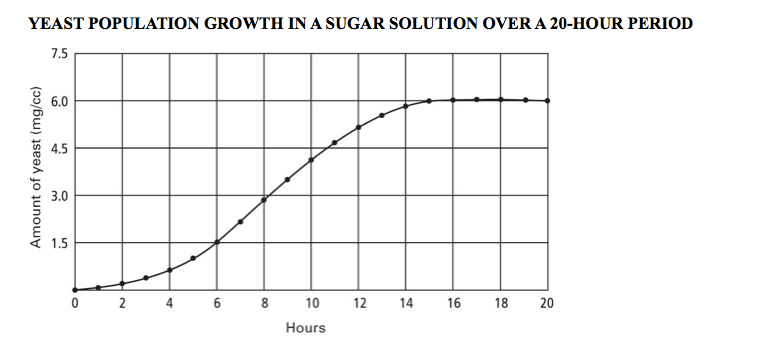
What type of growth is shown on this graph?
a)
logistic
b)
exponential
c)
average
d)
density-independent
58.
Which of the following is a density-independent limiting factor?
a)
natural disaster
b)
predation
c)
disease
d)
parasitism
59.

Which of the following leads to a decrease in birthrates among women?

a)

Higher Education

b)

High Infant Mortality Rate

c)

No Prenatal Care

d)

No contraceptives

60.

What type of growth is the human population experiencing today?

a)

Exponential growth

b)

Zero population growth

c)

Slight decreases in growth

d)

Slight increases in growth

61.

Which of the following statements about survivorship curves is correct?

a)

Germany has a mortality pattern that matches the Type II survivorship curve.

b)

People that have a Type I survivorship curve are likely to die early in life, but if they live past

the early life stage, they are likely to live for a long time.

c)

People that have a Type II survivorship curve are likely to survive infancy and live until a

certain advanced age.

d)

A survivorship curve indicates the likelihood of survival at different stages of life.

62.
What is the goal of the pioneer species in Primary Succession?
a)
To kill the dead materials after a disaster
b)
To rebuild soil
c)
To feed Johnny
d)
To put fresh oxygen into the air
63.

Which acronym represents the threats to biodiversity?

a)

HIPPO

b)

HIPPCO

c)

HIPPA

d)

HIPCA

64.

Nonnative sea lampreys invading the Great lakes and decreasing fish populations is an example of what part of HIPPCO?

a)

invasive species - the I in HIPPCO

b)

overharvesting - the O in HIPPCO

c)

pollution - one of the Ps in HIPPCO

d)

none of these

65.

Deforestation is an example of which part of HIPPCO?

a)

habitat loss - the H in HIPPCO

b)

pollution - one of the Ps in HIPPCO

c)

invasive species - the I in HIPPCO

d)

none of these

66.

This theory says that the rate biodiversity develops on islands is proportional to the distance of the island from the mainland and the size of the island

a)

theory of natural selection

b)

theory of island biogeography

c)

theory of habitat destruction

d)

theory of greenhouse effect

67.

How many years would it take a country to double its population with an AGR of 35%?

a)

1

b)

2

c)

35

d)

70

68.

Identify two main contributors for the dramatic increase in the world population over the last century.

a)

increased access to birth control

b)

development of modern medicine

c)

increased immigration

d)

introduction of the Industrial Revolution

69.

Estimated growth rate of organisms living under optimal conditions

a)

biotic potential

b)

boom & bust (cyclic)

c)

linear (constant) growth

d)

logistic growth

70.

If a country has a crude birth rate of 22 and a crude death rate of 7, what is the Annual Growth Rate? AGR = (cbr-cdr)/10

a)

0.7%

b)

1.5%

c)

2.2%

d)

7.0%

71.

Which factor below is least likely to affect birth and fertility rates today?

a)

number of people 60 or older

b)

cost of raising and educating children

c)

religious beliefs

d)

educational and employment opportunities for women

e)

average age at marriage

72.

A metropolitan region of 100,000 people has 2000 births, 500 deaths, 200 emigrants, and 100 immigrants over a 1-year period. Its population growth rate is

a)

1.2 percent.

b)

1.4 percent

c)

1.6 percent.

d)

1.8 percent.

e)

2.0 percent.

73.

Which of the following pairs of indicators best reflects the availability of health care in a country?

a)

Crude death rate and growth rate

b)

Crude death rate and crude birth rate

c)

Growth rate and life expectancy

d)

Infant mortality rate and life expectancy

e)

Infant mortality rate and crude death rate
74.
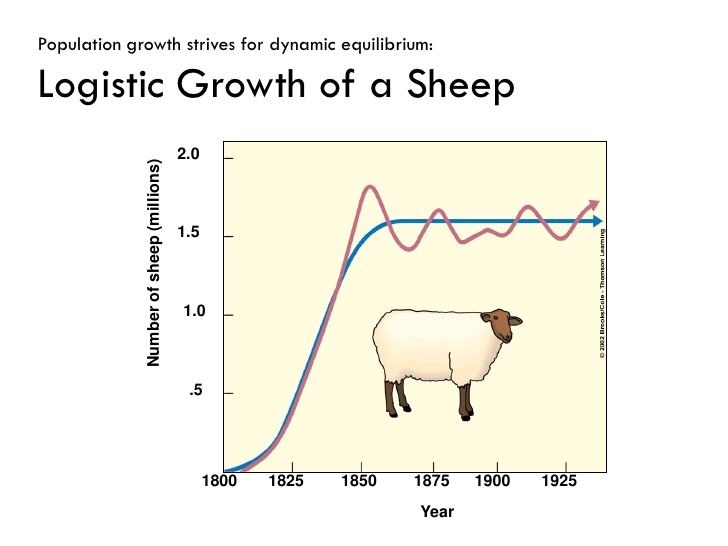
What is the carrying capacity for this sheep population?
a)
1.8 million
b)
1.25 million
c)
1.6 million
d)
1.o million
75.
When a population grows past the ecosystem's carrying capacity, what happens to the population?
a)
Continues to grow
b)
The population starts to die off to return to carrying capcity
c)
The population will go extinct due to lack of resources
d)
The population grows then finds a new carrying capacity
76.
Food, water, sunlight, shelter, and space are resources that are often __________.
a)
limiting factors
b)
wet
c)
messy
d)
found in rocks
77.
Which kind of dispersion is shown in #1?
a)
clumped
b)
random
c)
uniform
d)
segregated
78.
Which kind of dispersion is shown in #3?
a)
clumped
b)
random
c)
uniform
d)
segregated
79.
This is the side of the mountain that is often drier and warmer.
a)
Leeward Side
b)
Wet Lapse Rate
c)
Windward Side
d)
Wild Side
80.
What is "upwelling"?
a)
when wind near a shore pushes surface water away, nutrient rich cold water rises from the depths
b)
water rises from springs at the bottom of lakes
c)
it is when cold water sinks in the Norwegian Sea
d)
It is when the Coriolis effect makes currents go around in a circle
81.
One consequence of El Nino is _______ and increased rainfall in South America..
a)
flooding
b)
stronger Tradewinds
c)
strong winter storms
d)
drought
82.

In which atmospheric layer do all the pressure, wind and precipitation changes occur?

a)

Troposphere

b)

Mesosphere

c)

Thermosphere

d)

Stratosphere

83.

What layer of the atmosphere absorbs harmful ultraviolet radiation?

a)

Troposphere

b)

Stratosphere

c)

Mesosphere

d)

Thermosphere

84.

Which of the following has the least permeability?

a)

Sand

b)

Silt

c)

Clay

d)

Loam

85.

This air circulation pattern occurs between 0 degrees latitude and 30 degrees latitude.

a)

Hadley cell

b)

Ferrell cell

c)

polar cell

d)

Coriolis effect

86.
Which of the following is the correct order of soil particles in order of increasing particle size?
a)
clay-sand-silt
b)
sand-clay-silt
c)
silt-clay-sand
d)
clay-silt-sand
87.
Which soil component has the least capacity for holding water?
a)
silt
b)
clay
c)
sand
d)
humus
88.

The primary cause of Earth's seasons is the

a)

constant tilt of Earth's rotational axis with respect to the plane of its orbit around the Sun

b)

changing distance of Earth from the Sun at different times of the year

c)

periodic wobbling of Earth on its axis of rotation

d)

changing relative positions of Earth, its Moon, and the Sun

89.
The most common gas in the atmosphere (78%).
a)
Nitrogen
b)
Oxygen
c)
Carbon Dioxide
d)
Trace gases
90.
Soil sample that is 60% clay, 30% silt, and 10% sand has which texture? 
a)
clay
b)
clay loam
c)
sandy loam
d)
silt 
91.
Water gets into the cracks of rock and freezes, causing the rock to break.  What is this an example of?
a)
erosion
b)
weathering
92.
Soil is made of
a)
weathered rocks and minerals
b)
dead plants and animals
c)
air and water
d)
all of the above
93.
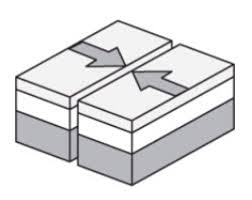
Name the boundary
a)
convergent boundary
b)
divergent boundary
c)
transform boundary
d)
sergent boundary
94.
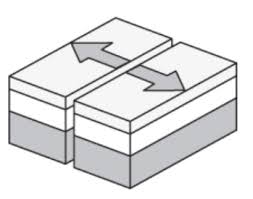
Name the boundary
a)
convergent boundary
b)
divergent boundary
c)
transform boundary
d)
sergent boundary
95.
Name the boundary
a)
convergent boundary
b)
divergent boundary
c)
transform boundary
d)
sergent boundary
96.

At which plate boundary is new crust formed?

a)

divergent

b)

convergent

c)

continental

d)

transform

97.

During a(n) ____ event, trade winds are much stronger than usual.

a)

El Nino

b)

La Nina

c)

Normal

d)

Partly sunny

98.

The picture represents a(n) ___ event.

a)

El Nino

b)

La Nina

c)

Non-El Nino (normal conditions)

99.

What is the shortest day of the year?

a)

Summer solstice

b)

Winter solstice

c)

Spring equinox

d)

Fall equinox

100.

The type of variable that responds to the experiment and is what you measure or count to determine if your hypothesis is true.

a)
Independent
b)
Dependent
c)
Control
101.
The parts of the experiment that must be kept the same.
a)
Constants
b)

Independent variable

c)

Dependent variable

d)

Conclusion

102.

Cindy wanted to find out how the amount of sunlight affects the growth of plants. She placed a tomato plant in 6 identical 10 inch pots with the same amount and type potting soil. She watered them ¼ cup each day. 3 plants were placed under a cardboard box and 3 plants were placed in the sunlight. She measured the growth of the plant each week for three weeks.

What is the dependent variable?

a)

Using the same type of plant

b)

Each plant was placed in a 10 inch pot

c)

The growth of the plant

d)

3 plants in the sunlight and 3 plants under a box

103.
If you were testing how well different dish soaps cleaned grease, the independent variable would be the:
a)
dish type
b)
amount of grease
c)
dish soap type
d)
grease type
104.

Which two factors allow earth to experience four distinct seasons?

a)

latitude & solar intensity

b)

tilt of axis & rotation of axis

c)

tilt of axis & rotation around sun

d)

distance from sun & place in orbit around sun
105.

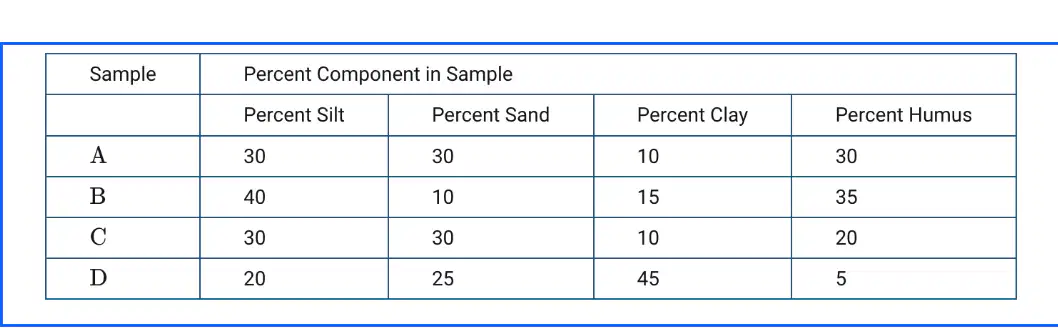
Which soil sample would water take the LONGEST to flow through?

a)

A

b)

B

c)

C

d)

D

106.

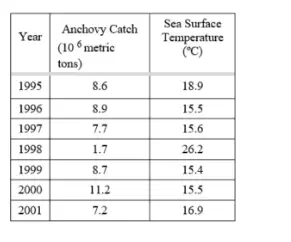
What most likely caused the LOW anchiovy catch shown in the data?

a)

Cold waters due to El Nino

b)

Warm waters due to El Nino

c)

Cold waters due to La Nina

d)

Warm waters due to La Nina