
 Worksheets
Test Review
Total questions: 76
Worksheet time: 2hrs 42mins


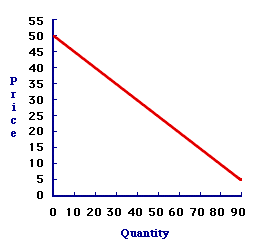
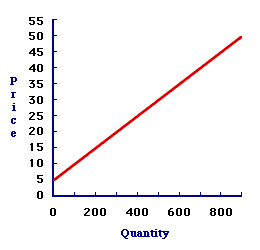
When producers offer more of a good as its price increases and less as its price falls, this defines the
law of demand
law of supply
change in demand
change in supply
Much of the tea in the U.K. is imported from India. If wages for Indian tea workers rose, thus increasing input costs, how would this effect supply of tea in the U.K.?
Supply would increase
Supply would Decrease
NO change in supply
who knows what would happen.
Which of the following is NOT one of the factors of supply?
Change in cost of inputs
Change in number of sellers
Substitutes
Change in technology
Identify the correct factor of supply:
Example: If the cost of electricity used to power an automotive factories falls, the supply of cars in the market increases
Cost of inputs
Number of sellers
Change in expectations
Change in technology
Identify the correct factor of supply.
Example: If the government requires factories to reduce pollution, complying will initially increase costs of production in the market and reduce supply.
Government regulation
Cost of input
number of sellers
Change in technology
Identify the correct factor of supply. Example: As the demand for DVDs decreased due to consumer preference for streaming movies, the market price for DVDs fell. This lower market price caused sellers to leave the DVD market and supply decreased.
Government regulation
Change in number of sellers
Natural disaster
Change in expectations
Identify the correct factor of supply. Example: If airlines expect prices for airline tickets to fall in September when families are less likely to travel due the school calendar, they will supply more during the summer months when they can charge higher fares.
Change in cost of inputs
Change in number of sellers
Expectations
Change in technology
Identify the correct factor of supply. Examples: When auto manufacturer were able to implement robotics on the production line, automobiles were produced more quickly and at a smaller cost per unit. This allowed the industry to supply more cars.
Government regulations
Expectations
Number of sellers
Change in technology
Labor costs are rising through the roof! Minimum wages are now at $25 an hour. This means even the basic item will need to cost more to keep up with rising costs. What factor of supply does this most relate to?
Change in technology
Change in number of sellers
Change in cost of input
Consumer taste/ preference
A brand new machine cooks, cleans, and never messes up a fast food order. This means we can sell more fast food than ever before, leading to producers cutting cost of fast food. Which supply factor does this most likely relate to?
Change in Technology
Substitute Goods
Change in Expectations
Taxes and Subsidies
The amount of a product available at all possible prices is called
Quantity supplied
Supply
The price of milk has recently increased. As a result, what will happen to the supply of icecream at Marble Slab Creamery?
Increase
Decrease
The Law of Supply states that when the price of a good INCREASES, quantity supplied (Qs)
Increases
Decreases
Which of the following is NOT one of the factors of supply?
Change in number of sellers
Change in income
Producer expectations
Worker productivity/ motivation
The amount of a product available at a SPECIFIC price is called
Quantity supplied
Supply
The Law of Supply states that when the price of a good DECREASES, quantity supplied (Qs)
Increases
Decreases
Construction workers in Georgia just received new and advanced drills and hammers. As a result, what will happen to the supply of homes in Georgia?
Increase
Decrease
Which of the following is NOT a factor of supply?
Change in cost of production
Technology
Change in number of consumers
Government regulations
The United Nations recently called for governments to stop the $5 trillion dollars they give to oil companies every year. This would likely cause a drop in the supply of oil products like gasoline. Which factor of supply does this illustrate?
Worker productivity/ motivation
Government regulations
Change in technology
Complements

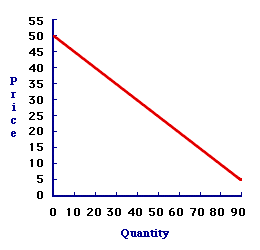
Demand means
the amount of a good or service that consumers are willing to buy.
is the amount of a good or service produced.
is the price that is demanded by consumers.
None of the above.
What does the law of demand say
consumers will buy less of something when price goes down.
consumers will buy more of something when price increases.
consumers will buy more of something when prices go down.
None of the above.
If the price of a good or service decreases what will happen to the demand for it?
increase
decrease
stay the same
who knows
If the price of a good or service increases what will happen to the demand for it?
increase
decrease
stay the same
who knows

If the price of printers goes down, what happens in the market for ink cartridges?
Supply increases.
Supply decreases.
Demand increases.
Demand decreases
What goes on the horizontal axis (x axis) of a demand graph?
price
quantity demanded
quantity supplied
change in demand

If Mary used to buy 10 units at $4 each and now buys 15 units when the price is $3, her
quantity demanded has increased
quantity demanded has decreased
supply has increased
supply has decreased
If there is a shortage, what will price do?
Price will increase.
Price will shift to the right.
Price will stabilize.
Price will exponentially decrease.
How is a shortage created?
When demand increases.
When demand decreases.
When demand stagnates.
When supply increases.
If there is a surplus, what will price do?
Price will decrease.
Price will stabilize.
Price will fluctuate.
Price will increase.
When orange juice producers put OJ on sale because they have too much OJ in warehouses, this excess is called:
Equilibrium.
Leftovers.
Surplus.
Shortage
States that people buy a different quantity of a product if that product’s price changes, appearing as a movement along the demand curve.
Change in demand
Change in supply
Change in quantity demanded
Change in quantity supplied
You express demand for a product when you
Are willing to purchase it
Are able to purchase it
Both are correct
Neither are correct
The effect that increasing or decreasing prices has on the buying power of a person is better known as....
Income Effect
Substitution Effect
Diminishing Marginal Returns
Inflation
Goods for which demand goes down as income goes up are better known as....
Inferior Goods
Normal Goods
Public Goods
Private Goods
This is a product that can be used in place of another product:
Product Good
Complementary Good
Related Good
Substitution
Factors of demand include income, expectations, taste, and...
Consumer Preference
Taxes
Marginal Equity
Unit Elasticity
All of the following are examples of complements EXCEPT
butter and margarine
cameras and film
peanut butter and jelly
flashlights and batteries

When a price ceiling is imposed in a market:
A surplus results
Sellers of the product are made better off
A shortage results
Quantity supplied is greater than the quantity demanded
At the price, neither a surplus or a shortage exists
equilibrium
consumer surplus
producer's surplus
dead weight
A _______________ is a maximum price sellers are allowed to charge for a good. It's an upper limit for the price.
equilibrium
shortage
surplus
price ceiling
This is the minimum price buyers are required to pay for a good. It's a lower limit for the price.
equilibrium
shortage
price floor
price ceiling
A price ceiling will result in a
shortage
surplus
equilibrium price
equilibrium quantity
A price floor will result in a
shortage
surplus
equilibrium price
equilibrium quantity

