
 Worksheets
msm physics
Total questions: 200
Worksheet time: 3hrs 20mins
The magnetic field inside a long straight solenoid carry
ing current is
Zero
decreases as we move towards its end
increases as we move towards its end
the same at all points
Which of the following property of Proton can change while it moves freely in a magnetic field?
mass
speed
velocity & momentum
momentum
A negatively charged particle projected towards west is deflected towards North by a magnetic field. The direction of magnetic field is:
Towards south
Towards East
Downward
upward
Fleming left hand rule gives the direction of:
Magnetic field
Current
Induced Current
Motion (Force)
Which of the following is the source of direct current:
Car battery
Car alternator
Power house generator
Bicycle dinemo
A rectangular coil copper wires is rotated in a magnetic field. The direction of the induced current changes once in each:
Two revolution
One revolution
Half revolution
One-forth revolution
The magnetic field lines near a long straight wire carrying current are:
Straight lines
Concentric rings
Spiral lines
Radial lines
The device used for producing current is called a:
Galvanometer
Ammeter
Motor
Generator
Which of the following is not the source of magnetic field:
Moving charge
Electric current
Magnet
A small piece of iron
Name the device which converts mechanical energy into electric energy
Motor
Generator
Heater
Transformer
The direction of magnetic field lines inside the magnet are:
From North to south
From south to north
From North to North
From South to South
Magnetic field is maximum:
At Two Poles
At one pole
At The center of the magnet
Outside the magnet
What is the pattern of magnetic field lines at the center of a current carrying solenoid:
Concentric rings
Straight lines
Curved lines
Radial lines
What is the role of split rings in a electric moter
Convert A.C. into D.C.
Convert D.C. INTO A.C.
Reverse the direction of Current
Increases the current
Force experienced by a current carrying conductor placed in a magnetic field is
Perpendicular to its length
Perpendicular to its magnetic field
Perpendicular to its length & magnetic field
Perpendicular to its width
According to right hand thumb rule the direction of magnetic field in a current carrying straight conductor is denoted by:
Thumb
Curl fingers
Middle finger
First finger
According to right hand thumb rule the direction of magnetic field in a current carrying circular coil is denoted by
Thumb
Middle finger
Curl finger
First finger
Who discovered Magnetic Effect of Current:
Faraday
Fleming
Newton
Oersted
In a glass slab the emergent ray is______ to incident ray
Parallel
Opposite
Intersect
None
In a triangular prism how many lateral surfaces are there ?
3
2
1
0
Angle formed between two lateral faces is called
Angle of deviation
Angle of joining
Angle of prism
Angle of triangle
The emergent ray coming out of the prism would be
Equal to the incident ray
Would bend towards base of the prism
Bends towards the direction of the incident ray
All
The band of 7 prominent colours is called
Dispersion
VIBGYOR
Spectrum
Scattering
Which colour have more wavelength?
Violet
Indigo
Orange
Red
The relation between speed and wavelength
V = 1/ lamta
V = lamta
V directly proportional to lamta
V inversely proportional to lamta
Which colour bends the least
Violet
Red
Blue
Yellow
Which colour travels faster
Violet
Red
Blue
None
Which colour bends the least
Violet
Red
Blue
Yellow
In which colour refraction would be more
Violet
Indigo
Yellow
Orange
Red
In which colour the speed would be less
Violet
Indigo
Red
Blue
Any light that gives a spectrum similar to that of sunlight is called
White coloured light
White painted light
White light
Spectrum
A rainbow is caused due to
Spectrum
Scattering
Refraction
Dispersion
A rainbow is formed direction
Opposite
Same
Parallel
None

Choose the phenomenon happening in the water droplets
Dispersion reflection scattering
Refraction dispersion scattering
Dispersion reflection refraction
All
To see a rainbow, the sun should be
Opposite to you
Infront of you
Behind you
Between you and waterdroplets
You might have observed the apparent random wavering or flickering of objects seen through a turbulent stream of hot air rising above a fire or a radiator. The air just above the fire becomes hotter than the air further up . The hotter air is lighter than the cooler air above it . So Which one is rarer medium
Cooler air
Hotter air
Both
None
Stars are
Extended
Point size
Enlarged
Luminous ( light giving )
The total variation in the amount of a large number of light entering our eyes From all the individual point sized sources will average out to
0
1
3
2
The red light has wavelength about_____ than blue
1.8 higher
1.7 less
1.8 less
1.7 more
____ is one of the best reflectors of light.
Gold
Silver
Brass
Aluminium
Reflection of light have___laws.
1
2
3
4
When light is available which image is formed.
Real
Virtual
Erect
If an object is placed at a distance of 10 cm in front of a plane mirror how far would it be from its image.
10cm
20cm
30cm
40cm
Which mirror has a wider field of view?
Convex
Concave
Plane
Which equation related to ohm's law?
V=IR
R=V/I
I=V/R
All of the above
When an obj is placed at focus then which type of image is formed?
Real
Virtual
Inverted
Both (1)and (3)
A ray of light is incident on a plane mirror at an angle of 30°.what is the angle of refrection?
10°
20°
30°
40°
Which type of image formed by plane mirror?
Same size
Erect
Virtual
All of the above
Real image is always
Erect
Real
Inverted
Virtual
A mirror having focal length –15 cm is _________________
Plane mirror
Concave mirror
Convex mirror
None of these
Assertion: For observing the traffic at the hairpin bend in the mountains a plane mirror is preferred over convex or concave mirror.
Reason: A convex mirror has a much larger field view than a plane mirror or a concave mirror.
Both Assertion and Reason are true and Reason is the correct explanation of Assertion.
Both Assertion and Reason are true but Reason is not the correct explanation of Assertion.
Assertion is true but Reason is false.
Assertion is false but Reason is true.
Which of the following characteristics are correct for the image formed in a plane mirror?
I. Upright
II. Inverted
III. Real
IV. Same size as the object
V. Virtual
I, II, III
I, III, IV
I, IV, V
III, IV, V
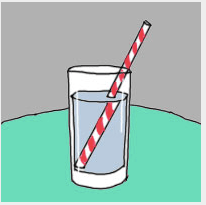
Why does the straw appear to be bent?
light is reflected
light is absorbed
light is turned
light is refracted

A positive sign in the value of magnification indicates that the image is
real
virtual
enlarged
near
A ray of light is travelling from a rarer medium to a denser medium. While entering the denser medium at the point of incidence, it
goes straight into the second medium
bends towards the normal
bends away from the normal
does not enter at all
Reflection is when light...
Bends
Bounces
Absorbs
transmits
flint glass n=1.70
barium glass n=1.60
crown glass n=1.523
water n=1.33
diamond n=2.45
Which figure represents the path light takes through a converging lens?
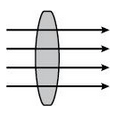
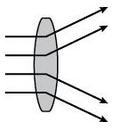
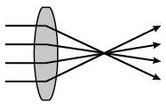
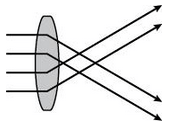


If a glass plate is placed over a magnet and iron filings are sprinkled over the glass, a pattern will be visible. What does this pattern indicate?
The magnetic field
The electrostatic field
The piezoelectric effect
The chemical reaction of the magnet and the filings
What causes magnetism?
the sun
moving neutrons
moving charges
friction

How can a wire become magnetic?
point it north
add a resistor
heat it up
run a current through it
How can a wire become magnetic?
point it north
add a resistor
heat it up
run a current through it

Q1) The most suitable material for making the core of an electromagnet is :
a) Steel
b) Iron
c) Soft iron
d) Aluminium
Q2) Which of the following is not attracted by a magnet?
(a) steel
(b) cobalt
(c) brass
(d) nickel
Q3) When a straight conductor is carrying current:
a) There are circular magnetic field lines around it
b) There are magnetic field lines parallel to the conductor
c) There are no magnetic field lines
d) None of the above
Q4) A plotting compass is placed near the south pole of a bar magnet. The pointer of plotting compass will:
(a) point away from the south pole
(b) point parallel to the south pole
(c) point towards the south pole
(d) point at right angles to the south pole
Q5) Two magnetic field lines:
a) Intersect at neutral point
b) Never intersect each other
c) Intersect near north-pole or south pole
d) Intersect at the mid point of the magnet

Q6) A student learns that magnetic field strength around a bar magnet is different at every point. Which diagram shows the correct magnetic field lines around a bar magnet?
a)
b)
c)
d)
Q7) The front face of a circular loop of a wire is North-pole, the direction of current in this face of the loop will be:
a) Clockwise
b) Anticlockwise
c) Towards North
d) Towards South
Q8) Which of the following statements is incorrect regarding magnetic field lines?
(a) The direction of the magnetic field at a point is taken to be the direction in which the north pole of a magnetic compass needle points.
(b) Magnetic field lines are closed curves.
(d) Relative strength of magnetic field is shown by the degree of closeness of the field lines.
(c) If magnetic field lines are parallel and equidistant, they represent zero field strength.
Q9) The magnetic field inside a long straight solenoid carrying current:
a) Is zero
b) Decrease as we move towards its end
c) Is same at all points
d) Increase as we move towards its end
Q10) A strong bar magnet is placed vertically above a horizontal wooden board. The magnetic lines of force will be:
(a) only in horizontal plane around the magnet
(b) only in vertical plane around the magnet
(c) in horizontal as well as in vertical planes around the magnet
d) in all the planes around the magnet

Q11) A student places some iron filings around a magnet. The iron fillings arrange themselves as shown in the image.
The student labelled four different regions around the magnet. Where would the magnetic field be the strongest?
P
Q
R
S
Q12) The strength of magnetic field inside a long current-carrying straight solenoid is :
a) More at the ends then at the center
b) Minimum in the middle
c) Same at all points
d) Found to increase from one end to the another
Q13) Which option explains Fleming’s left-hand rule to understand the working of a motor?
(a) When a current carrying conductor is moved with a force, it creates the magnetic field.
b) When a conductor is moved inside a magnetic field, current is produced in the conductor.
(c) When the magnetic field is moved relative to the conductor, current is produced in the conductor.
d) When a current carrying conductor is placed in a magnetic field, it experiences a force by magnetic field.
Q14) The force on a current-carrying conductor when placed perpendicular in a uniform magnetic field.
a) F=BIL
b) F=B/IL
c) F=L/BI
d) F=I/BL
Q15) A student inserts a bar magnet in the coil. The student observes deflection in the galvanometer connected to the coil. What will happen if the magnet is continuously getting in and out of the coil?
a) the current induced in the coil will increase
(b) the current will change its direction continuously
(c) the magnetic field will create a motion in the coil
d) the magnetic field of the bar magnet would keep decreasing

Q16) A metal rod PQ is placed in the magnetic field. The ends of the rod are connected with a battery using wires.
Where will the rod move?
(a) upward
(b) downwards
(c) into the field
(d) out of the field
Q17) A soft iron bar is introduced inside a current carrying solenoid. The magnetic field inside a solenoid:
a) decrease
b) Will increase
c) Will become Will zero
d) Will remain unaffected
Q18) Assertion (A): As the speed of the coil in the motor increases, there is reduction in the current flowing through it.
Reason (R): During rotation in an electric motor, some induced current is produced.
(a) (A) is incorrect and (R) is correct.
(b) (A) is correct and (R) is incorrect.
(c) Both (A) and (R) are correct but (R) is not the correct explanation of (A).
(d) Both (A) and (R) are correct but (R) is the correct explanation of (A).

Q21) A student makes an arrangement to study electromagnetic induction, as shown.
She changes the arrangement in four different ways.
Trial
1.Moves the coil to the left away from the magnet.
2.Moves the magnet to the right away from the coil.
3.Moves both coil and magnet towards each other.
4.Moves both coil and magnet in the same direction at the same speed.
In which trial would the galvanometer remain undeflected?
1
2
3
4
Q22) Appliances that have a metal body are generally connected to the earthing wire. What is the reason to earth these wires?
(a) to prevent excess of current
(b) to prevent the leakage of current
(c) to provide extra current to appliance
d) to provide high resistance to the appliance
WHAT IS THE MELTING POINT OF TUNGSTEN IN DEGREE CELSIUS?
ABOUT 3460
ABOUT 5437
ABOUT 3380
ABOUT 2225
WHICH DEVICE IS USED FOR MEASURING SMALL CURRENT ?
VOLTMETER
DOUBLE AMMETER {SPECIFIC}
GALVANOMETER
AMMETER
WHICH OF THIS IS GOOD CONDUCTOR OF ELECTRICITY?
AMMETER
VOLTMETER
BOTH A AND B
NON OF THESE
WHICH GAS PREVENTS TUNGSTEN PRESENT IN THE BULB TO BE OXIDISED?
HYDROGEN GAS
NITROGEN
ARGON
ALL OF THE ABOVE
WHICH OF THESE IS GOOD CONDUCTOR OF HEAT AND POOR CONDUCTOR OF ELECTRICITY?
LEAD
MICA
NICHROME
BORAX
1 horsepower is equal to
700 WATT
100 WATT
746 WATT
627 WATT
THE COMMERCIAL UNIT OF ELECTRIC ENERGY IS
(a)
The equivalent resistance of the series combination of two equal resistances is S. When they are joined in parallel, the total resistance is “P”. If S = nP, what is the value of “n”?
2
1
4
3
6
The resultant value of resistances each of value r ohms when connected in parallel is x, when these resistances are connected in series the resultant resistance is : (HOTS)
(x/n)2
N^2X
nx
(x/n)
According to ohms law,
The resistance increases with the increases in current.
The resistance increases with the increases in voltage.
The resistance and current both increases wiTh the increases in voltage.
The current increases with the increases in voltage.
Which instrument is used to measure potential difference
Ammeter
Voltmeter
Rheostat
All of these

This is symbol of
Resistor
Cell
Variable resistance
Ammeter
Work done in moving a charge of 2C across 2 points having a potential difference of 12V is
6J
24J
12J
48J
Which is the correct mathematical form of Ohm"s law
I = V R
R = I V
V = I / R
V = I R
Resistance of conductor depends on its
Length
Area of cross section
Nature of material
All of these
SI unit if resistivity
Ohm
Ampere
Ohm metre
Volt
If 3 resistors of capacity 1 ohm ,,2ohm and 3ohm are connected in parallel then equivalent resistance in the circuit is
More than 3 ohm
Less than 1 ohm
More than 2 ohm
6 ohm

This is
Ohms law
Faraday's law
Flemmings law
Joules law of heating
Electric bulb filament is made of tungsten because it has
High MP and high resistance
High MP and low resistance
Low MP and high resistance
Low MP and low resistance
The rate of flow of electric charge is
Electric resistance
Electric current
Potential differnce
Power
Flow of one Coulumb of charge per second is
1 W
1A
1 V
1 Ohm
The property of a conductor to resist the flow of charges through it is
Power
Potential difference
Electric current
Resistance
Which device can be used to change the resistance in the electric circuit
Fuse
Rheostat
Switch
Battery

Electic current throug the circuit is
1 A
36A
6A
0.5 A
Total resistance in the circuit if 2 resistors of 2 ohm each are connected in parallel
2 ohm
1 ohm
4 ohm
1/4 ohm
It's a safety device which protects electrical appliances by stopping flow of any unduly high current and which works on joules law of heating
Electric wire
Rheaostat
Fuse
None of this
Kilowatt hour is commonly known as
Watt
Power
Unit
Voltage
Keeping potential difference constant if resistance is doubled then electric current is
Doubled
Halved
Reduced to zero
Tripled
SI unit of electric charge is
Watt
Coulomb
Ampere
Ohm
Which statement about fuse is wrong
It's a safety device
It works on joules law if heating
It has high Melting point
Its connected in seris with the device
The potential at a point is 20V. The work- done in bringing a charge of 0.5 C from infinity to this point will be
20 J
10 J
5 J
40J
A charge is taken from point A to B . The work done per unit charge in this process is called
the potential at A
the potential at B
the potential difference between B and A
the current from A to B
Joule/coulomb is same as
watt
volt
ampere
ohm
Voltmetre is used to measure
potential difference
electric current
electric power
resistance
In metals
all the electrons are bound to their parent atom
all electrons are free to move
there are no electrons
some electrons are free to move
The current in wire depends
only on the potential difference applied
only on the resistance of the wire
on both of them
none of them
Consider the following incomplete statement " Ohms law relates potential diffrence with ........... for a given resistance" The suitable choice for missing word is
Power
Energy
Current
Time
Resistance of a cylindrical piece of rubber is (a) then that a similar piece of copper
The Kilowatt hour is the unit of (a)
The equivalent resistance of two equal resistance in parallel is (a) the values of each resistance
How much charge flows through a wire in 10 minutes if the current through it is 2.5 A ?
1000 C
1200 C
1500 C
1800 C
Electrical resistivity of a given metallic wire depends upon
its length
its thickness
its shape
nature of the material
A current of 1 A is drawn by a filament of an electric bulb. Number of electrons passing through a cross section of the filament in 16 seconds would be roughly
1020
1016
1018
1023
What is the minimum resistance which can be made using five resistors each of 1/5 ohm?
1/5 ohm
1/25 ohm
1/10 ohm
25 ohm
What is the minimum resistance which can be made using five resistors each of 1/5 ohm?
1/5 ohm
10 ohm
5 ohm
1 ohm
Unit of electric power may also be expressed as
volt ampere
kilowatt hour
watt second
joule second
Two resistors of resistance 2 ohm and 4 ohm when connected to a battery will have
same current flowing through them when connected in parallel
same current flowing through them when connected in series
same potential difference across them when connected in series
different potential difference across them when connected in parallel
10. A cylindrical conductor of length l and uniform area of crosssection A has resistance R. Another conductor of length 2l and resistance R of the same material has area of cross sec
A/2
3A/2
2A
3A
According to ohm's law,
The resistance increases with the increases in current.
The resistance increases with the increases in voltage.
The resistance and current both increases wiTh the increases in voltage.
The current increases with the increases in voltage.
According to ohm's law,
The resistance increases with the increases in current.
The resistance increases with the increases in voltage.
The resistance and current both increases wiTh the increases in voltage.
The current increases with the increases in voltage.
Current carriers in Electrolyte are/is
Free electrons
Holes
Electrons and holes both
Positive and negative ions
An electrical component that we use in electronics circuits to limit current though an active component or to reduce voltage in the circuit.
Capacitor
Current
Resistor
Ancestor
What is the unit of measurement for resistance?
Voltage
Ampere
Watts
Ohms
This is symbol of
Resistor
Cell
Variable resistance
Ammeter
Which instrument is used to measure potential difference
Ammeter
Voltmeter
Rheostat
All of these
Work done in moving a charge of 2C across 2 points having a potential difference of 12V is
6J
24J
12J
48J
Which is the correct mathematical form of Ohm"s law
I = V R
R = I V
V = I / R
V = I R
Resistance of conductor depends on its
Length
Area of cross section
Nature of material
All of these
SI unit if resistivity
Ohm
Ampere
Ohm metre
Volt
Flow of one Coulumb of charge per second is
1 W
1A
1 V
1 Ohm
Keeping potential difference constant if resistance is doubled then electric current is
Doubled
Halved
Reduced to zero
Tripled
Electrical potential is ------------
scalar quantity
vector quantity
both scalar and vector
neither scalar nor vector
kilowatt hour is unit of
energy
power
momentum
force
SI unit of resistivity (specific resistance) is ----------
ohm
ohm meter
volt
ampere
How is a voltmeter connected in the circuit to measure the potential difference between two points?
series
parallel
according to the situation either series or parallel
none
SI unit of electric current is -----------
volt
coulomb
ampere
ohm
SI unit of resistance is ------------
ohm
volt
ampere
coulomb
An electric bulb is rated 220 V and 100 W. When it is operated on 110 V, power consumed will be ---------------. [Use P = (V X V)/R]
100 W
75 W
50 W
25 W
The property of a conductor by which it obstructs the flow of current is known as ------------------ of the conductor
voltage
conductivity
power
resistance
What is the direction of conventional current?
positive terminal to negative terminal
negative terminal to positive terminal
depends on the condition
none
Ammeter is used to measure ----------------.
voltage
electric current
resistance
resistivity
Ohm's law is applicable only when ----------------
temperature remains constant
temperature increases
temperature decreases
none
Keeping the potential difference constant, the resistance of the circuit is halved, the current will become --------------
four times
half
double
one-third
Electrical resistivity of a given metallic wire depends upon ----------
its length
its thickness
its shape
nature of the material
What is the SI unit of electric charge?
ampere
volt
ohm
coulomb
What is the maximum resistance which can be made using five resistor each of 1/5 ohm?
1/5 ohm
10 ohm
5 ohm
1 ohm
What is the minimum resistance which can be made using five resistors each of 1/5 ohm?
1/5 ohm
1/25 ohm
1/10 ohm
1/25 ohm
When a 4 ohm resistor is connected across the terminals of a 2 V battery, the number of coulombs passing through the resistor per second is --------------
0.5
1
2
4
If the current flowing through a fixed resistor is halved, the heat produced in it will become -----------------
one-fourth
one-half
double
four times
The solution which conducts electricity is known as --------
conductor
electrolyte
insulator
none
The work done to bring unit positive charge from infinity to a point in an electric field is known as ----------
potential
resistance
current
charge
An electric iron of resistance 20 ohm takes a current of 5 A. Calculate the heat developed in 30 s. [Use H = I X I X R X t]
1000 joules
2000 joules
15000 joules
30000 joules
An electric iron has a rating of 750 W, 220 V. Calculate current passing through it. [Use P = IV]
5 A
6 A
3.4 A
7 A
Calculate the amount of charge that would flow in 1 hour through the element of an electric bulb drawing a current of 0.2 A. [Use I = Q/t]
300 C
320 C
700 C
720 C
Calculate resistance of an electric bulb which allows a 10 A current when connected to 220 V power source. [Use V = IR]
10 ohm
12 ohm
22 ohm
32 ohm
When a 12 V battery is connected across an unknown resistor, there is a current 2.5 mA in the circuit. Find the value of resistance of the resistor. [Use V = IR]
1000 ohm
2000 ohm
4800 ohm
6700 ohm
In a filament lamp, in what form is most of the energy lost?
Heat
Sound
Kinetic energy
Radio waves
What is power?
The number of repetitions of squats a body-builder can perform
The number of cylinders in a car
The rate at which energy is absorbed
The rate at which energy is transferred
What is the formula for power?
P = E⁄t
P = t⁄E
P = E⁄2t
P = 2E⁄t
Calculate the power of an appliance that uses 1000 joules of energy in 5 seconds.
100 W
200 W
300 W
400 W
Power, potential difference and current are correctly related by which equation?
P = I x V
P = 2I x V
P = I⁄V
P = I⁄2V
What is the voltage of an appliance if it uses 200 J per second when supplied with a current of 5 A?
10 V
20 V
30 V
40 V

This is the symbol for a...
Motor
Ammeter
Bulb
Voltmeter

This is the symbol for a...
Bulb
Voltmeter
Ammeter
Motor
When a beam of white light falls on a glass prism, the colour of light which will deviate least is:
Violet
Red
Green
Blue

Which of the following figures correctly represents the passage of white light through prism?
a
b and c
c
d
The star appear shifted from their actual position due to the phenomenon of:
Diffraction of light
Scattering of light
Refraction of light
Reflection of light

Which of the following graph represents the correct variation of angle of incidence (i) and angle of deviation (δ)?
a
b
c
d

