wayground logo

Free Printable Worksheets

Font size

S
M
L
XL
Worksheets

Biology Semester 1 Final Exam

Total questions: 80

Worksheet time: 58mins
Name
Class
Date
1.
Where in the cell are proteins made? 
a)
Ribosome
b)
Cell Membrane
c)
Chloroplast
d)
Nucleus
2.
Why is the nucleus important? 
a)
It give the cell its energy
b)
It stores genetic information
c)
It uses sunlight for food
d)
It makes the proteins
3.
What does the chloroplast do in cells? 
a)
Allows things in and out of cell
b)
Controls the whole cell
c)
Uses sunlight for photosynthesis
d)
Makes energy for the cell
4.
What does the cell wall do for the cell?
a)
Allows things in and out
b)
Provides protection and structure
c)
Controls the cell
d)
Makes protein 
5.
If a cell had the following organelles: nucleus, mitochondria, ribosome, and cell membrane. And DID NOT have a chloroplast and cell wall, what kind of organism is the cell found in? 
a)
Animals only
b)
Plants only
c)
Both plants and animals
d)
Bacteria
6.
Where can you find the chloroplast? 
a)
Only Plants
b)
Only Animals
c)
Plants & Animals
d)
Animals & Bacteria
7.
This organelle takes food and turns it into ENERGY for plant and animal cells.
a)
Chloroplast
b)
Mitochondria
c)
Lysosome
d)
Ribosome
8.

A rigid layer, made of cellulose, that lies outside the cell's  membrane is...

a)

Cytoskeleton

b)

Cilia

c)

Cell Wall

d)

Flagella

9.

Consists of a jellylike substance in which the organelles are contained

a)

ribosomes

b)

cytoplasm

c)

chloroplasts

d)

cell wall

10.
The ____________ packages and processes material before it exports out of the cell.
a)
Vacuoles
b)
mitochondria
c)
Golgi apparatus 
d)
nucleus 
11.
Which of the following is an enzyme filled organelle that breaks down waste in the cell?
a)
lysosomes
b)
chloroplast
c)
mitochondria 
d)
Golgi apparatus 
12.
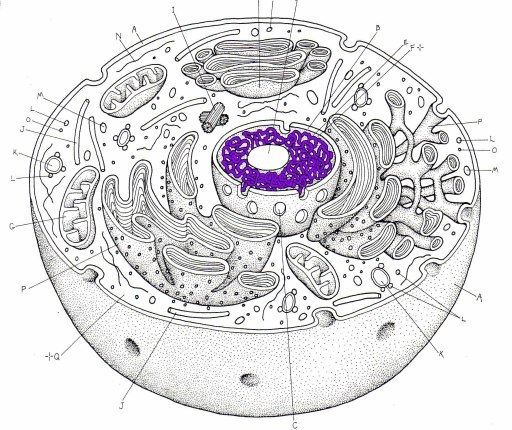
What is the name and function of the organelle displayed above?
a)
Mitochondria: breakdown glucose and produce ATP
b)
Chloroplast: converts solar energy into chemical energy
c)
Vacuole: Stores H2O, salt, food
d)
Nucleus: stores genetic information
13.
which of the following transports material within the cell?
a)
Golgi apparatus 
b)
Endoplasmic reticulum
c)
cell wall 
d)
ribosomes
14.
Rough endoplasmic reticulum has ________________ attached to it. 
a)
ribosomes 
b)
chromosomes 
c)
Golgi apparatus 
d)
nucleolus 
15.
What 2 features do eukaryotes have that prokaryotes do not?
a)
membrane-bound organelles and DNA
b)
DNA and Nucleus
c)
Cell Wall and Ribosomes
d)
Membrane-bound organelles and Nucleus
16.
All eukaryotes and prokaryotes are surrounded by a _____.
a)
cell wall
b)
cell membrane
c)
cell envelope
d)
loving, supportive family
17.
Where is the DNA found in a eukaryotic cell? 
a)
floating around in the cytoplasm 
b)
in the nucleus 
18.
What number is pointing to the flagella?
a)
1
b)
5
c)
6
d)
7
19.
What kind of cell is this?
a)
Eukaryotic
b)
Prokaryotic
20.

This cellular structure helps organisms maintain homeostasis by controlling what substances may enter or leave cells.

a)

vacuole

b)

nucleus

c)

cell membrane

d)

cell wall

21.
What is the purpose  of an enzyme?
a)
give permission for the reaction
b)
raise activation energy
c)
speed up reactions
d)
control how many reactions occur
22.
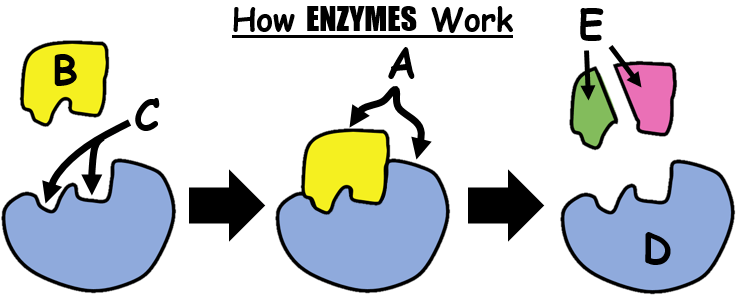
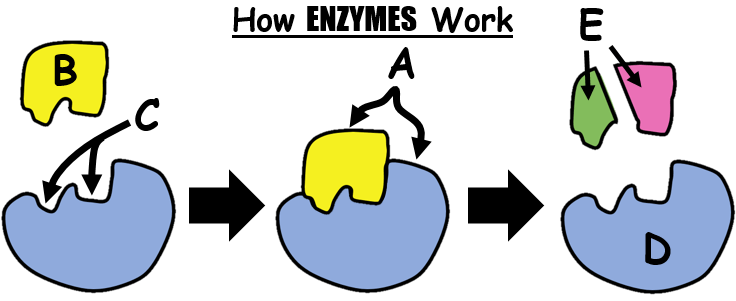
Letter D...
a)

active site

b)

enzyme

c)

substrate

d)

products

23.
Letter E...
a)
active site
b)
enzyme
c)
substrate
d)
products
24.
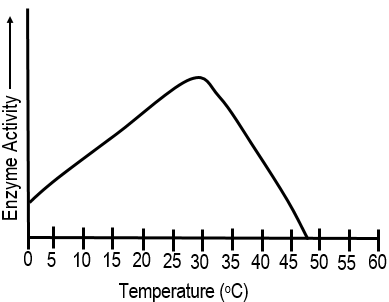
Based on the graph, what is the optimal temperature for this enzyme? 
a)
15oC
b)
40oC
c)
30oC
d)
35oC
25.
What are the 3 particles that make-up the atom?
a)
protons, neutrons, and isotopes
b)
neutrons, isotopes, and electrons
c)
positives, negatives, and electrons
d)
protons, neutrons, and electrons
26.
A solution with a pH of 3.6 would be...
a)
Acid
b)
Base
c)
Neutral
d)
Acid and Base
27.
What type of respiration does not require oxygen?
a)
Aerobic
b)
Anaerobic
28.
A weightlifter is using heavy weights in short bursts for a competition. Because his muscle cells are not able to take in enough oxygen to make very much ATP the weightlifter begins to get fatigue in his muscles. Which of the following processes is most likely going on in the muscles of the weightlifter as he competes in his event
a)
As the cells run out of oxygen they switch to anaerobic respiration, which allows the cell to make small amounts of ATP in the absence of oxygen. 
b)
As the cells run out of oxygen, they die off gradually and the weightlifter's muscles have fewer contracting muscle cells.
c)
The cells will never run out of oxygen if the weightlifter is breathing.
d)
As the cells run out of oxygen, they will continue to make the same amount of ATP, since oxygen is not required to make ATP. 
29.
What process is the opposite of aerobic respiration?
a)
anaerobic respiration
b)
cellular respiration
c)
photosynthesis
d)
lactic acid fermentation
30.
What are the products of photosynthesis?
a)
water and carbon dioxide
b)
oxygen and glucose
c)
oxygen and carbon dioxide
d)
oxygen and water
31.
Which gas is removed from the atmosphere during photosynthesis?
a)
hydrogen
b)
oxygen
c)
nitrogen
d)
carbon dioxide
32.
A student is collecting the gas given off from a plant in bright sunlight at a temperature of 27°C. The gas being collected is probably ________.
a)
oxygen
b)
carbon dioxide
c)
ATP
d)
glucose
33.
Which of the following is the correct equation for PHOTOSYNTHESIS?
a)
CO+ light + H2O --> O+ Sugar
b)
CO+ sugar + H2O --> O+ light
c)
O2 + light + H2O --> CO+ Sugar
d)
CO+ O2 + H2O --> Light+ Sugar
34.
Proteins are made of monomers called ___________
a)
Nucleotides
b)
Monosaccharides
c)
Amino Acids
d)
Glycerol and fatty acids
35.

The monomer of which macromolecule is shown?

a)

lipid

b)

protein

c)

nucleic acid

d)

carbohydrate

36.

Which element must be found in all organic molecules?

a)

Carbon

b)

Calcium

c)

phosphorus

d)

Nitrogen

37.

RNA and DNA are examples of which macromolecule?

a)

Carbohydrates

b)

Lipids

c)

Nucleic Acids

d)

Proteins

38.

Sucrose and cellulose are examples of which macromolecule?

a)

Carbohydrates

b)

Lipids

c)

Nucleic Acids

d)

Proteins

39.

The main component of a cell membrane are composed of which macromolecule?

a)

Carbohydrates

b)

Lipids

c)

Nucleic Acids

d)

Proteins

40.

What would be a good example of a primary consumer?

a)

carnivore

b)

detrivore

c)

decomposer

d)

herbivore

41.

The lion would be a _____ in this food web.

a)

decomposer

b)

producer

c)

primary consumer

d)

secondary consumer

42.
Non-living factor that affects an ecosystem
a)

biotic factor

b)

abiotic factor

c)

food chain 

d)

biome

43.

A collection of organisms that belong to different populations, but all live in the same area and interact with one another.

a)

Population

b)

Ecosystem

c)

Community

d)

Ecosphere

44.

What type of growth is represented by this graph?

a)

exponential

b)

logistical

c)

type I

d)

type III

45.
What point on the graph represents the carrying capacity?
a)
A
b)
B
c)
C
d)
D
46.

Which of the following is NOT a density dependent limiting factors?

a)

competition for resources

b)

predation

c)

disease

d)

natural disasters

47.

Which of the following is NOT a density independent limiting factors?

a)

forest fire

b)

seasonal cycles

c)

storms

d)

disease

48.

A pack of wolves that live and move together are an example of what type of dispersion?

a)

territorial

b)

clumped

c)

uniform

d)

random

49.

Nesting birds often space themselves evenly from other nests. This pattern is called

a)

uniform dispersion

b)

clumped dispersion

c)

random dispersion

d)

type I dispersion

50.

Tapeworms enter the body of their host. They live by taking nutrients from the host organism. This is an example of

a)

mutualism

b)

commensalism

c)

parasitism

51.
What type of symbiosis?  Hummingbirds feed on nectar from flowers.  The flowers are pollinated by hummingbirds as they move from flower to flower.
a)
commensalism
b)
mutualism
c)
parasitism
d)
predation
52.
What type of symbiosis?  Skunks often live in burrows that have been dug and abandoned by woodchucks.  
a)
commensalism
b)
mutualism
c)
parasitism
d)
predation
53.

If there is 1000 Kcal available in the producers, how much energy is available to the herbivores?

a)

10 Kcal

b)

1 Kcal

c)

100 Kcal

d)

1000 Kcal

54.
Organism that breaks down dead plants & animals and releases nitrogen back into atmosphere
a)
bacteria
b)
plants
c)
animals
d)
producers
55.

How do animals get the nitrogen they need?

a)

from the air they breathe

b)

from the water they drink

c)

from the food they eat

d)

from the Sun

56.

Describe the growth on this age structure diagram...

a)

Rapid Growth

b)

Industrialized Country

c)

Declining Growth

d)

Stable Growth

57.

Which type of survivorship curve represents organisms that produce many offspring that mainly die early in life

a)

Type I

b)

Type II

c)

Type III

58.
Read the following statement and choose which characteristic of living things it describes.A bear hibernates when it's cold.
a)
Obtain and Use Resources
b)
Respond to a Stimulus
c)
Grow and Develop
d)
Reproduce
59.
Read the following statement and choose which characteristic of living things it describes.Birds mate and the female bird then lays eggs.
a)
Obtain and Use Resources
b)
Respond to a Stimulus
c)
Grow and Develop
d)
Reproduce
60.
All organisms have this in common.
a)
They are made of cells
b)
They need light 
c)
They cannot live in water
d)
They are nonliving
61.

What is the main difference between primary and secondary ecological succession?

a)

Primary begins WITHOUT soil; Secondary begins WITH soil

b)

Primary is the first state and secondary is the second stage

c)

Primary builds plant community; secondary builds animal community.

d)

Primary begins WITH soil; Secondary begins WITHOUT soil

62.
Examples are mushrooms and yeast
a)

Fungi

b)

Protista

c)

Plantae

d)

Animalia

63.

The kingdom contains prokaryotic, unicellular organisms that live in extreme environments.

a)

Protista

b)

Archaebacteria

c)

Eubacteria

d)

Eukarya

64.

What level of organization is described by the interaction of a wolf and the deer that it eats?

a)

population

b)

community

c)

ecosytem

d)

organelle

65.

What level of organization is studied when a scientist tests how rain and flood waters affect the species in an area

a)

population

b)

ecosystem

c)

community

d)

organism

66.

What are the components that make up eukaryotic cells called?

a)

tissues

b)

organs

c)

systems

d)

organelles

67.

Plants are different than fungi because they are autotrophs which means that they

a)

Make their own food

b)

Get their food from others

c)

are made up of many cells

d)

have cells with a nucleus

68.

I have cell walls

I am an autotroph

I am multicellular

What am I?

a)

Plant

b)

Animal

c)

Eubacteria

d)

Fungi

69.

An organism made up of more than one cell and often made up of different types of cells

a)
Autotroph
b)
Multicellular
c)
Unicellular
d)
Heterotroph
70.
What is the most basic unit of life?
a)
cell
b)
tissue
c)
organ
d)
organ system
71.
Which of the following is NOT a characteristic shared by all living organisms?
a)
Ability to move
b)
Ability to grow and develop
c)
Made up of one or more cells
d)
Responds to stimuli
72.
Your body shivers when you are cold. This is because of the concept of...
a)
homeostasis
b)
heredity
c)
energy metabolism
d)
cellular organization
73.

Green plants produce their own food through the process of photosynthesis. What characteristic of life does this support?

a)

All living things use energy

b)

All living things contain cells

c)

All living things maintain homeostasis

d)

All living things reproduce

74.

Justin has learned that the brain, spinal cord, and peripheral nerves work together. What do they combine to form?

a)

A cell

b)

A tissue

c)

An organ

d)

An organ system

75.
What is the total magnification of a microscope with two lenses when one lens has a magnification of 10x, and the other lens has a magnification of 30x?
a)
15x
b)
30x
c)
40x
d)
300x
76.

Which part of the microscope controls the amount of light available?

a)

coarse adjustment knob

b)

diaphragm

c)

objective lens

d)

revolving nosepiece

77.

What part is 5?

a)

coarse adjustment

b)

fine adjustment

c)

diaphragm

d)

stage

78.
Waxes, oils and fats are examples of
a)
Carbohydrates
b)
Lipids
c)
Proteins
d)
Nucleic Acids
79.
What is biology?
a)
The study of mammals.
b)
The study of fish.
c)
The study of living things.
d)
The study of dead things.
80.

What is the independent variable in the experiment?

a)

amount of water

b)

plant growth

c)

amount of sunlight

d)

plant number