wayground logo

Free Printable Worksheets

NEW

Font size

S
M
L
XL
Worksheets

CH 4 TEST -SINGLE GENE INHERITANCE

Total questions: 55

Worksheet time: 5hrs 35mins

Name
Class
Date
1.
Tall is dominant to short. A homozygous tall plant is crossed with a short plant. What will be the phenotypes of the offspring?
a)
100% tall
b)
50% tall, 50% short
c)
75% tall, 25% short
d)
25% tall, 75% short
2.

In sheep, the allele for belly fur (A) is dominant to the allele for no belly fur (a): Two sheep with no belly fur mate and produce offspring. What is the percent chance that the offspring will have belly fur?

a)

0%

b)

25%

c)

50%

d)

75%

e)

100%

3.
What is the probability of a purple-horned unicorn if a heterozygous pink-horned unicorn is crossed with a heterozygous pink-horned unicorn?
a)
0%
b)
25%
c)
50%
d)
75%
4.
What gamete possibilities could come from this parent's genotype?
a)
AB, AB, aB, aB
b)
Ab, AB, Ab, ab
c)
Ab, Ab, Ab, Ab
d)
AB, aB, ab, aB
5.

A white mouse with red eyes is crossed with a black mouse with brown eyes. The white mouse is recessive for both of its traits. The black mouse is dominant for both of its traits.

This cross would be

a)

BBEE x bbee

b)

BBEe x BbEe

c)

BbEE x BbEe

d)

BBee x BBEE

6.

A male beetle has the genotype Ttbb. If this beetle mates with a female with genotype TTBb, what is the chance their offspring will have the genotype TtBb?

a)

12.5% (2/16)

b)

25% (4/16)

c)

50% (8/16)

d)

75% (12/16)

7.
An organism’s physical appearance, or visible traits. 
a)
Genotype
b)
Phenotype
c)
Beanotype
d)
Notype
8.
A characteristic that an organism can pass on to its offspring through its genes is ___________
a)
Trait
b)
Gene
c)
Allele
d)
Dominant
9.

In pea plants, green seeds (G) and dominant to yellow seeds (g). Cross a heterozygous green pea plant with a homozygous dominant pea plant. What are the genotypic ratios?

a)

1 Gg: 1 gg

b)

1 GG: 1 Gg

c)

1 GG: 1 Gg: 1 gg

d)

1 Green: 1 Yellow

e)

1 Green

10.
In watermelons, green rinds (G) are dominant to striped rinds (g).  What is the genotype of a heterozygous green watermelon?
a)
GG
b)
Gg
c)
gg
d)
green
11.
Long tongues (T) are dominant to short tongues in green tree frogs.  What is the probability that two frogs that are heterozygous for long tongues could produce offspring with short tongues?
a)
100%
b)
75%
c)
50%
d)
25%
12.
One of the two forms of a gene is called a(n)
a)
genotype
b)
allele
c)
hybrid
d)
trait
13.
A genotype is
a)
the listing of the alleles for the trait
b)
the physical appearance of the trait
c)
the separation of the chromosomes
d)
the letters seen on the outside of the Punnett square
14.
This process produces four sex cells, each containing half the usual number of chromosomes.
a)
meiosis
b)
mitosis
15.
This is an example of a ______________.
a)
phenotype
b)
genotype
c)
xenotype
d)
base pairs
16.
This is an example of _____________.
a)
phenotype
b)
heliotype
c)
DNA
d)
genotype
17.
The genetic make up of this flower is ________.
a)
homozygous recessive
b)
heterozygous
c)
homozygous dominant
d)
white
18.
The genetic makeup of the flower is ______.
a)
homozygous dominant
b)
heterozygous
c)
pink
d)
homozygous recessive
19.
A diagram used to predict an outcome of a cross or breeding experiment.
a)
pedigree
b)
Punnet Square
20.
A genotype is
a)
the listing of the alleles for the trait
b)
the physical appearance of the trait
c)
the separation of the chromosomes
d)
the letters seen on the outside of the Punnett square
21.
When a person has two different alleles for a gene, they are said to be
a)
heterozygous
b)
homozygous
22.
In pea plants, the trait for tall stems is dominant over the trait for short stems. If two heterozygous tall plants are crossed, what percentage of the offspring would be expected to have the same phenotype as the parents?
a)
100%
b)
75%
c)
50%
d)
25%
23.
The observable traits of an organism are known as its
a)
allele
b)
dominance
c)
phenotype
d)
genotype
24.
Each parent contributes one of the genes for a particular trait. The genes of the pair are called:
a)
variables
b)
gametes
c)
hybrids
d)
alleles
25.
In snapdragons, Tallness (T) is dominant to dwarfness (t). In a cross between two plants that are homozygous for the recessive allele, the percent of offspring expected to exhibit tallness is
a)
 25%
b)
 75%
c)
100%
d)
0%
26.
The color black is dominant in guinea pigs. The phenotypes of homozygous black guinea pigs and heterozygous black guinea pigs are:
a)
black
b)
gray
c)
BB and Bb
d)
white
27.
The gene makeup of an organism for a particular trait is known as its
a)
dominance
b)
phenotype
c)
allele
d)
genotype
28.
What is the percentage of homozygous recessive offspring?
a)
0%
b)
25%
c)
50%
d)
75%
29.
Green peas are dominant (G) to yellow peas (g). What is the genotype for a hetereozygous dominant offspring?
a)
Gg
b)
gg
c)
GG
30.
In Mendel's pea plants, the homozygous recessive phenotype was white flowers.  If Mendel crossed two homozygous recessive pea plants, what color flowers would be seen in the offspring?
a)
white and purple
b)
white 
c)
purple
d)
lavendar
31.
What percentage of the offspring will be purebred dominant?
a)
0%
b)
25%
c)
50%
d)
75%
32.
Dominant alleles are represented by a(n)
a)
phenotype
b)
lower case letter
c)
upper case letter
d)
punnett square 
33.
D = dimples        d = no dimples 
What is the genotype for a homozygous recessive offspring?
a)
DD
b)
Dd
c)
dd
34.
What is the percentage of a homozyogus dominant offspring?
a)
75%
b)
50%
c)
25%
d)
0%
35.
What percentage of the offspring will be heterozygous dominant?
a)
100%
b)
75%
c)
50%
d)
25%
36.
Chromosomes that carry genes that code for the same products, such as hemoglobin or eye pigment, are said to be:
a)
homologous
b)
heterozygous
c)
heterogeneous
d)
homozygous
37.
In dragons, large scales (S) are dominant and small scales (s) are recessive. A dragon that is heterozygous for the trait is crossed with a dragon that has small scales. What should be the ratio of large-scaled dragons to small-scaled dragons among the offspring?
a)
1:2
b)
1:1
c)
2:1
d)
3:1
38.
Cystic Fibrosis (CF) is a genetic disorder that is controlled by a recessive allele. If a person suffering from CF were to marry an individual who is heterozygous for the trait, what % of their children could be expected to unaffected carriers of the trait? Ignore issues of sterility in persons with CF.
a)
0%
b)
25%
c)
75%
d)
50%
39.
Tay Sachs disease is a fatal genetic disorder. Children born with this disorder generally die before they are five years old. A couple has had three children who died of Tay Sachs. About this couple it can safely be assumed that:
a)
 any children they have in the future will also die from this disease
b)
they are both heterozygous for the Tay Sachs trait
c)
 they are both homozygous for the Tay Sachs trait
d)
one is heterozygous and the other is homozygous for the Tay Sachs trait
40.
What gamete possibilities could come from this parent's genotype?
a)
AB, AB, aB, aB
b)
Ab, AB, Ab, ab
c)
Ab, Ab, Ab, Ab
d)
AB, aB, ab, aB
41.
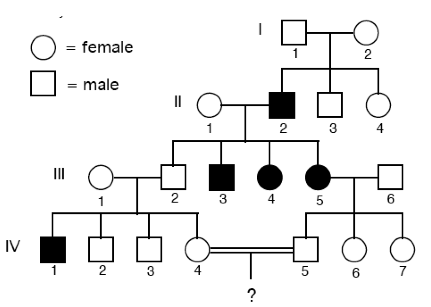
What does a filled in square represent?
a)
Not affected Female
b)
Not affected Male
c)
Affected Male
d)
Affected Female
42.
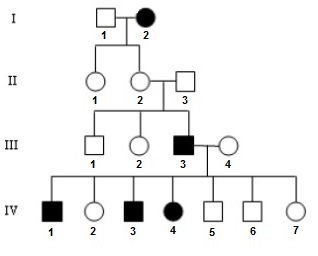
How many generations are shown in this pedigree?
a)
1
b)
2
c)
3
d)
4
43.
How many kids did the mother and father from the first generation have?
a)
2
b)
4
c)
5
d)
6
44.
This pedigree represents the inheritance of hemophilia in this family. How many of the females have the hemophilia trait?
a)
8
b)
5
c)
2
d)
3
45.
What do half colored symbols represent?
a)
The individual is a carrier (heterozygous).
b)
The individual expresses the trait.
c)
The individual has both recessive alleles.
d)
The individual has both dominant alleles.
46.
Is this trait (the shaded individuals) dominant or recessive?
a)
dominant
b)
recessive
47.
How many people in this whole pedigree have the trait/disease?
a)
2
b)
3
c)
4
d)
6
48.
What do we use pedigrees for?
a)
To look at families
b)
To make determinations about the offspring
c)
To track traits in families
d)
Nothing
49.
What does a vertical line coming down from a square and circle that are connected by horizontal line indicate?
a)
They are cousins
b)
The children
c)
Aunts and Uncles
50.
In the second generation-how many people are carriers of the trait?
a)
2
b)
3
c)
5
d)
6
51.

Individuals II 1 and II 2 have some children with dominant phenotypes and some with recessive phenotypes. Which cross represents the genotypes of individuals II 1 and II 2?

a)

TT x TT

b)

TT x Tt

c)

Tt x Tt

d)

Tt x tt

e)

tt x tt

52.
What is the genotype for a pea plant heterozygous for round seeds (R), and homozygous recessive for green seeds (y)?
a)
Ry
b)
RRyy
c)
RrYy
d)
Rryy
53.
In a dihybrid cross
a)
one trait is crossed.
b)
two traits are crossed.
c)
four boxes are needed for the punnett square.
d)
mom's alleles are dominant.
54.

Based off this punnett square, what fraction of the offspring will have wrinkled, yellow seeds?

a)

9/16

b)

3/16

c)

1/16

d)

16/16

55.
What goes in box 3
a)
Aabb
b)
AABB
c)
AAbb
d)
aaBb