wayground logo

Free Printable Worksheets

Font size

S
M
L
XL
Worksheets

Evolution

Total questions: 57

Worksheet time: 2hrs 39mins

Name
Class
Date
1.

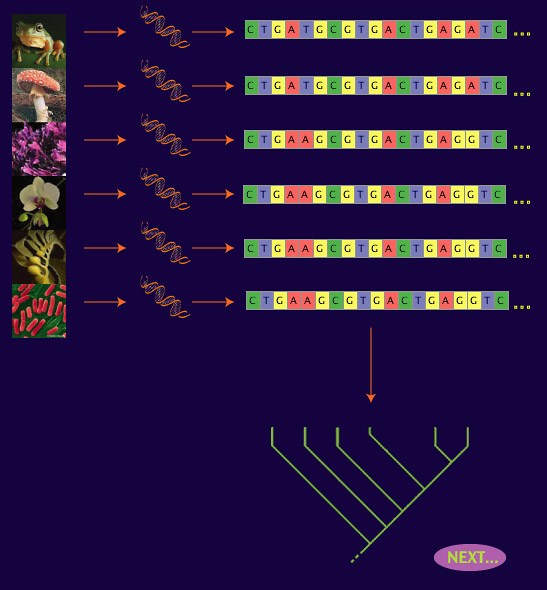
Which of the following provide evidence for evolution? (Select all that apply)

a)

physical features

b)

molecular features, such as DNA

c)

geographical information

d)

fossils

2.
Two organisms that are closely related would have
a)
very similar DNA sequence
b)
exactly the same DNA sequences
c)
no proteins in common
d)
completely different DNA sequence
3.
 The embryos of fish, chicken, pigs have gill slits and tails.  The presence of these features suggests that:-
a)
  Gill slits and tails are required for embryonic development
b)
Pigs and chickens are closely related
c)
These animals have a common ancestor
d)
    All these animals can swim
4.
Genetic variation can arise from a random change in the DNA of a gene.  The change is called a(n)
a)
mutation
b)
gene flow
c)
gene pool
d)
allele
5.
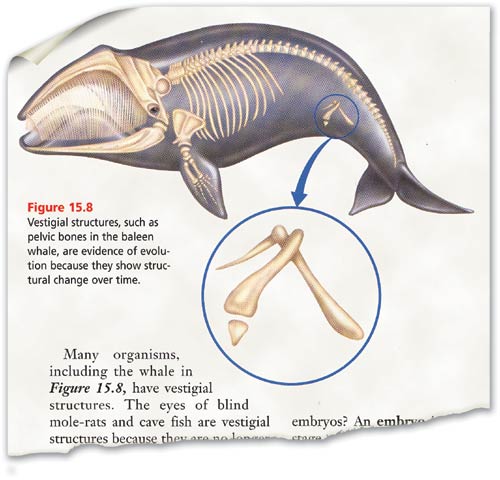
This picture is best known as
a)
homologous structures
b)
analogous structures
c)
vestigial structures
d)
embryology
6.
To adjust to a changing environment
a)
Mutation
b)
Adapt
7.
Using Data Table 1, which organism shares a most recent common ancestor with rabbits?
a)
Fly
b)
Bat
c)
Tree
d)
Bacterium
8.

Taxonomy is...

a)

The study of life

b)

the science of naming and classifying animals

c)

the evolutionary history of species

d)

the sequence in which different groups evolved

9.
Darwin wrote that organisms with traits that are best suited to the environment will ________________
a)
increase in number
b)
become extinct
10.
Some organisms that share a common ancestor have features that have different functions, but similar structures.  These are known as
a)
vestigial structures
b)
analogous structures
c)
homologous structures
d)
fossil structures
11.

Layers of rock give evidence of

a)

Lamarckian inheritance.

b)

population growth.

c)

the great age of Earth.

d)

artificial selection.

12.

Which of the following is the result of artificial selection?

a)

The rain forest plants and animals

b)

The fish that live in the ocean

c)

A particular breed of dogs with a certain coat.

d)

The weeds in a garden.

13.
A farmer's use of the best livestock for breeding is an example of
a)
natural selection
b)
artificial selection
c)
extinction
d)
adaptation
14.
Which best describes fossils?
a)
They are the preserved remains or evidence of ancient living things
b)
They are the preserved remains or evidence of ancient living and nonliving things
c)
They are the preserved bones of ancient animals
d)
They are impressions of plant leaves in ancient rocks
15.
When an organism completely dies out, it is called.....
a)
Adaption
b)
Extinction
c)
Fossilization
d)
Mutation
16.
In the graph shown, how many species of lizards seem to have beneficial adaptations?
a)
1
b)
2
c)
3
d)
4
17.
Mistakes or changes that occur int he DNA sequence are called....
a)
adatations
b)
Darwinism
c)
mutations
d)
natural selection
18.
What does this picture model?
a)
DNA structure of the horse
b)
Evolution of the horse
c)
Extinction of the horse
d)
Singular traite of the horse
19.
Which beneficial variation would be most helpful in a desert environment?
a)
white fur
b)
claws for burrowing
c)
grean and black camouflage
d)
flippers
20.
What is it called when an organism is best adapted to its environment, it will survive and reproduce more successfully than other organisms less adapted?
a)
cloning
b)
evolution of all species
c)
natural selection
d)
selective breeding
21.
This scientist came up with the idea of natural selection.
a)
Jean Baptiste Lamarck
b)
Gregor Mendel
c)
Charles Darwin
d)
Thomas Malthus
22.
Survival of the fittest or when favorable adaptations reproduce faster is called what?
a)
Evolution
b)
Adaptation
c)
Natural selection
d)
Fossilization
23.
Which of the following is an example of a vestigial structure?
a)
the wings of a red-tailed hawk
b)
the hind limbs of a house cat
c)
the fins of sharks
d)
the tailbone of a human
24.
The diagram shows fossils in different rock layers. Which of these statements about the age of these fossils is most likely correct?
a)
Fossil A and C are the same age
b)
Fossil B is older than fossil C
c)
Fossils A is older than fossil B
d)
Fossil D is older than fossil C
25.

What do we call a change in a species over time?

a)

Adaptation

b)

Evolution

c)

Extinction

d)

Environmental influences

26.
Why do embryologist study embryos?
a)
to see if they are related
b)
to understand adaptations
c)
to determine the age
d)
to learn what parents are vestigial
27.
Which of the following are examples of evidence for evolution?
a)
Fossils and Cellular Structure
b)
Biological Structures 
c)
Genetics/DNA
d)
All of the Above
28.
This is the trace or remains of an organism that lived long ago, most commonly preserved in sedimentary rock.
a)
Competiton
b)
Extinction
c)
Evidence
d)
Fossil
29.

Whales are aquatic mammals that contain a pelvis (hip) bone. Even though it does not aid in its movement, the function must have been used by a common ancestor of the whale. Thus, the pelvis is referred to as a(n)

a)

vestigial structure

b)

analogous structure

c)

homologous structure

30.
What is the sugar in DNA called?
a)
Deoxyribose
b)
Dantein
c)
Diglyceride
d)
Dalvin
31.
Which of the following bases would not be found in DNA?
a)
Adenine
b)
Uracil
c)
Cytosine
d)
Guanine
32.
Adenine pairs with...
a)
Thymine
b)
Cytosine
c)
Guanine
d)
It does not pair with any of them
33.
Which part of DNA is considered the "genetic code"?
a)
Bases
b)
Sugar
c)
Phosphate
d)
Hydrogen bonds
34.
The shape of DNA is...
a)
Twisted helix
b)
Flat helix
c)
Hexagon
d)
Pentagon
35.
DNA, in eukaryotes, is found within the...
a)
Nucleus
b)
Golgi apparatus
c)
Cytosol
d)
Outside the plasma membrane
36.

What does DNA stand for?

a)

Deoxyribonucleic acid

b)

Denitrogenous acid

c)

Deribonucleic acid

d)

Dexoyribonucic acid

e)

Deoxyribonuclic acid

37.
What is the monomer of nucleic acids?
a)
Glycerol
b)
Monosaccharides
c)
Amino Acids
d)
Nucleotides
38.

What are the components of a nucleotide?

a)

nitrogen base, phosphate group, and 5-carbon sugar

b)

5 carbon sugar, purine, and pyrimidine

c)

nitrogen base and a phosphate group

d)

DNA, phosphate group, monosaccharide

39.
In a molecule of double-stranded DNA, the amount of Adenine present is always equal to the amount of
a)
cytosine
b)
guanine
c)
thymine
d)
uracil
40.
Guanine bonds with ______________.
a)
Adenine
b)
Guanine
c)
Cytosine
d)
Thymine
41.
Which 2 molecules form the sides (backbone) of the DNA ladder?
a)
deoxyribose sugar and adenine
b)
deoxyribose sugar and a hydrogen bond
c)
deoxyribose sugar and the nucleus
d)
deoxyribose sugar and phosphate
42.
What will the matching sequence be on a strand that reads AAGCTAT?
a)
AACGATA
b)
TTCGTTA
c)
CCTGATA
d)
TTCGATA
43.

What are the four nitrogen bases?

a)

adenine, thymine, guanine, cytosine

b)

adenine, lysine, prolene, guanine

c)

arganine, cytosine, lysine, purine

d)

lysine, cytosine, lucine, guanine

44.
Which of the following best describes a DNA molecule?
a)
double helix
b)
contains ribose
c)
made of amino acids
d)
contains Uracil
45.
Which of the following units are repeatedly joined together to form a strand of DNA?
a)
amino acids
b)
nucleotides
c)
fatty acids
d)
polysaccharides
46.
What determines the code, or information, of a DNA molecule?
a)
the shape (structure) of the nitrogen bases
b)
the order (sequence) of the nitrogen bases
c)
the color of the nitrogen bases
d)
the frequency (number) of nitrogen bases
47.
Nitrogenous bases are joined by which type of bond?
a)
polar bonds
b)
ionic bonds
c)
covalent bonds
d)
hydrogen bonds
48.
What are the three components of a nucleotide?
a)
sugar, hydrogen, nitrogen base
b)
sugar, oxygen, nitrogen base
c)
sugar, phosphate, nitrogen base
d)
sugar, phosphate, protein
49.

Which is in order from largest to smallest structure?

a)

chromosome, DNA strand, gene, nucleotide

b)

chromosome, gene, DNA strand, nucleotide

c)

gene, DNA strand, chromosome, nucleotide

d)

DNA strand, chromosome, gene, nucleotide

50.

Covalent bonds occur:

a)

on the ribbon (between the sugar)

b)

between the bases

c)

only between A & T

d)

only between G & C

51.

What is this a picture of?

a)

nucleotide

b)

DNA strand

c)

chromosome

d)

gene

52.

Label the picture in order:

a)

phosphate ; sugar ; base

b)

phosphate ; base ; sugar

c)

base ; sugar ; phosphate

d)

base ; phosphate ; sugar

53.

In which phase does the DNA copy itself?

a)

interphase

b)

metaphase

c)

anaphase

d)

telophase

54.

In which phase do the chromosomes line up?

a)

prophase

b)

metaphase

c)

anaphase

d)

telophase

55.

In which phase do the chromosomes form?

a)

prophase

b)

metaphase

c)

anaphase

d)

telophase

56.

In which phase do the chromatids split apart?

a)

prophase

b)

metaphase

c)

anaphase

d)

telophase

57.

In which phase do new nuclear membranes form?

a)

prophase

b)

metaphase

c)

anaphase

d)

telophase