Wayground logo

Free Printable Worksheets

Font size

S
M
L
XL
Worksheets

Photosynthesis

Total questions: 34

Worksheet time: 42mins
Name
Class
Date
1.
Which organelle performs PHOTOSYNTHESIS?
a)
Chloroplast
b)
Mitochondria
2.
Which of the following is the correct equation for PHOTOSYNTHESIS?
a)
CO2 + light + H2O --> O2 + Sugar
b)
CO2 + sugar + H2O --> O2 + light
c)
O2 + light + H2O --> CO2 + Sugar
d)
CO2 + O2 + H2O --> Light+ Sugar
3.
What is the ultimate ORIGINAL source of energy for living things
a)
Sugar
b)
Sun
c)
Moon
d)
Carbon Dioxide
4.
What is the pigment in chloroplasts that performs photosynthesis?
a)
Chlorosynthesis
b)
Chlorophyll
c)
ADP
d)
Electron Transport
5.
Which gas is removed from the atmosphere during photosynthesis?
a)
hydrogen
b)
oxygen
c)
nitrogen
d)
carbon dioxide
6.
What are the products of photosynthesis?
a)
water and carbon dioxide
b)
oxygen and glucose
c)
oxygen and carbon dioxide
d)
oxygen and water
7.
What is photosynthesis?
a)
The process in which humans eat their food
b)
When a photographer takes a photo.
c)
To get your pictures from the photo lab.
d)
The process in which plants make their food.
8.
Chloroplasts are...
a)
Structures of animal cells to produce ATP
b)
Organelles where lipids are elaborated
c)
Specialized structures of plants where food is made
d)
Waste organelle of plants
9.
Leaves look green because.....
a)
they eat their vegetables
b)
to blend into their environment
c)
they contain a molecule named chlorophyll
d)
they are sick
10.
Which organelle from the plant cell is primarily responsible for converting sunlight to energy?
a)
Mitochonria
b)
Nucleus
c)
Vacuole
d)
Chloroplast
11.
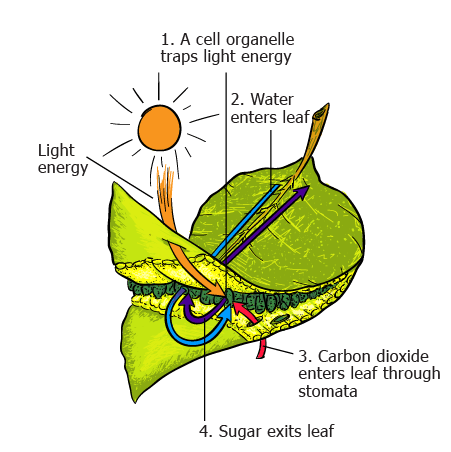
Look at the image
What substances and organelle work together to absorb sunlight to perform photosynthesis in this example?
a)
cell wall and chloroplast
b)
mitochondria and water
c)
vacuole and carbon dioxide
d)
chloroplast and chlorophyll
12.
If all four plants were watered daily but placed in a closet, receiving no sunlight, what process would NOT occur?
a)
Ingestion of carbon dioxide
b)
Filtration of water through the soil
c)
Photosynthesis
d)
Water absorbtion
13.
What are the reactants (what's needed) for photosynthesis?
a)
glucose and oxygen
b)
light, water, and carbon dioxide
14.
What type of organism uses photosynthesis?
a)
plants
b)
bacteria
c)
animals
d)
both plants and bacteria
15.
What gas is released by plants during photosynthesis?
a)
sulfur
b)
carbon dioxide
c)
oxygen
d)
hydrogen
16.
What are the two products of the light reactions that are needed for the calvin cycle?
a)
NAD and NADPH
b)
NADP + and Glucose
c)
NADPH and ATP
d)
Oxygen and NADPH
17.
The formula for glucose is...
a)
C12 H22 O11
b)
NaCl
c)
NaOH
d)
C6 H12 O6
18.

What role does NADPH play in cellular respiration

a)

It is long term energy storage

b)

it is a high-energy hydrogen carrier

c)

it breaks down glucose

d)

it is an enzyme

19.
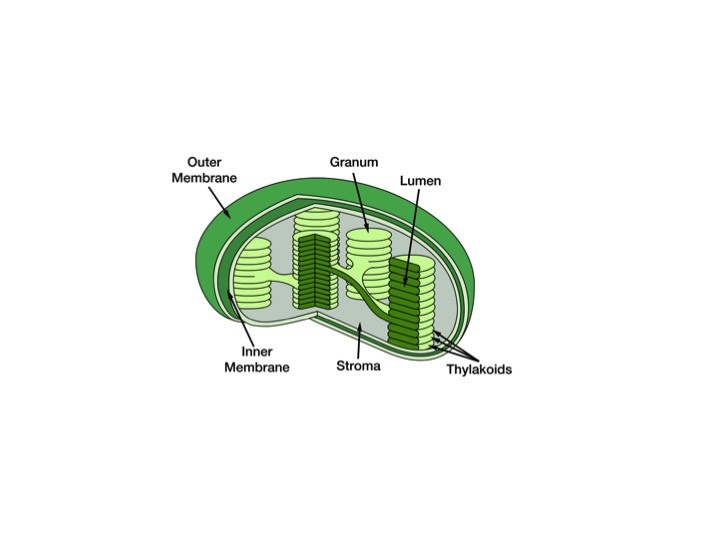
Where does the Calvin Cycle occur?
a)
thylakoid
b)
stroma
c)
lumen
d)
mitochondria
20.
Where do the light-dependent reactions occur? 
a)
thylakoid membrane
b)
stroma
c)
mesophyll
d)
mitochondria
21.
Most plants appear green because chlorophyll
a)
absorbs green light.
b)
absorbs violet light.
c)
does not absorb green light.
d)
does not absorb violet light.
22.
The openings on the bottom of leaves, which allow in CO2 (carbon dioxide) and releases O2 (oxygen) is the 
a)
stomata
b)
xylem
c)
Phloem
d)
Mesophyll
23.
What group of pigments break down later in the year and give leaves their orange, red, and yellow colors?
a)
carotenoids
b)
chlorophyll a
c)
chlorophyll b
d)
rhodopsin
24.
Where do the light reactions take place inside a chloroplast?
a)
stroma
b)
lamellae
c)
chloroplast membrane
d)
thylakoid membrane
25.

What is produced in the stroma?

a)

ATP

b)

glucose/G3P

c)

O2

d)

CO2

26.

Why do CAM plants grow much slower than other plants?

a)

they live in areas that do not have a lot of sunlight

b)

they live in areas that do not have a lot of water

c)

they can only fix CO2 during the night hours

d)

they can only fix CO2 during the day hours

27.
If we enclosed a plant in an air-proof bottle, what would happen to the rate of photosynthesis 
a)
Gradually slow down to zero because CO2 is used up
b)
Shows a constant rate as long as the light remains on
c)
Gradually speeds up because O2 builds up
d)
Gradually slows down because glucose builds up
28.

5 carbon sugar that combines with CO2 in the Calvin Cycle

a)

3-PGA

b)

G3P

c)

RuBP

d)

Glucose

29.

Plants can close their stomata when the temperature is hot

a)

To prevent water loss

b)

To prevent loss of oxygen

c)

To prevent loss of carbon dioxide

d)

To bring in more carbon dioxide

30.

Which of the following is a way to increase the rate of photosynthesis?

a)

Increase oxygen levels

b)

Decrease CO2 levels

c)

Increase light intensity

d)

Decrease water level

31.

Which is not a C4 plant?

a)

Cactus

b)

Corn

c)

Sugar cane

d)

Crab grass

32.

Which of the following is a CAM plant?

a)

Corn

b)

Sugar cane

c)

Crabgrass

d)

Pineapple

33.

Increasing carbon dioxide can increase photosynthesis, but only to a maximum rate because

a)

There are not enough RuBP molecules

b)

Oxygen cannot leave fast enough

c)

Large amounts of CO2 cannot fit in the chloroplast

d)

Calvin cycle can only go as fast as the light reactions

34.

Increasing temperature can speed up photosynthesis to a certain point.

a)

True

b)

False