wayground logo

Free Printable Worksheets

Font size

S
M
L
XL
Worksheets

Phases of Matter and Energy Transfer

Total questions: 41

Worksheet time: 43mins

Name
Class
Date
1.

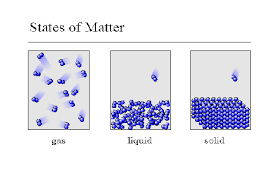
What phase of matter is shown in the diagram?

a)

solid

b)

liquid

c)

gas

d)

plasma

2.

Which of the following describes liquids?

a)

definite shape, definite volume

b)

no definite shape, definite volume

c)

no definite shape, no definite volume

d)

no definite shape, no definite volume, electrically charged

3.
Which sentence is true?
a)
If ice is heated up a little, it will turn into a liquid, but if it is heated up even more, it will turn into a gas.
b)
If ice is heated up a little, it will turn into a gas, but if it is heated up even more, it will turn into a liquid.
c)
If ice is heated up a little, it will turn into a liquid, but if it is heated up even more, it will turn into a solid.
d)
If ice is heated up a little, it will turn into a solid, but if it is heated up even more, it will turn into a gas.
4.
The theory that states that all particles in matter are constantly moving; helps to describe the phases of matter
a)
behavior of gases
b)
kinetic theory 
c)
matter matters
d)
temperature 
5.
Solids are described as having a 
a)
definite shape and indefinite volume
b)
indefinite shape and indefinite volume
c)
definite shape and definite volume
d)
indefinite shape and definite volume
6.
Gases are described as having a 
a)
definite shape and indefinite volume
b)
indefinite shape and indefinite volume
c)
definite shape and definite volume
d)
indefinite shape and definite volume
7.
Gas particles have the ________ kinetic energy because they move the fastest.
a)
least
b)
most
8.
When a gas changes its phase and turns into a liquid it is known as
a)
condensation.
b)
sublimation.
c)
vaporization.
d)
freezing or solidification.
9.
When a gas changes its phase and turns into a solid it is known as
a)
deposition.
b)
sublimation.
c)
condensation.
d)
freezing or solidification.
10.
What kind of energy is added to or removed from matter to cause a phase change?
a)
Radiation
b)
Heat
c)
Solar
d)
Wind
11.
A substance that has a definite shape and volume.
a)
evaporation
b)
gas
c)
liquid
d)
solid
12.
Electrically charged state of matter similar to a gas.
a)
temperature
b)
liquid
c)
plasma
d)
gas
13.

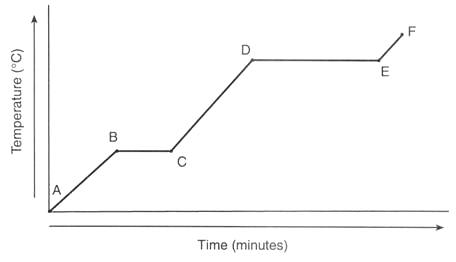
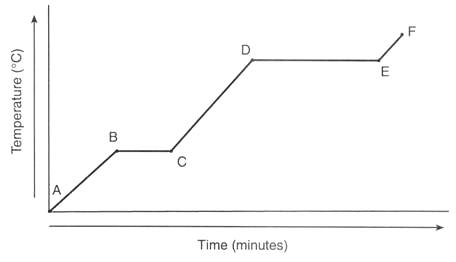
Between which points is the temperature of the substance remaining constant?

a)

A-B only

b)

A-B, C-D, and E-F

c)

B-C only

d)

B-C and D-E

14.

__________ show the change in state of matter as heat is added.

a)

Phase diagrams

b)

Heating curves

c)

Density graphs

d)

Temperature plots

15.

The melting point of the sample is

a)

-60 ºC

b)

20 ºC

c)

60 ºC

d)

100 ºC

16.

Which letter indicates where water is in both the solid and liquid phase at the same time?

a)

A

b)

B

c)

C

d)

D

e)

E

17.

A measure of the average kinetic energy of the particles in an object is called

a)

Heat

b)

Temperature

c)

Kinetic energy

d)

Enthalpy

18.

In which region(s) does temperature increase?

a)

Region C only

b)

Regions B and D

c)

Regions A, C, and E

d)

Regions A and B

19.

In which region(s) of the heating curve would water be a liquid and a gas at the same time?

a)

A

b)

B

c)

C

d)

D

e)

E

20.

The energy transferred between objects that are at different temperatures is called

a)

Heat

b)

Temperature

c)

Energy

d)

Friction

21.

Describe the substance at letter A.

a)

Solid

b)

Liquid

c)

Melting

d)

Evaporating

22.

How many states of matter are present during line segment BC?

a)

One

b)

Two

c)

Three

d)

Depends on the temperature

23.

NaCl was heated starting at an initial temperature of 0°C. The heating curve is shown in the picture. What is the melting point of this substance?

a)

0°C

b)

801°C

c)

1000°C

d)

1465°C

24.

Describe the substance at letters D.

a)

Gas

b)

Liquid

c)

Melting

d)

Evaporating

25.

At higher temperatures

a)

Particles in an object move slower

b)

Particles in an object move faster

c)

Particles move at the same speed as lower temperature

26.

If Ice is heated from -50 C to 80 C. The water will (a)   at 0 C.

27.
What line segment represents only the solid state?
a)
A-B
b)
B-C
c)
C-D
d)
D-E
28.
At higher temperatures
a)
particles in an object have less energy
b)
particles in an object move faster
c)
a gas contracts
29.
Before: molecules move around each other, After: molecules move in place
a)
Before, the substance was a solid and later a liquid.
b)
Before,the substance was a gas, and later a liquid.
c)
Before, the substance was a liquid and later a solid.
d)
Before,the substance was a liquid, and later a gas.
30.
The amount of energy required to raise the temperature 1ºC for every kilogram is called____?
a)
Thermal Energy
b)
Specific Heat
c)
Temperature
d)
Kinetic Energy
31.
A high specific heat means...
a)
It requires less energy to change temperature
b)
It requires more energy to change temperature
c)
It heats up very quickly
32.
Copper, Stainless Steel, Carbon Steel, and Zinc were all heated using the same thermal energy.  What material would be the coolest after being heated?
a)
Copper
b)
Carbon Steel
c)
Zinc
d)
Stainless Steel
33.
What does temperature measure?
a)
Heat
b)
ºC
c)
Kinetic Energy
d)
Thermal Energy
34.
How does heat flow?
a)
Always from cold to warm
b)
Always from warm to cold
c)
Both warm to cold & cold to warm
d)
It depends on the temperature
35.

Which of the following best describes temperature?

a)

Number of molecules

b)

Motion of molecules

c)

Size of molecules

d)

Type of molecules

36.

What happens when a cold drink sits in a hot room?

a)

It remains cold

b)

It gets warmer

c)

It starts boiling

d)

It starts to freeze

37.

When you heat a pot on a stove, the handle gets warm. Which type of heat transfer is responsible?

a)

Conduction

b)

Radiation

c)

Convection

d)

All of the above

38.

Heat from the Sun reaches Earth through which type of heat transfer?

a)

Conduction

b)

Radiation

c)

Convection

d)

All of the above

39.

Convection currents occur:

a)

Only in liquids

b)

When a dense substance is warmer than a less dense substance

c)

In both liquids and gases

d)

Weakly in solids

40.

Which of the following shows a transfer of energy by means of conduction?

a)

Standing near a warm fire.

b)

Watching a microwave oven cook your food.

c)

Grabbing a metal seat belt buckle after a car has been closed up in the sun all day.

d)

Feeling the breeze that blows over the land during the day and toward the sea later that night.

41.

To check if an iron is hot, you place your hand near the iron and feel that it is warm without touching it. What type of heat transfer is this?

a)

Condensation

b)

Conduction

c)

Convection

d)

Radiation