wayground logo

Free Printable Worksheets

Font size

S
M
L
XL
Worksheets

Chromosomal & Molecular Genetics

Total questions: 67

Worksheet time: 1hrs 18mins

Name
Class
Date
1.
A ribosome can be best described as...
a)
a protein factory
b)
a trash collector
c)
the powerhouse of the cell
d)
the brain of the cell
2.
What is the function of the smaller unit of the ribosome? 
a)
read the transfer RNA (tRNA)
b)
support the larger unit of the ribosome
c)
read the messenger RNA (mRNA)
d)
take in nutrients for the ribosome
3.
From his work with mice and pneumonia-causing bacteria, Frederick Griffin coined the term
a)
Replication
b)
Transcription
c)
Transformation
d)
Translation
4.
By using radioactive isotopes, Hershey and Chase were able to conclude that __ is/are the carrier(s) of genetic information.
a)
nucleic acid
b)
Proteins
c)
Carbohydrates
d)
Lipids
5.
The work of scientists including Griffin, Avery, Hershey & Chase and Franklin helped us to determine the __ are responsible for carrying genetic material.
a)
Amino Acids
b)
Proteins
c)
Nucleic Acids
d)
Carbohydrates
6.
Griffith discovered that
a)
DNA is different than RNA.
b)
adenine = thymine.
c)
bacteria can transfer DNA.
d)
DNA is the genetic molecule.
7.
What did Avery use to destroy proteins, lipids, and carbohydrates to show that DNA was the transforming factor?
a)
Bacteriophages
b)
X-ray diffraction
c)
Enzymes
d)
Radioactive isotopes
8.
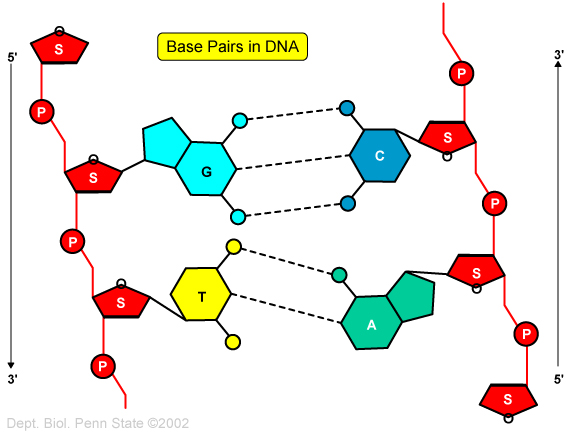
Adenine bonds with ______________.
a)
Guanine
b)
Thymine
c)
Cytosine
d)
Adenine
9.
Which of the following units are repeatedly joined together to form a strand of DNA?
a)
amino acids
b)
nucleotides
c)
fatty acids
d)
polysaccharides
10.
The enzyme that unzips the DNA to prepare for replication
a)
helicase
b)
replicase
c)
polymerase
d)
synthase
11.
DNA replication results in two DNA molecules,
a)
each one with two original strands
b)
each one with two new strands
c)
each one with one new strand and one original strand
d)
one with two new strands and the other with two original strands
12.
Okazaki fragments form on the:
a)
lagging strand
b)
leading strand
c)
base-pairs
d)
5' end
13.
Which of the following is required for DNA replication to occur?
a)
DNA helicase
b)
DNA ligase
c)
DNA polymerase
d)
all of these
14.
During replication, what enzyme adds complimentary bases?
a)
helicase
b)
synthesase
c)
ligase
d)
polymerase
15.

Which enzyme is responsible for forming phosphodiester bonds between the Okazaki fragments?

a)

Ligase

b)

Helicase

c)

DNA Polymerase 1

d)

DNA Polymerase 3

16.

Direction that DNA is replicated

a)

3' to 5'

b)

5' to 3'

17.

Direction that DNA is READ?

a)

3' to 5'

b)

5' to 3'

18.

The separation of the two single strands of DNA creates a ‘Y’ shape?

a)

enzyme

b)

unzip

c)

A replication fork

19.

This structure is an Okazaki fragment.

a)

A

b)

D

c)

F

d)

G

20.
What strand is copied faster?
a)
Leading
b)
Lagging
21.
Nitrogenous bases are joined by which type of bond?
a)
polar bonds
b)
ionic bonds
c)
covalent bonds
d)
hydrogen bonds
22.
Guanine bonds with ______________.
a)
Adenine
b)
Guanine
c)
Cytosine
d)
Thymine
23.
Which sequence of DNA bases would pair with this partial strand
ATG TGA CAG
a)
ATG TGA CAG
b)
TAC ACT GTC
c)
GTA AGT GAC
d)
CAT TCA CTG
24.
Which of the following units are repeatedly joined together to form a strand of DNA? (This is the MONOMER of DNA.) 
a)
amino acids
b)
nucleotides
c)
fatty acids
d)
polysaccharides
25.
What is a nucleotide?
a)
Lipid
b)
A single base, deoxyribose sugar, and a phosphate
c)
Carbohydrate
d)
All of the above
26.
This image shows that DNA Replication is _______.
a)
Conservative
b)
Semiconservative
c)
Dispersive
d)
Spontaneous
27.
Before the cell divides, what process needs to happen?
a)
Transcription
b)
Translation
c)
Replication
d)
Protein synthesis
28.
Name this structure
a)
double helix
b)
nucelotide
c)
twisted ladder
d)
hydrogen bond
29.
DNA replication results in two DNA molecules,
a)
each one with two original strands
b)
each one with two new strands
c)
each one with one new strand and one original strand
d)
one with two new strands and the other with two original strands
30.
Which of these bases does not exist in RNA?
a)
C
b)
T
c)
U
d)
A
31.
DNA codes for...
a)
cholesterol
b)
proteins
c)
fatty acids
d)
a sandwich
32.
Which is a difference between DNA and RNA
a)
RNA is double stranded
b)
RNA is not made of nucleotides
c)
RNA contains Uracil instead of Thymine
d)
RNA does not contain a sugar
33.
What is occurring in this picture?
a)
Translation
b)
Replication
c)
Translocation
d)
Transcription
34.
what does mRNA do?
a)
carry info from genes to ribosomes
b)
carry amino acids to ribosomes
c)
help with RNA splicing
d)
make up ribosomes
35.
Where does transcription take place?
a)
nucleus
b)
ribosome
c)
cytoplasm
d)
smooth ER
36.
In order for DNA instructions to move from the nucleus to the ribosomes in the cytoplasm of a cell, an RNA copy of a DNA strand must be made. This process, which takes place in the cell nucleus, is called
a)
translation
b)
mutation
c)
DNA replication
d)
transcription
37.
Which RNA bases would pair with TACGAA in transcription
a)
AUGCUU
b)
ATGCTT
c)
GCATCC
d)
GCAUCC
38.
How can a person's muscle cells have the same exact DNA sequences as their nerve cells even though the look and perform completely different?
a)
The two different cells become mutated
b)
The proteins expressed in each cell are different
c)
They actually have different DNA in the two types of cells.
d)
The genome of the different cells changes
39.
What structure of this molecule binds with the mRNA molecule?
a)
Amino Acid
b)
tRNA
c)
Anticodon
d)
Codon
40.

Translation is a process where:

a)

a polypeptide sequence is produced from a sequence of rRNA codons.

b)

a polypeptide sequence is produced from a sequence of tRNA codons.

c)

a polypeptide sequence is produced from a sequence of mRNA codons.

d)

a DNA nucleotide sequence is used to produce mRNA codon sequence.

41.

Epigenetics modulates genetic expression:

a)

differently in each cell in the body.

b)

by altering the genome.

c)

in response to only intracellular processes.

d)

consistently throughout an individual's life.

42.

SELECT ALL THAT APPLY: Autosomes Chromosomes:

a)

Pair #23

b)

Determine whether you're male / female

c)

Pairs #1-22

d)

Every chromosome except sex chromosomes

43.

SELECT ALL THAT APPLY: Sex Chromosomes:

a)

Pair #23

b)

Determine whether you're male / female

c)

Pairs #1-22

d)

Every chromosome except sex chromosomes

44.

Monosomy:

a)

Missing 1 chromosome

b)

3 chromosomes (instead of a pair)

c)

Chromosomes are normal

45.

Trisomy:

a)

Missing 1 chromosome

b)

3 chromosomes (instead of a pair)

c)

Chromosomes are normal

46.

Meiotic Errors: What answer choice best describes the meiotic error where there are 3 copies instead of 2 of the 21st chromosome?

a)

nondisjunction

b)

Down Syndrome

c)

aneuploidy

d)

translocation

47.

Meiotic Errors: What answer choice best describes the meiotic error where chromosomes fail to separate during the division?

a)

nondisjunction

b)

Down Syndrome

c)

aneuploidy

d)

translocation

48.

Because females have

two X chromosomes and males have only one, body cells

randomly turn off one of the X chromosomes. This is called

...........................................................

a)

dosage compensation or X-inactivation.

b)

Incomplete dominance

49.

What is the chromosome pattern for people with Turner's syndrome?

a)

XX

b)

XO

c)

XXY

d)

XY

50.

Color Blindness is a sex-linked trait carried on the X chromosome. A normal couple has 3 girls that are not color blind. Their fourth child is a boy. He is color blind. Select the statement that BEST Explains his inheritance of the color blind trait.

a)

His grandmother was color blind.

b)

His grandfather passed the color blind trait to his father.

c)

The boy's father carries the trait for color blindness.

d)

The boy's mother carries the trait for color blindness.

51.
Colorblindness is a recessive, X chromosome sex-link disorder. Cross the parents to figure out which percentage of their offspring will be colorblind.
a)
25%
b)
0%
c)
75%
d)
50%
52.

Because males have only one X chromosome, they are more likely to have a sex-linked trait controlled by a recessive allele.

a)

True

b)

False

53.
The reason some linked genes may get separated during gamete formation is - - - 
a)
genes aren't on the same chromosome
b)
genes don't compliment each other well
c)
a crossing over event shuffles the genes
d)
an environmental impact forces the genes to shuffle
54.
DNA and RNA are examples of...
a)
proteins
b)
nucleic acids
c)
carbohydrates
d)
lipids
55.
What is the monomer of nucleic acids?
a)
Glycerol
b)
Monosaccharides
c)
Amino Acids
d)
Nucleotides
56.

What is the shape of DNA?

a)

Double Hyperbola

b)

Paraolic

c)

Double Helix

d)

Linear

57.

What sugar is found in RNA?

a)

Ribose

b)

Deoxyribose

c)

Glucose

d)

Galactose

58.

Which number represents a nucleotide?

a)

1

b)

2

c)

3

d)

4

59.

Based upon the data in the table provided complete letter D (32% Thymine), determine the percentage of Cytosine present in DNA of Yeast.

a)

20%

b)

36%

c)

64%

d)

18%

60.

What best explains the interaction between tRNA and mRNA during translation?

a)

anticodons on the mRNA line up with complementary codons on the tRNA

b)

anticodons on the tRNA line up with complementary codons on the mRNA

c)

tRNA attach amino acids to the complementary mRNA sequence

d)

mRNA attach amino acids to the complementary tRNA sequence

61.

What does tRNA "transfer"?

a)

amino acids

b)

nucleic acids

c)

nucleotides

d)

AUG

62.

codons are located on __________

a)

mRNA

b)

tRNA

c)

rRNA

d)

snRNA

63.

anti-codons are located on __________

a)

mRNA

b)

tRNA

c)

rRNA

d)

snRNA

64.

How many nucleotides make up a single codon?

a)

3

b)

5

c)

4

d)

1

65.

What sequence of mRNA always begins a new polypeptide chain?

a)

UAG

b)

AUG

c)

GAU

d)

UGA

66.

The following codon is translated into which amino acid?


AUU

a)

Methionine

b)

Isoleucine

c)

Histidine

d)

Arginine

67.

The following codon is translated into which amino acid?


UAA

a)

STOP

b)

Phenylalanine

c)

Valine

d)

Aspartic acid