
Font size
 Worksheets
Histology Test Review
Total questions: 71
Worksheet time: 40mins
Label the types of epithelial tissues by dragging them to their correct locations.
Stratified columnar
Pseudostratified
Simple squamous
Stratified squamous
Simple cuboidal
Simple columnar

What type of tissue is this?
Cardiac
Epithelial
Skeletal
Neurons
Label the diagram

Which muscles act involuntarily?
(i) Striated
(ii) Smooth
(iii) Cardiac
(iv) Skeletal
(i) and (ii)
(ii) and (iii)
(iii) and (iv)
(i) and (iv)
Which tissue enables various forms of movement, both voluntary and involuntary?
Muscle
nerve
connective
epithelial
Which tissue assists in support and protection of organs and limbs?
epithelial
connective
muscle
nerve
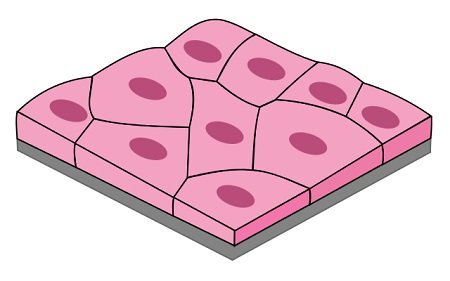
Name the type of epithelium
simple cuboidal
simple squamous
simple columnar
stratified squamous

Name the tissue
Pseudostratified
Simple columnar
Transitional
Stratified Squamous
These cells are small and flat
Cuboidal
Columnar
Squamous
Pseudostratified
This name means that there are multiple layers of cells
Simple
Stratified
Columnar
Pseudostratified
Cardiac muscle is found around the
Liver
Heart
Lungs
Stomach
The four types of tissue are
Cardiac, transitional, epithelial, connective
Muscle, Nervous, Epithelial, Connective
Connective, Epithelial, Transitional, Muscle
Epithelial, Connective, Muscle, Squamous

Name this tissue
Bone
Adipose
Cartilage
Blood
Which type of muscle tissue would line the intestines?
Smooth
Skeletal
Cardiac
Transitional
Which of the following is not a type of connective tissue?
Blood
Bone
Skin
Adipose
______________ tissue provides cushioning to our organs.
Areolar
Adipose
Cartilage
Lymph
Epithelial cells present in the small intestine are tall and thin. They are called
squamous
cuboidal
columnar
rectangular
Function of the adipose tissue in the inner layer of skin functions to...
insulate the body
provide pigment to the skin
help to make collagen and elastin
produce sebum
The epidermis (skin) is composed of _____.


What type of tissue is this?
Muscle
Epithelial
Nervous
Connective

What tissue is this?
Simple columnar
Simple cuboidal
Adipose
Skeletal muscle

What type of nervous tissue is in this image pictured in blue?
Sprainous nervous tissue
Neuron nervous tissue
Peely nervous tissue
Neuroglial nervous tissue

What type of nervous tissue is this pictured in yellow?
Neuroglial nervous tissue
Neuron nervous tissue
Smooth nervous tissue
Cardiac nervous tissue

What type of muscle tissue is in this image?
Skeletal muscle tissue
Cardiac muscle tissue
Nervous muscle tissue
Smooth muscle tissue

What type of muscle tissue is in this image?
Skeletal muscle tissue
Cardiac muscle tissue
Smooth muscle tissue
Bicep muscle tissue

What type of muscle tissue is in this image?
Skeletal muscle tissue
Cardiac muscle tissue
Smooth muscle tissue
Love muscle tissue

What type of tissue is in this image?
Elastic
Blood tissue
Adipose tissue
Areolar tissue

What type of tissue is in this image?
Adipose tissue
Blood tissue
Bone tissue
Areolar tissue

What type of cartilage is in this image?
Fibrocartilage
Elastic cartilage
Hyaline cartilage
Tre Martinson cartilage

What type of Cartilage is in this image?
Hyaline cartilage
Fibrocartilage
Bone cartilage
Elastic cartilage

What type of tissue is in this image?
Stratified Cuboidal Epithelium
Stratified Columnar Epithelium
Transitional Epithelium
Pseudostratified Columnar epithelium

What type of tissue is in this image?
Stratified Columnar epithelium
Simple cuboidal epithelium
Pseudostratified columnar epithelium
Simple columnar epithelium

What type of tissue is in this image?
transitional epithelium
Stratified Cuboidal epithelium
stratified columnar epithelium
Eric Aguirre

What type of tissue is in this image?
Pseudostratified Columnar epithelium
Stratified cuboidal epithelium
Stratified Squamous epithelium
Jr araiza

What type of tissue is in this image?
Pseudostratified columnar epithelium
Stratified squamous epithelium
Call of Duty: Modern Warfare 2
Transitional epithelium

What type of tissue is in this image?
Transitional Epithelium
Stratified Squamous Epithelium
Simple Cuboidal Epithelium
Simple Columnar Epithelium

What type of tissue is in this image?
Stratified Squamous Epithelium
Pseudostratified Columnar Epithelium
Simple Cuboidal Epithelium
Simple Columnar Epithelium

What type of tissue is in this image?
Simple squamous epithelial
hyaline
bone
Fortnite
Which tissue is a continuous sheet of tightly packed cells, covers body surfaces, lines organs, and forms glands?
muscular
nervous
connective
epithelial
This type of tissue is composed of neurons and neuroglia.
muscular
nervous
connective
epithelial
This tissue has a free apical surface and is attached to a basement membrane.
muscular
nervous
connective
epithelial

Squamous

Cuboidal

Columnar
Mitochondria
They generate and store energy
Ribosome
Makes Proteins
Nucleolus
Make ribosomes
Lysosome
Breaks down materials
Rough Endoplasmic Reticulum
Packages and modifies proteins
All of the following are functions of Epithelium EXCEPT...
Covering surfaces such as the inside of organs
Connecting structures together
Diffusion
Secretion
What are the contractile proteins in muscles called? Choose 2.
actin
myosin
microtubules
dynein
keratin
What are the three types of muscle?
Smooth, Hard, Cardiac
Cardiac, Smooth, Skeletal
Skeleton, Heart, Bladder
This tissue controls body functions:
muscle
connective
epithelial
nervous
The nerve cells that generate and conduct nerve impulses are called:
dendrites
axons
myalin
neuron

Why is that you can FEEL a paper cut, but it often does NOT bleed?
Epithelium is vascular and has a direct nerve supply
Epithelium is avascular and has a direct nerve supply
Epithelium is vascular and does not have a direct nerve supply
Epithelium is avascular and does not have a direct nerve supply

What is the proper name for a tissue that has box-shaped cells with multiple layers?
Simple Cuboidal Epithelium
Stratified Cuboidal Epithelium
Simple Squamous Epithelium
Stratified Squamous Epithelium

What would be the proper name for one layer of tall, rectangular cells that have hairlike structures on their free surface?
Pseudostratified Columnar Epithelium
Ciliated Simple Columnar Epithelium
Non-Ciliated Simple Columnar Epithelium
Simple Columnar Epithelium
The process by which fluid or a nutrient it taken into a cell
Absorption
Diffusion
Osmosis
Secretion

Which term describes a tissue that appers to have multiple layers, but really has only one?
Simple
Stratified
Pseudostratified
Which type of epithelial cells have the ability to change shape?
Columnar
Cuboidal
Squamous
Transitional
Which type of glandular epithelium releases its products directly onto a surface?
Endocrine
Exocrine

A specialized cell that is associated with columnar tissue, that releases mucus.
Adipocyte
Goblet Cell
Mast Cell
Plasma Cell
The part of Epithelium that anchors it to underlying connective tissue
Basal surface
Free surface
All of the following are functions of Epithelium EXCEPT...
Covering surfaces such as the inside of organs
Connecting structures together
Diffusion
Secretion
These epithelial cells have the largest amount of surface area, making them good for storage
Columnar
Cuboidal
Squamous
Transitional
If an epithelial tissue has more than one layer of cells, it would be described as...
Simple
Stratified
Pseudostratified
This term describes a cell that is very thin and flat
Columnar
Cuboidal
Squamous
Transitional

