
 Worksheets
SMT 2 Day 2 review
Total questions: 62
Worksheet time: 34mins
Before a cell can divide, what must happen during the S phase of Interphase?
Nothing, it is always ready to divide
The number of chromosomes must be cut in half
The DNA must replicate
The DNA must triple.

Crossing over leads to.....
an increase in genetic material combinations
an increase in the number of chromosomes
a decrease in number of genes
a decrease in genetic material combinations
If a human sex cell (gamete) with 46 chromosomes undergoes meiosis, it will result in 4 gentically different cells with _____ number of chromosomes
46
92
22
23
After mitosis is complete how many cells will there be and how to they look like?
1 daughter cell that is identical to the parent cell
2 daughter cells that are identical to the parent cell
3 daughter cells that are different from parent cell
4 daughter cells that are different from parent cell
Why is sexual reproduction better than asexual reproduction?
It increases genetic diversity
It makes everyone be identical
It happens faster.
It helps skin cells divide faster to heal wounds.

The process on the right is:
Right: meiosis
Right: cloning
Right: meiosis
Right: mitosis

Cancer/ tumor is because of
cell repairing themselves
cytokinesis after mitosis
controlled cell division
uncontrolled cell growth

Which line in the graph is showing a cancerous cell
red line
blue line
both lines
none
cancer is caused because of a mutation of
proteins that form cell membrane
proteins that allows things to come in and out
proteins that regulate cell cycle
proteins that produce antibody

Identify the lobe that labeled #2.
frontal
parietal
occipital
temporal

Identify the structure labelled #4.
cerebrum
cerebellum
brain stem
medulla oblongata

Identify the lobe that is labeled #3.
occipital
temporal
parietal
frontal
How do vaccines help your body?
stimulates antibody production
stimulates red blood cell production
inhibits antigen production
inhibits white blood cell production
Which of the following is an example of a non-specific immune response?
Plasma cells releasing antibodies
T cells searching out and destroying the viruses
Infected cells trigger fever and inflammation that inhibits viruses
Memory B cells activating to respond to viruses

Which structure is responsible for the production of sperm?
vans deferens
testes
scrotum
urethra
What would happen if you removed one of female ovaries?
Menstrual cycle would not occur.
Fertilization will not occur.
The number of eggs will be less.
The number of nutrients the fetus receives will be less.
Drinking alcohol is particularly harmful to the fetus during the first trimester of pregnancy because:
alcohol can easily enter the mouth of the fetus
the lungs of the fetus become functional
many of the essential organs are forming
the fetus cannot excrete wastes
Abnormalities present in the lining of the uterus will impact which of the following?
differentiation of gametes into zygotes
production and release of egg cells
secretion of estrogen
development of the embryo into a fetus

Identify structure D.
scrotum
epididymis
testes
penis
The rate of blood flow changes in response to many factors. Which one of the factors below affects blood flow?
the narrowing of blood vessels increases blood pressure and increases flow
a low blood pH decreases the rate of diffusion through blood vessels
A high viscosity of blood causes increased resistance & leads to slow blood flow
The crescent shape of the blood cells decreases resistance and leads to faster blood
flow
What is the function of amniotic fluid in the amniotic sac?
protects the baby,regulates body temperature and allows for movement
Removes wastes through excretion and supports digestion
Keeps bacteria from entering and causing infection
transports blood and oxygen from the mother to the fetus
If the placenta does not form correctly, which of the following is a likely result?
the mother would not be able to produce milk
the mother and fetus would not be able to share a blood supply
the fetus would not be able to perform mitosis and meiosis
the mother and fetus would not be able to exchange food oxygen, and wastes
After mitosis right after telphase, the cytoplasm divides to make two cells in a process called as
cytokinesis
telophase
synthesis
interphase
Building muscles
Helping the Immune System
Immediate Energy like before a run
Generating Heat

Which line (bold or dotted) in the graph shows a reaction with enzyme?
The bold line.
Both the bold and dotted lines.
The dotted line.
None of them.

In the experiment shown, a snail was added to test tube 2, a water plant added to test tube 3, and a snail & plant was added to test tube 4. Into each tube an indicator was also added. An indicator is a substance which changes color. In this case, the indicator changes color from green to blue to yellow with increased CO2 (carbon dioxide) concentration. What is the purpose of test tube 1?
The amount of light received was too intense which killed the snail
The experiment needed to be repeated using neutral sample
Scientist had an extra tube so they just kept it
It is used to compare the color change in the other test tube
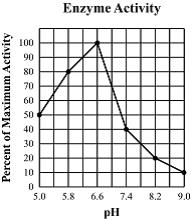
Which of the following conclusions can be drawn from this graph?
The optimal pH of the enzyme is 6.6.
The optimal pH of the enzyme is 9
The enzyme’s activity increases as pH increases from 7 to 9
The enzyme cannot do anything when the pH is 4.

Which monomer making up this protein is represented by the blue regions
monosaccharide
amino acid
fatty acid
nucleotide
What is the role of enzyme in cellular reactions?
enzymes supply oxygen for the reactions
enzymes speed up the rate of the reactions
enzymes change the reactants from solid to liquid form
enzymes remove carbon dioxide formed during reaction

In the picture, which represents a fatty acid?
F
G
H
J
Stomach has a pH of 2 and Small Intestine has a pH of 6.5. What do you think will happen to the enzyme that is used to digest the food in stomach when the food moves into small intestine?
It keeps working the same way
It will denature
It's activity will increase since the pH increases
It begins to replicate
In organisms, macromolecules are made up of monomers. Which of these pairs is paired INCORRECTLY ?
Nucleic acid = nucleotide
Protein = fatty acid
Carbohydrate = monosaccharide
Lipid = fatty acid
Which microscope is used to see the outside surface 3-D details?
dissecting microscope
compound light microscope
transmission electron microscope
scanning electron microscope
A scientific theory changes when
when new models and evidence give scientists new information
Theories can never change
Theories have no scientific evidence so they can change whenever someone has a new hypothesis
Which microscope allows you to see the tiny details inside the cell, such as the mitochondria?
dissecting microscope
compound light microscope
transmission electron microscope
scanning electron microscope

What is the purpose of folding inside the mitochondria?
to increase the volume of things that come in
to increase the surface area to perform its function
to look good
to be able to hold a lot of stuff
Which of the following is an example of a specific immune response?
Plasma cells releasing antibodies
Infected cells trigger fever and inflammation that inhibits viruses
Memory cells activating to respond to a virus

Use the codon chart to find the amino acid sequence for the following mRNA strand: 5'- AUGAAGGAA-3'
Met-Asp-Glu
Glu-Met-Asp
Met-Lys-Glu
Asp-Met-Glu
Why is the DNA code considered universal?
all living things have the same kind of organelles
all living things have the same number of chromosomes
all living things have the same genetic makeup (same start codon)
all diseases are genetic and can bee passed down after each generation
The following DNA strand is coded for a gene: 5' AGATCCGAATGCGTT 3". How many amino acids are coded for this segment?
1
4
5
12
What is the corresponding sequence of the complimentary DNA strand?
GCC AGA TCG
TAA TAG GAG
TAG CGC GAA
CGG TCT AGC
CGG ACA TGG
Scientists have developed some antibiotics that prevent DNA from unzipping. This will directly affect which process?
creation of mRNA
DNA replication
creation of new nucleotides
synthesis of tRNA
Guanine bonds with _____.
Cytosine
Uracil
Adanine
Thymine
What happens during DNA replication?
one strand of DNA is used as a template to create a complementary strand of DNA
a cell's genetic information transfers to a new cell
genetic information is turned on or off within a cell
none of these
_________occurs with the substitution of ONE nucleotide in a gene
insertion mutations
point mutation
frameshift mutation
none of these
Gene mutations do not always negatively impact the organism.
True
False
What type of cells could possible pass mutagens to offspring?
skin cells
brain cells
muscle cells
sex cells (sperm and egg)
DNA _____ into mRNA which ____ into proteins.
translates, transcribes
transcribes, replicates
replicates, unzips
transcribes, translates
Cells check to make sure there are no mistakes during DNA replication. Why is important to have an exact copy at the end of DNA replication?
It is not important, it is a waste of energy.
Newly formed cells get exact copies from dead cells
Each new cell needs a complete set of instructions.
Each new cell needs an extra set of DNA
The genetic code is considered universal to all organisms, why?
Organisms share a common ancestry.
The same codons are used by all organisms to determine amino acid sequences
All organism have the same bases A, T, C, G that make up their DNA.
all of the above
A company wants to test a new fertilizer. They water 100 marigold plants with their fertilizer water and they seemed to grow bigger over 30 days. What is wrong with their experiment?
they tested too few plants
they did not wait enough time to see results
they tested the wrong kind of plants
no control group was used

A scientist wanted to know if the pH of soil affected plant growth. She placed the same type of plants in 7 different pH soils and measured their growth in cm after 30 days. She made sure they all received the same amount of sunlight and water each day. What is the independent variable?
average height in cm
pH of soil
amount of water given
type of plant used
A doctor believed a supplemental vitamin would make people recover from illness quicker. Half of his study group received the supplement and half did not (they received a placebo). The data showed the people given the supplement recovered in about 1/2 the time. The doctor concluded the supplement was beneficial.
The data is not relevant to the doctor's conclusion
The data does not support the doctor's conclusion that the supplement was beneficial.
The data supported the doctor's conclusion.
The data was irrelevant because no one recovered.

A student thinks that the smaller a plant the less oxygen bubbles produced during photosynthesis. She sets up three plants, one small, one medium and one large so they all are set up like the image. She then measures the amount of oxygen produced. What is the independent variable?
the amount of oxygen collected
the size of the test tubes
the amount of carbon dioxide the plants consume
the varying sizes of the plants used (small, medium and large)

This diagram shows a point mutation. What is most likely the result of this mutaiton?
DNA coded for a protein, lactase enzyme, the person can no longer drink milk.
DNA still codes for the information but some is missing.
DNA still codes for the protein and it will still function correctly.
DNA now codes for cells that are not able to reproduce.
An experiment was done to discover the right amount of water to use on a plant. Ten seeds were planted in each of 5 pots found around the house that contained 500g of “Pete’s Potting Soil.” The pots were given the following amounts of distilled water each day for 40 days: Pot 1, 50ml; Pot 2, 100ml; Pot 3, 150ml; Pot 4, 200ml; Pot 5, 250ml. The height of each plant was measured at the end of the experiment. What is the dependent variable?
height of plants measured
amount of water
ten seeds
the type of container they were planted in
CATGCCGAT
This strand is
DNA
mRNA
tRNA
amino acids
Transcribe this strand of DNA
TATCCGTTA
TATCCGTTA
UAUCCGUUA
AUAGGCAAU
ATAGGCAAT
If this is one side of a DNA molecule, What is the other complimentary strand of DNA ?
TATCCGTTA
TATCCGTTA
UAUCCGUUA
AUAGGCAAU
ATAGGCAAT

This image represents
an amino acid
a nucleotide
A DNA strand
mitosis

