
 Worksheets
Air Masses and Fronts
Total questions: 62
Worksheet time: 2hrs 55mins

An air mass is
a large body of air with about the same temperature and humidity throughout
the amount of moisture in the air
a place where two different air masses meet
a cold air mass that bumps against a warm air mass
What is humidity?
cold air
hot air
the amount of moisture in the air
direction of a front
What is a warm front?
a cold air mass bumps against a warm air mass
a warm air mass meets a colder air mass and slowly rises over it
two air masses meet and stop moving
warm air mass gets caught between 2 cold air masses
What kind of pressure system is light and rises bringing wet, cloudy weather
High pressure system
Low pressure system
What weather instrument measures air pressure?
hygrometer
anemometer
thermometer
barometer
Air pressure is determined by...
the density of air particles in a given volume
the mass of each air particle in a given volume
the size of each air particle in a given volume
the weight of air particles in a given volume
After a cold front passes through an area, the weather will be...
warmer and stormy
cooler and clear
cooler and stormy
warmer and clear
When a warm front arrives, the area will experience...
cooler temperatures, higher air pressure, and storms
cooler temperatures, higher air pressure, and gentle rain
warmer temperatures, lower air pressure, and storms
warmer temperatures, lower air pressure, and gentle rain
Winds always move ...
in random directions
from areas of high pressure to areas of low pressure
from areas with warm temperatures to areas with cold temperatures
from land toward oceans
Choose all that apply. Components of weather that are important parts of forecasts include...
Temperature and air pressure
Relative humidity and wind speed
Fronts and pressure systems
Cloud cover and precipitation
In North America, winds and weather usually travel from
East to West
West to East
North to South
South to North

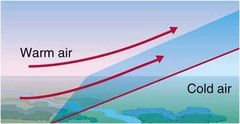
How does the air in this type of front move?
Warm air slowly pushes out cold air
Warm air rapidly moves up as cold air overtakes it.
Warm air is trapped between two colder air masses
Warm air meets cold air and cannot move

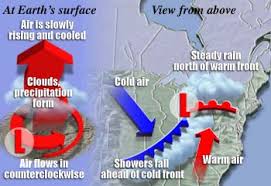

What type of weather does this warm front bring?
Cloudiness and light precipitation; warm and mild weather follows
Thunderstorms can occur; cool, fair weather follows
Many days of clouds and precipitation
Temperature drops; strong winds and heavy precipitation
How do pressure changes affect the formation of air masses?
Pressure changes cause air masses to run amok all over the planet.
Leave me alone, I'm copying math homework
Pressure changes allow particles to expand or contract, forming warmer or cooler air masses
Pressure changes are unrelated to air mass formation

1. Ms. Foxworth was interested in measuring the atmospheric pressure outside to show her students how to use this instrument. What instrument would she use to measure atmospheric pressure (air pressure)? Please use the image to answer this question.
thermometer
barometer
wind vane
compass

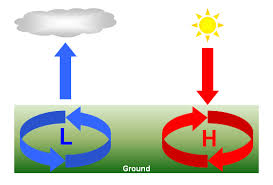
6. Which diagram shows Low pressure?
diagram A
diagram B

7. Which diagram shows High pressure?
diagram A
diagram B

8. Air in Fig. A is rising because it is
less dense
more dense

9. Air in Fig. B. brings with it
warm, moist air
bad weather
cold, moist air
good weather
11. Tornadoes and hurricanes are large areas of ____________ pressure.
no
high
average
low

Directions: Please look at the answers below and choose which represents the colored front symbol.
13. This front symbol is used for the type of front that forms when there is a sudden drop in temperature (gets colder), heavy rain, that can sometimes bring hail, thunder, and lightning.
cold front
warm front
stationary front
occluded front

Directions: Please look at the answers below and choose which represents the colored front symbol.
14. This front symbol is used for the type of front that forms when warm air masses push into cooler air masses. This front brings stormy weather as the warm air at the surface rises above the cool air mass.
cold front
warm front
stationary front
occluded front
Weather occurs because of high and low pressure systems. Which of the following is the MOST likely CAUSE of high and low pressure systems?
Solar energy
lunar gravity
global warming
Earth's magnetic field
What is the primary cause of rainstorms? (THINK- more than one of these is TRUE> Which one is the MAIN cause of rain)
Earth is heated by the Sun.
Mountains direct moist air upward.
Water forms droplets when cooled.
Most of Earth is covered with water.
Which condition is associated with MOST warm fronts?
cloud formations bringing steady precipitation
violent air mass collisions
low temperatures
tornado formations
The reading on a barometer rises when ......
air pressure increases.
air pressure decreases.
air humidity increases.
air humidity decreases.
High Pressure Causes...
Clear skies
Wind
Clouds
storms

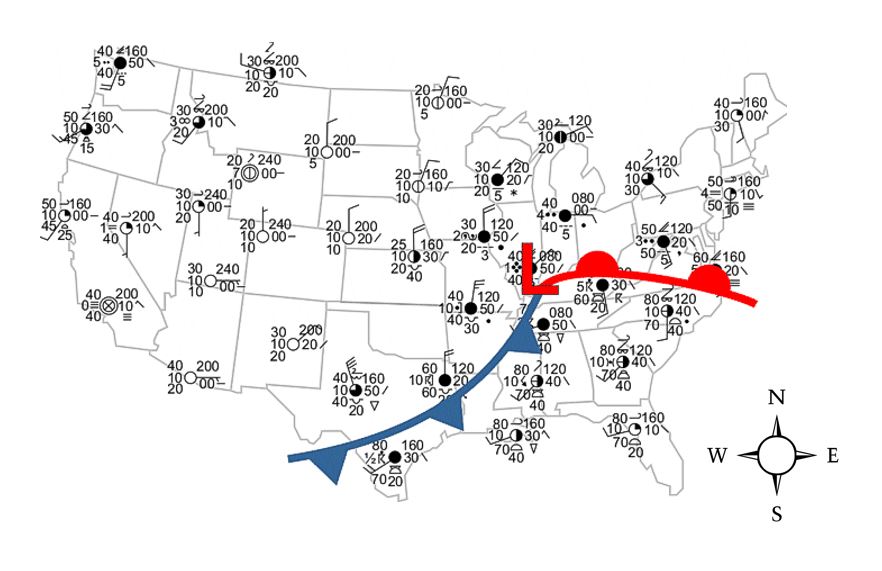
Which state is currently experiencing a warm front?
California
Detroit
Georgia
South Dakota



A prediction about weather based on observations of atmospheric conditions.
Forecast
Weather report
Climate report
Pretell
Where does the moisture in an air mass come from?
Rain
Fog
Evaporation
Cool air

According to this map, a cold front is located in which region of the United States?
South West
Midwest
North West
North East
Robert noticed that sunny skies suddenly became stormy. Which most likely happened when the weather changed in this way?
Winds weakened
Humidity decreased
Air Pressire decreased
Temperature increased
What comes after evaporation during the water cycle?
How does this occur?
Water evaporates into water vapor
Water vapor condenses and forms a cloud
Water precipitates to the ground
Water runs down into the hydrosphere

Which diagram (A or B) shows a HIGH pressure system?
A
B

Which diagram illustrates a LOW pressure system?
A
B
True or false: an air mass generally has uniform temperature and humidity.
true
false

As altitude increases, what happens to temperature?
temperature gets hotter
temperature gets colder

