Wayground logo

Free Printable Worksheets

Font size

S
M
L
XL
Worksheets

Quest review

Total questions: 60

Worksheet time: 1hrs 2mins

Name
Class
Date
1.

Which statement is true?

a)

The galaxies are moving toward us.

b)

The galaxies are moving away from us.

c)

The universe remains static or unchanged in motion.

d)

None of the above

2.

How does Cosmic Microwave Background Radiation support the Big BangTheory?

a)

Microwaves are found everywhere in the universe.

b)

Microwaves occurred at the time of the Big Bang

c)

Microwaves are useful in our everyday lives

d)

Only A & B

3.
Galaxies that are redshifted are:
a)
actually blue.
b)
really far away.
c)
invisible.
d)
moving away from us.
4.
The universe is expanding!  This means that:
a)
all of the galaxies are spreading out.
b)
the universe must have started from a single point.
c)
the universe is cooling down.
d)
all of the above.
5.

The Cosmic Background Radiation is:

a)

the remaining energy from the big bang.

b)

incredibly hot.

c)

visible to the human eye.

d)

only located in certain places in the universe.
6.
The universe is ____________ years old.
a)
8.13 billion
b)
13.8 billion
c)
1.83 billion
d)
381 million
7.
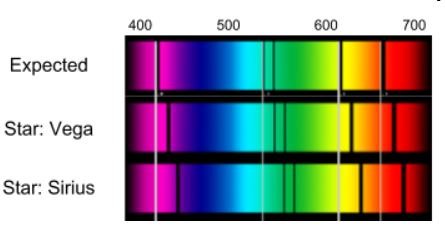
What is true about these stars?
a)
Both of these stars are moving away from us.
b)
Both of these stars are moving towards us.
c)
Both of these stars are blueshifted.
d)
The star Sirius is closer to us.
8.
What were the original two elements in our universe?
a)
Lithium and Carbon
b)
Hydrogen and Neon
c)
Helium and Chlorine
d)
Hydrogen and Helium
9.

In relation to us, most galaxies are…

a)

Moving toward us

b)

Moving away from us

c)

Not moving

10.

Most scientists believe the Big Bang Theory explains which of the following questions?

a)

How our planets and moons formed

b)

How our universe began

c)

How the sun turns hydrogen into helium

d)

How fast light travels through space

11.
What does the Big Bang theory suggest?
a)
The universe was just there
b)
The Milky Way is the only solar system
c)
The universe is continually expanding
d)
The universe is collapsing in toward a single point
12.
The name of our galaxy is the
a)
Andromeda
b)
Milky Way
c)
Magellan
d)
Whirlpool
13.
We can't see all of the stars in our galaxy because they
a)
are too far away
b)
are too hot
c)
are revolving too quickly
14.
The Milky Way is shaped like a
a)
ellipse
b)
spiral
c)
double spiral
15.
The universe is
a)
1 light year across
b)
everything that exists
c)
only our galaxy
16.
No one knows how large the universe is.
a)
False
b)
True
17.
Which planet in our solar system is closest to the Sun?
a)
Earth
b)
Jupiter
c)
Mercury
d)
Saturn
18.

Which of the following is an accurate model of how the Sun, Earth, and Moon move?

a)

Sun and moon orbit Earth

b)

Earth and moon orbit Sun

c)

Earth orbits the Sun and the moon orbits Earth

d)

Earth and sun orbit moon

19.
Earth and the other planets closest to the Sun are made mostly of _______
a)
gas
b)
metal
c)
water
d)
rock
20.
A ball of ice and dust with a tail of gas and dust pointing away from the sun.
a)
Asteroid
b)
Comet
c)
Moon
d)
Meteor
21.

Which planet is NOT one of the

"Gas Giants"?

a)

Uranus

b)

Venus

c)

Neptune

d)

Saturn

22.
One full orbit of an object around another object is called a ________.
a)
axis
b)
rotation
c)
revolution
d)
satellite
23.

This table shows the rotation period and revolution period for 6 planets, and Earth’s moon, all relative to Earth’s periods. Which 2 planets have shorter days than Earth?

a)

Jupiter and Saturn

b)

Venus and Mercury

c)

Mars and Jupiter

d)

Saturn and Moon

24.
Gravity pulls everything toward...
a)
The ground
b)
The center of mass
c)
The moon
d)
The Sun
25.

What shape are all orbits?

a)

Circular

b)

Spherical

c)

Orbital

d)

Elliptical

26.

As planets move farther from the Sun during their orbit, what happens to their speed (Kepler's 2nd Law)?

a)

They orbit slower

b)

They orbit faster

c)

Their speed does not change

d)

Speed depends on their mass

27.
A perfect circle has an eccentricity of ______.
a)
0
b)
.99
c)
1
d)
2
28.
The period of the earth's orbit around the sun is ____.
a)
1 day
b)
1 year
c)
24 hours
d)
364 hours
29.
The gravitational attraction between the star and the planet will be greatest at position 
a)
A
b)
B
c)
C
d)
D
30.
Which diagram shows a planet with the least eccentric orbit?
a)
1
b)
2
c)
3
d)
4
31.
Calculate the eccentricity for the following orbit. 
a)
1.6
b)
0.8
c)
0.6
d)
1.2
32.
Which orbit is most eccentric? 
a)
1
b)
3
c)
4
d)
5
33.
What is eccentricity? 
a)
a measurement of how elliptical an orbit is. 
b)
a measurement of the distance between the planet and the sun
c)
a measurement of how long the planet takes to rotate around the sun
d)
none of these
34.
During which month is the earth moving the slowest? 
a)
July 
b)
March
c)
January
d)
September
35.
An ellipse is drawn around two points called
a)
aphelion
b)
perihelion
c)
foci
d)
axis
36.
The place where a planet is closest to the Sun as it orbits the Sun is called the
a)
perihelion
b)
aphelion
37.

What is the name of the cloud that a star is formed in?

a)

Nebula / Stellar Nursery

b)

Supernova

c)

Main Sequence

d)

Dwarf

38.

When a Red Giant runs out of fuel, it become a:

a)

Supernova

b)

Nebula

c)

White Dwarf

d)

Main Sequence Star

39.

What is a red giant?

a)

It is what happens when a star begins fusing helium into carbon.

b)

It is a star on the main sequence of the HR diagram.

c)

It is a star that has died and is no longer fusing any material.

40.

What is a supernova?

a)

The measure of brightness of a star.

b)

Something that only low mass stars can do.

c)

A star that explodes, creating a great amount of light and energy.

41.
Once a star uses up all of its _________, the star will begin to go into its death phase.
a)
light
b)
heat
c)
energy
d)
hydrogen
42.
What color of star is the hottest?
a)
Blue
b)
Red
c)
Yellow
d)
Orange
43.
What color of star is the coolest?
a)
Red
b)
Yellow
c)
Blue
d)
White
44.
The life cycles of stars are determined by their:
a)
mass (size)
b)
color
c)
distance from Earth
d)
luminosity
45.

What is the source of energy for the Sun?

a)

nuclear fusion

b)

burning coal

c)

burning of solar gases

d)

splitting of atoms

46.

A collection of gas and dust that can form a star is called a...

a)

Stellar Nebula.

b)

Planetary Nebula.

c)

Globular Cluster.

d)

Stellar Nursery.

47.
This is an image of the formation of a star, also known as a .... 
a)
Main Sequence
b)
Planetary Nebula
c)
Supernova
d)
Stellar Nebula
48.
______ is a force that causes dust particles to stick together in a nebula.
a)
nuclear fusion
b)
gravity
c)
hydrogen
d)
friction
49.

The process that allows a star to generate energy

a)

Doppler Effect

b)

Nuclear Fusion

c)

Visible Light Spectra

d)

Protein Synthesis

50.

A chart that organizes stars by luminosity, size, color, temperature, and stage in their life cycle.

a)

Doppler Radar

b)

H.R. Diagram

c)

Venn Diagram

d)

Visible Light Spectra

51.

Larger stars have ________ life spans than smaller stars.

a)

Shorter

b)

Longer

c)

The Same

52.
In the diagram given, what happens as we move to the left?
a)
Stars Get Larger
b)
Stars get Colder
c)
Stars get hotter
53.
Which star is the coldest?
a)
Yellow Star
b)
Red Star
c)
Orange Star
d)
Blue Star
54.
The category that contains the most stars is...
a)
Main Sequence
b)
Supergiants
c)
Giants
55.
Which category is our Sun located in?
a)
White Dwarfs
b)
Supergiants
c)
Main Sequence
d)
Giants
56.
Compared to the rest of the stars, our sun is considered...
a)
Extremely Large and Cold
b)
Small with a medium temperature
c)
Medium size with medium temperature
57.
As a whole, Giants are considered hotter than White Dwarfs.
a)
True
b)
False
58.
The stable period of a star’s life cycle is called... 
a)
The birth of a star
b)
Nebula 
c)
Neutron star
d)
Main Sequence 
59.
At what stage in a stars life cycle are elements heavier than iron form? 
a)
Red Giant
b)
Supernova
c)
Black Hole
d)
Main Sequence
60.
The big bang theory explains the...
a)
Life cycle of a star
b)
Seasons of the earth
c)
origin of the universe
d)
Sheldon...just sheldon