
 Worksheets
CA #4 Review
Total questions: 76
Worksheet time: 54mins

There are 2 herds of Caribou in Northwestern Montana, one male Caribou strays from one herd to mate with a female in the other herd. What mechanism of evolution is this?
Gene Flow
Genetic Drift
Population Drift
Divergent Evolution

In a forest a large fire broke out that destroyed much of the area. There were 2 large populations of rabbits, one with brown fur and the other with white fur. After the fire the there were hardly any of the rabbits with white fur left. What mechanism of evolution is at work here?
Gene Flow
Genetic drift
Allele frequency
Natural selection
Which of the following would be considered genetic drift?
Select all that apply.
A female deer leaves her herd to join a separate large herd
A few spotted rabbits leave a large population of rabbits and start a new population of their own in a different place
Following a hurricane, a species of lizard was thought to be extinct until a small pregnant female was found alive.
The black robin was hunted until only 5 individuals were left. Through careful conservation efforts, the population is now over 250 birds.,
Following a hurricane, it was discovered that only one lizard survived.
Which of the following represents a gene pool?


When Arizona's Grand Canyon formed, squirrels and other small mammals that had once been part of a single population could no longer contact and reproduce with each other across this new geographic barrier. They can no longer interbreed. This is an example of...
founder effect
speciation
gene flow
coevolution

The sugar flying and the flying squirrel are distantly related, but share many characteristics. This is an example of?
Convergent Evolution
Divergent evolution
Complete Evolution
Coevolution

random chance
natural selection
non-random mating (sexual selection)
artificial selection
All of the genetic information found in a population.
population
genetic drift
evolution
gene pool
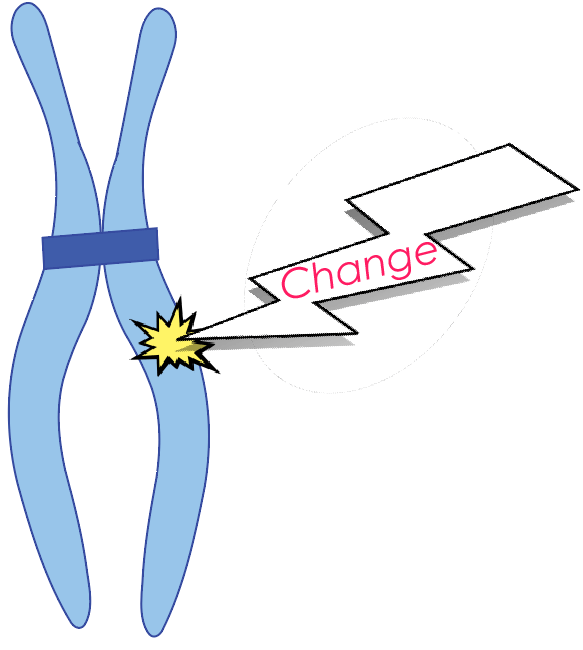
A change in a gene, group of genes or chromosome that results in a change in the proteins.
Replication
Mutation.
Translation
Transcription
A mutation is defined as:
A change in the cell's structure
Anything that changes in an embryo
Any change in the physical features of a human
A change in the DNA sequence

A forest fire ignites in the Sam Houston State Forest and kills many members of a population of pigmy rattlesnakes.
Gene Flow
Genetic Drift
Coevolution
Divergent evolution.

Maria Concepcion Soto settled in the northern area of Venezuela. She suffered from a rare genetic disorder called Huntington’s Disease. As a result, the now 20,000 individuals who live there also have a high risk of Huntington’s Disease. This is an example of_
Gene Flow
Genetic Drift
Divergent Evolution
Speciation
Genetic Diversity is increased through this process.
Gene Flow
Genetic Drift
Gradualism
Coevolution

gene pool
gene flow
genetic drift
mutation

When looking for mates, female bower birds prefer males who decorate their nests with a little extra blue, be it plastic or feathers.
sexual selection/non random mating
gene flow
mutation
genetic drift

gene flow
genetic drift
mutation
divergent evolution

What is natural selection?
When reproduction occurs and mutations happen.
When a offspring has the traits from its parents.
When an organism is able to camoflauge in its environment.
the process whereby organisms that are better adapted to their environment tend to survive and reproduce more offspring.

Gene flow
Natural Selection
Mutation
Genetic Drift


Genetic Drift
Hardy Effect
Gene Flow
None of These

New traits usually occur due to:
Random genetic mutations
An organism adapting
Effects from the environment
An extremely large gene pool

If a new trait DOES NOT help an organism survive, what may happen to it?
It dies and its DNA is not passed on
It survives and its DNA is passed on
It changes its traits to adapt and survive

What does the scientific name tell you about an organism?
Its' family and order
Its' kingdom and domain
Its' genus and species
Its' kindgom and order

All bacteria are.....
eukaryotic
prokaryotic
heterotrophic
autotrophic
What are the 3 domains?
Kingdom, Phylum, Class
Archaea, Bacteria, Eukarya
Class, Order, Species
Genus, Species, KIngdom
Thermophiles, Halophiles, and Methanogens all exist in extreme environments. What domain do these organisms belong to?
Eukarya
Archaea
Bacteria
Of the following classifications , the largest or most inclusive is
Order
Family
Class
Phylum
Of the following classifications, the smallest or least inclusive is
order
genus
species
class

Carnivores in the same order would also be in the same___
Class
Family
Genus
Species

Mushrooms are an example of this Kingdom.
Use all lower case letters.
(a)

What is the species name of the Timber Wolf, Canis lupus (you will not be able to italicize the word)?
(a)
A group of organisms that can mate with each other and produce fertile offspring is considered the same (a) .
Use all lower case letters.

A dichotomous key for trees is provided. Hikers found a tree that has large brown cones and single sharp needles. What species of tree have the hikers found? Write and answer as it is written on the key.
(a)

A dichotomous key for insects is given. To what order does an insect with two pairs of scaly wings belong? Write the word as it is written on the key.
(a)

A student discovers an arachnid with a segmented abdomen, long legs, and a tail with no stinger. The student uses the dichotomous key below to identify it. Which arachnid has the student found?
Write the answer as it is written on the key.
(a)

What scientific name is typed correctly?
Quercus Alba
quercus Alba
Quercus alba
quercus alba
Which taxa of classification has the largest variety of organisms?
genus
phylum
class
order
Cells that have a true nucleus are called....
eukaryotes
unicellular
prokaryotes
multicellular
I am prokaryotic and am found everywhere. What kingdom do I belong to?
Eubacteria
Fungi
Archaebacteria
Protista
The organisms Panthera leo and Panthera tigris are the same (a) . Use all lower case letters.
Which domain is capable of living in extreme environments like hot springs, geysers, or very salty waters?
Bacteria
Archaea
Eukarya

What would the scientific name of this organism be (you will not be able to italise your answer)?
Kingdom: Animalia
Phylum: Chordata
Class: Mammalia
Order: Carnivora
Family: Canidae
Genus: Canis
species: mesomelas
(a)

According to this image, which two domains of life are most related?
Bacteria & Archaea
Archaea & Eukarya
Eukarya & Bacteria
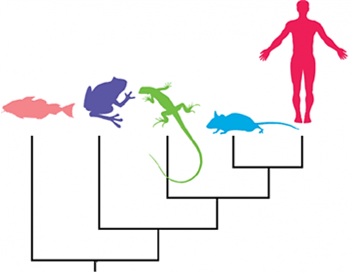
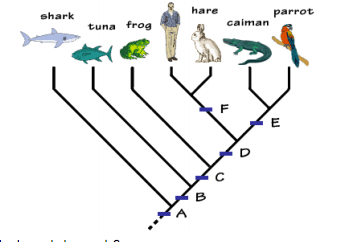
According to this phylogenetic tree, which creature is the least related out of all pictured?
Fish
Frog
Salamander
Human

Which group of animals on this tree are most closely related to birds?
Saurischian dinosaurs
Ornithischian dinosaurs
Crocodiles
None of these are related to birds

What number is the common ancestor of C and D
1
2
3
4

From the graphic, what derived character do perch and salamanders have in common?
Backbone
Jaws
Lungs
Feathers
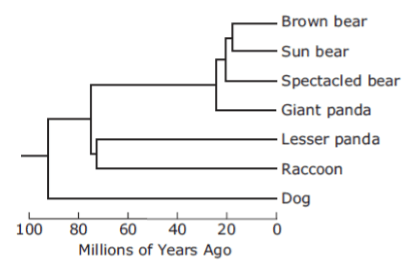
Who is the closest relative to the brown bear?
Giant panda
Dog
Lesser panda
Sun bear

Which organism is the most distantly related to all the others?
Raccoon
Dog
Giant Panda
Sun Bear
Which group of animals on this tree are most closely related to birds?
Saurischian dinosaurs
Ornithischian dinosaurs
Crocodiles
None of these are related to birds


convergent evolution & homologous structures
convergent evolution & analogous structures
divergent evolution & homologous structures
divergent evolution & analogous structures
Which type of evolution stems from a common ancestor?
convergent
divergent
co-evolution
none of the above

Other insects cannot, but, a bumble bee has just enough weight to open up the snapdragon flower to pollinate it. This is an example of...
convergent evolution
co-evolution
divergent evolution
speciation
A physical or behavioral trait that helps an organism survive and reproduce in its environment is called a what?
An adaptation
A response to a stimulus
A mutation
Evolution

If you have a dramatic change resulting in a new species in between long stretches of time with no change this would be
Gradualism
Swift speciation
Punctuated Equilibrium
Coevolution
Coevolution is the
Species looking similar due to a common ancestor
Species looking similar due to a common environment
evolution of two species that do not interact
evolution of one species in response to evolution in another species
If an animal evolves to be more camouflaged in an environment, and another animal evolves a better ability to sense movement. This would be
Divergent Evolution
Coevolution: predator Pray
Coevolution: mimicry
Forming of a new species by evolution from pre-existing species.
Speciation
Extinction
Gradualism
Punctuated equilibrium
Slow changes over a long period of time.
Gradualism
Extinction
Coevolution
Convergent evolution

What type of evolution is described in the following scenario:Porcupines in the United States have quills (spines) that are attached to their skins. When they feel threatened, they can tense up their bodies, causing the quills to “shoot out.” These spiny quills can pierce the skin of attacking animals, causing injury and pain. Although not closely related to the porcupine, hedgehogs that live throughout parts of Europe also have protective spines that they use to defend themselves from attacking animals.
Coevolution
Divergent Evoluction
Convergent Evolution
Adaptive Radiation

What type of evolution is described in the following scenario: King Snakes are a family of snakes that usually eat other snakes in the wild. Even though many of the snakes they eat are very poisonous, King Snakes have adapted the ability to not be affected by their poisons. In response, some of these poisonous snakes, like rattlesnakes, have adapted other defensive behaviors (other than biting) to try and “scare off” the King Snakes.
Coevolution
Divergent Evolution
Convergent Evolution
Adaptive Radiation

What type of evolution is described in the following scenario: The flowers that bloom from the saguaro cactus have evolved a bright, white coloration to attract many of the bats they rely on to pollinate their flowers. Since they rely on the bats, they have also adapted to opening their flowers at night, when the bats are active. The bats have also adapted to the cactus by a.) developing the ability to hover above the flowers, and b.) developing a long tongue that can reach deep inside the flower.
Coevolution
Divergent Evolution
Convergent Evolution
Adaptive Radiation

What type of evolution is described in the following scenario: Chameleons, a type of lizard (reptile), have two eyes they can move in completely different directions, so they can see all the way around themselves. Sand lances are a type of fish that can also move their eyes like the chameleon, even though they are not related to one another.
Coevolution
Divergent Evolution
Convergent Evolution
Adaptive Radiation

What type of evolution is described in the following scenario: A kit fox lives in the desert and has large ears with greater surface area that keep the fox from getting overheated. The red fox lives in the forest and has a red coat that keeps it camouflaged.
Coevolution
Divergent Evolution
Convergent Evolution
Natural Selection

What type of evolution is described in the following scenario: In the ocean surrounding Antarctica, there are fish that survive the cold water by using a molecule made of glycoproteins that circulates the blood and keeps it from freezing. Certain kinds of worms that live in the Arctic ocean also make antifreeze proteins that help them live in icy water
Coevolution
Divergent Evolution
Convergent Evolution
Adaptive Radiation

What type of evolution is described in the following scenario: Bees don’t see red, but do see yellow, blue, and ultra-violet light. Thus, bee-pollinated flowers are mostly yellow or blue with UV nectar guides (landing patterns) to guide the bee.
Coevolution
Divergent Evolution
Convergent Evolution
Adaptive Radiation
The primary difference between a bacterium and a unicellular protist is the presence of a (a) ( lower case)

