wayground logo

Free Printable Worksheets

Font size

S
M
L
XL
Worksheets

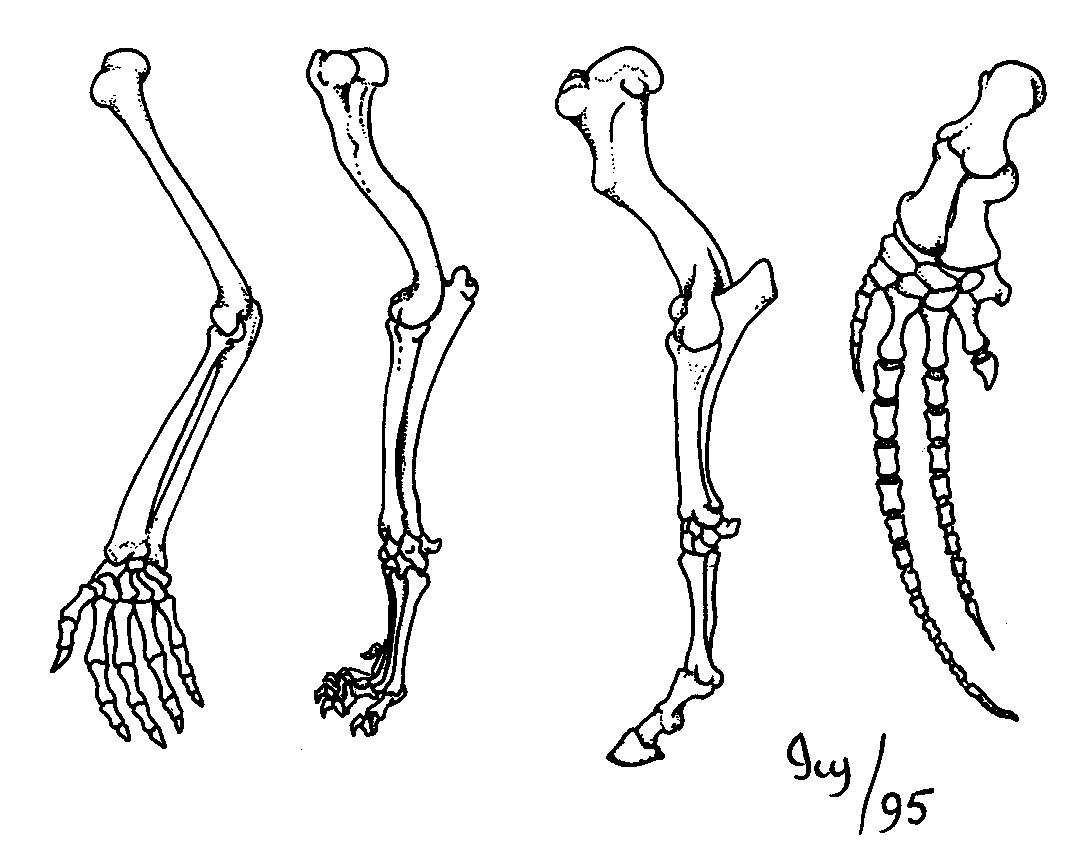
HW - 4/1 - Reporting Category 3 - Biological Evolution

Total questions: 75

Worksheet time: 56mins
Name
Class
Date
1.
Structures with the same parts have different functions; suggests that organisms share a common ancestry
a)
vestigial structures
b)
homologous structures
c)
adaptive radiation
d)
fossil
2.
Study of embryos of various organisms to show a common ancestor because of similarities in development
a)
natural selection
b)
embryology
c)
speciation
d)
evolution
3.
How do fossils provide evidence that evolution has happened on Earth?
a)
Fossils show how the sizes of certain animals has changed drastically over millions of years
b)
Fossils show that some species have gone extinct
c)
Fossils show how life forms present today are different than those from the past
d)
Different sedimentary rock layers provide evidence for how the environment has changed over time
4.
The diagram illustrates an embryonic stage of two organisms.

Which of the following can be determined by observing the embryos shown in the diagram
a)
The organisms share a common ancestry.
b)
The organisms belong to the same genus.
c)
The organisms are native to the same geographic areas.
d)
The organisms will grow into anatomically similar adults.
5.

Vestigial structures

a)

structures that perform a similar function but are not similar in origin

b)

remnants of once-important structures that have slowly lost all or most of their function

c)

features found in different organisms that share structural similarities but may have very different functions

d)

preserved remains of an organism

6.
Which layer is the youngest
a)
1
b)
2
c)
3
d)
4
7.
The changes of species over time
a)
Embryonic 
b)
Natural selection 
c)
Mimicry 
d)
Evolution 
8.

The picture shows a/an ___________

a)

homologous structure

b)

vestigial structure

9.

What is this an example of?

a)

Homologous structure

b)

Analogous structure

c)

Vestigial organs

d)

Functional adaption

10.
How do fossils provide evidence that evolution has happened on Earth?
a)
Fossils show how the sizes of certain animals has changed drastically over millions of years
b)
Fossils show that some species have gone extinct
c)
Fossils show how life forms present today are different than those from the past
d)
Different sedimentary rock layers provide evidence for how the environment has changed over time
11.

What best describes the hind leg bones seen in the whale?

a)

The bones are analogous structures to the fins of living fish.

b)

The bones are vestigial structures that had a function in an ancestor.

c)

The bones are homologous structures to the wings of butterflies.

d)

The bones are fossil structures from an extinct ancestor.
12.
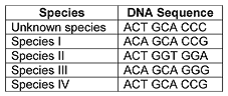
According to this data, the unknown bacterial species is most closely related to: 
a)
Species I
b)
Species II
c)
Species III
d)
Species IV
13.
Which species’ DNA is most similar to the DNA of the toothed whale? 
a)
Hippopotamus 
b)
Baleen Whale
c)
Grazing Mammals
d)
Camels
14.
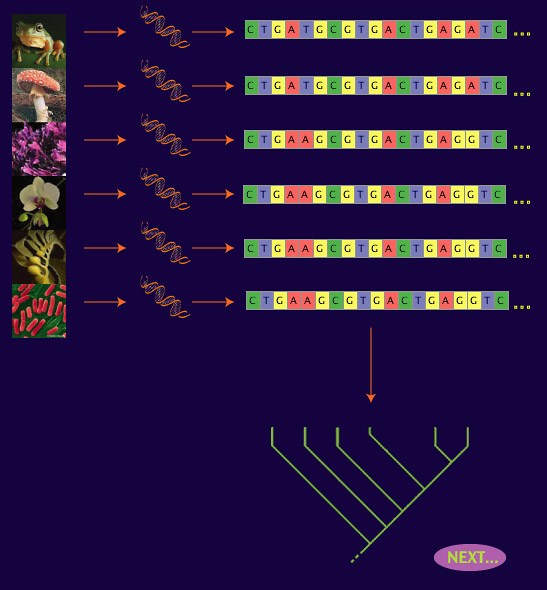
Two organisms that are closely related would have
a)
very similar DNA sequence
b)
exactly the same DNA sequences
c)
no proteins in common
d)
completely different DNA sequence
15.

_______________, or selective breeding, is one way that humans impact evolution. One example is how the Belgian Blue cow has been bred to have greater muscle mass.

a)

Artificial selection

b)

Homologous

16.

Scientists are studying a particular protein found in blood cells. Based on this, which animals are most closely related?

Dog: ARG - LYS - HIS - TYR

Rabbit: ARG - LYS - TYR - TYR

Elk: ARG - PRO - TYR - ARG

a)

Dog & Rabbit

b)

Rabbit & Elk

c)

Dog & Elk

17.
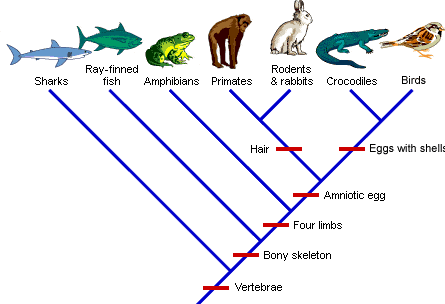
According to this cladogram, sharks are MOST closely related to which organism? 
a)
Amphibians
b)
Ray finned fish
c)
Crocodiles
d)
Birds
18.

This makes an organism more suited to its environment

a)

species

b)

lifespan

c)

adaptation

d)

mutation

19.
Where the better adapted organisms survive to pass traits along to offspring.
a)

Evolution

b)

Natural Selection

c)

Extinction

d)

Artifical Selection

20.
Which organisms are most likely to survive?
a)

the best adapted

b)

the fastest

c)

the strongest

d)

the most domesticated (tamed)

21.
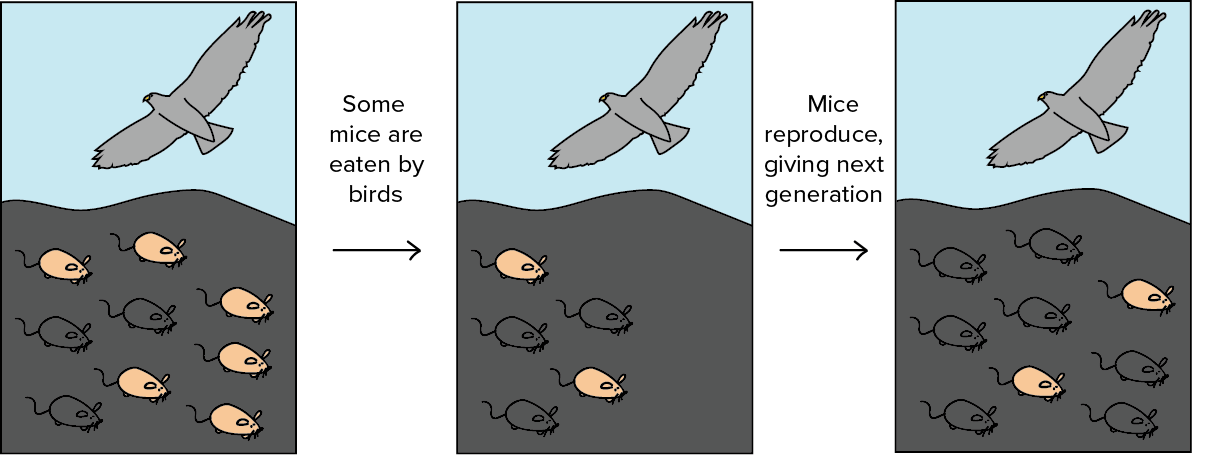
Why is the mouse population changing over time?
a)

The light mice can reproduce more successfully than the dark mice

b)

The hawks eat more dark mice than light mice because the dark mice taste better

c)

The hawks eat more light mice than dark mice because they can see the light mice more easily

d)

The hawks eat more dark mice than light mice because they can see the dark mice more easily
22.
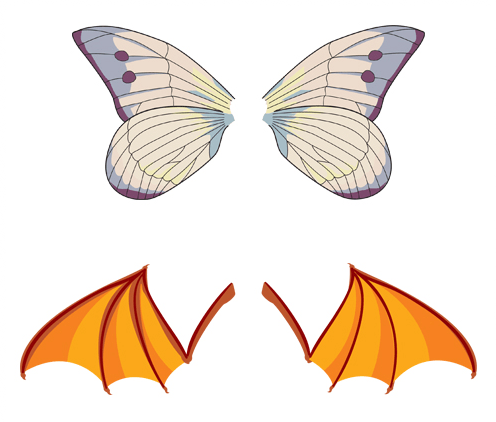
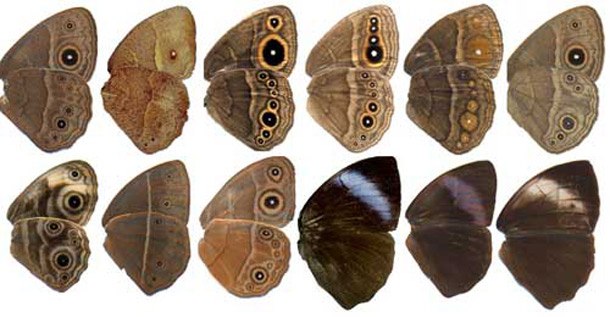
These moths are all the same species. The differences between their wings is an example of ________________
a)

Natural Selection

b)

Variation

c)

Homeostasis

d)

Extinction

23.

Why are advantageous traits more likely to be passed onto offspring?

a)

Because they are more likely to survive and reproduce.

b)

Because they come from dominant alleles.

c)

Because they come from recessive alleles.

d)

Because the organism knew it needed that trait, survives, and passes it on.

24.

Mutations are a change in what?

a)

DNA

b)

tRNA

c)

protein

d)

rRNA

25.

Where do adaptations come from?

a)

The individual organism decides to adapt

b)

Mutations that give an organism an advantage in its environment

c)

Genetic recombination during meiosis

d)

Both mutations and genetic recombination are sources of adaptation

26.

Mutations are important because they bring about

a)

death of the organism in which they develop

b)

genetic variation needed for a population to evolve

c)

benefits for the individual, not for the population

d)

changes in genotype, but not phenotype

27.
Why do frogs and other organism reproduce so many eggs or offspring?
a)
so that their babies can have friends to play with
b)
the more offspring the more likely the offspring will survive
c)
the more offspring the less likely offspring will survive 
d)
the more offspring the less competition
28.
Domesticated dogs are an example of:
a)
Natural Selection
b)
Selective Breeding
29.

Another term for Natural Selection is:

a)

Breeding

b)

Commensulism

c)

Communism

d)

Survival of the fittest

30.

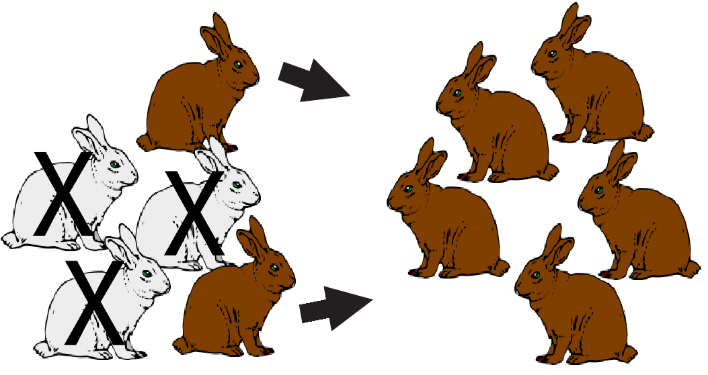
Which of the following represents genetic drift?

a)

b)

c)

d)

31.

Which of the following represents gene flow?

a)

b)

c)

d)

32.

Match the following

a)

the movement of genes into or out of a population

1.

Gene Flow

b)

Random chance; small population

2.

Genetic Drift

c)

A sudden change in one or more characteristics due to a change in a gene

3.

Mutation

d)

Occurs due to physical difference as a result of a genetic difference

4.

Non-Random Mating

e)

The movement of organisms from one place to another

5.

Migration

33.

Which of the following does not show genetic drift?

a)

b)

c)

d)

34.
In recent years "SuperBugs" (bacteria that aren't effected by antibiotics) are becoming more and more common. How could natural selection explain this?
a)
Superbugs survive antibiotics and reproduce
b)
Antibiotics cause bacteria to become superbugs
c)
We have always had the same amount of superbugs; modern media just discusses them more.
d)
There is no reliable data on the origin of super bugs.
35.

Species show very little evolutionary change in the fossil record

a)

Stasis

b)

Natural Selection

c)

Artificial Selection

d)

Darwinsim

36.

Evolution occurring gradually and slowly over long periods of time

a)

Homeostasis

b)

Stasis

c)

Punctuated Equilibrium

d)

Gradualism

37.

Evolution occurring quickly due to catastrophic events

a)

Homeostasis

b)

Gradualism

c)

Statsis

d)

Punctuated Equilibrim

38.

Two populations of the same species are separated by land barriers like rivers or mountains.

a)

geographical isolation

b)

temporal isolation

c)

adaptive ratiation

d)

behavioral isolaton

39.

Two populations of the same species do not have the same mating rituals or signals.

a)

geographical isolation

b)

temporal isolation

c)

adaptive ratiation

d)

behavioral isolaton

40.

The frequency that single genes (alleles) for a trait appear in a population.

a)

Genome

b)

Gene frequency

c)

Genetic Drift

d)

Population Frequency

41.

Organisms of the same species can no longer interbreed therefore creating two species.

a)

Gene Pool

b)

Genetic Drift

c)

Gene Frequency

d)

Speciation

42.

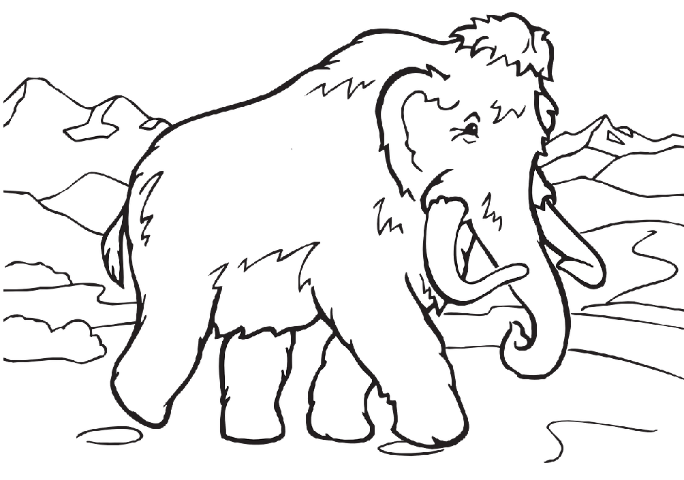
Severe population reduction reduces the gene pool

and increases the rate of genetic drift. Woolly mammoths became extinct. Elephants survived.

a)

Gene Pool

b)

Bottleneck Effect

c)

Founders Effect

d)

Gene Frequency

43.

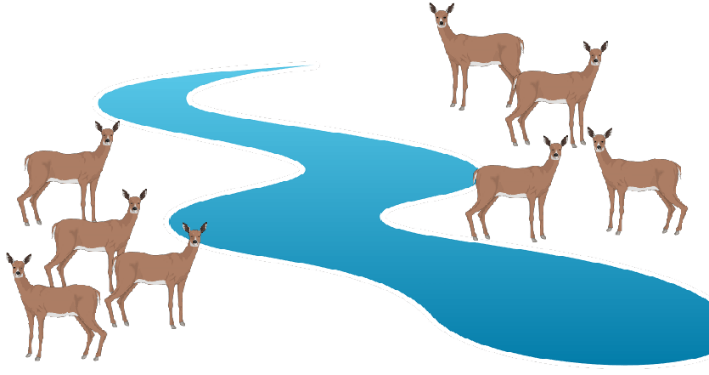
Isolated small populations speed up genetic drift.

a)

Gene Pool

b)

Mitosis

c)

Speciation

d)

Founders Effect

44.

Natural selection affects _______________

a)
Populations
b)
Individuals
45.
Organisms in the Kingdom Animalia are
a)
mutlicellular and heterotrophic
b)
multicellular and autotrophic
c)
unicellular and autotrophic
d)
unicellular and autotrophic
46.
How many Domains are there?
Name them:
a)
3; Archaea, Bacteria, Eukarya
b)
2; Bacteria, Eukarya
c)
1; Eukarya
d)
3; Bacteria, Eukarya, Protists
47.
A student discovers an arachnid with a segmented abdomen, long legs, and a tail with no stinger. The student uses the dichotomous key below to identify it. Which arachnid has the student found?
a)
Whip Scorpion
b)
Wind Scorpion
c)
Daddy long legs
d)
Scorpion
48.

What is the order of the taxonomic levels from least specific to most specific?

a)

Kingdom, Family, Species, Order, Class, Phylum, Genus

b)

Kingdom, Phylum, Class, Order, Family, Genus, Species

c)

Species, Order, Kingdom, Family, Genus, Phylum, Class

d)

Species, Genus, Family, Order, Class, Phylum, Kingdom

49.
Autotrophs- make their own  food.
Heterotrophs- obtain food from other animals.
Observing the table above, Fungi and Animals are________?
a)
Autotrophs
b)
Heterotrophs
50.

What are the names of the two levels used in binomial nomenclature?

a)

domain

b)

genus

c)

species

d)

phylum

e)

kingdom

51.
Which domain includes all animals and plants?
a)
Archaea
b)
Eukarya
c)
Bacteria
52.

bacteria belong to which domain?

a)

Eukarya

b)

Prokarya

c)

Archaea

d)

Bacteria

53.
Which kingdoms have some organisms that can make their own food (autotrophic)?
a)
Plantae and Animalia
b)
Fungi and Plantae
c)
Protista and Plantae
54.

What is the science of organizing, classifying and naming living things?

a)

taxification

b)

taxadermy

c)

taxonomy

d)

toxicology

55.
In the 8 levels of classification which level is the broadest category? 
a)
Kingdom
b)
Family
c)
Species
d)
Domain
56.
Things that are classified together ___________.
a)
are not related to each other.
b)
share a similar evolutionary history.
c)
are larger organisms.
d)
have a different evolutionary history
57.
Organisms that belong to the same _________ share the MOST DNA.
a)
family
b)
kingdom
c)
genus
d)
species
58.

Which organism is most closely related to Quercus rubrum?

a)

Acer rubrum

b)

Quercus macrophylla

59.

Which of the following taxa contain the fewest members?

a)

phyllum

b)

family

c)

genus

d)

class

60.
Which kingdoms are prokaryotic?
a)
Archaebacteria and Animalia
b)
Eubacteria and Archaebacteria
c)
Fungi and Protista
d)
Plantae and Eubacteria
61.
This domain is characterized by bacteria that can live in extreme environments, such as hot springs.
a)
Archaea
b)
Bacteria
c)
Eukarya
d)
Prokarya
62.
 You would find mushrooms and molds in which kingdom?
a)
Plantae
b)
Protists
c)
Fungi
d)
Animalia
63.
In which kingdom do I belong if I am unicellular, autotrophic, and eukaryotic?
a)
Archaebacteria
b)
Protista
c)
Animalia
d)
Plantae
64.
What is the difference between Archaebacteria and Eubacteria?
a)
Eubacteria are eukaryotic.
b)
Archaebacteria are multicellular.
c)
Archaebacteria can live in extreme environments.
d)
Archaebacteria are found everywhere.
65.
All of the following have a nucleus except...
a)
bacteria
b)
animals
c)
plants
d)
protists
66.
Which kingdom contains multicellular, heterotrophic organisms whose cells have NO cell walls?
a)
Protista
b)
Fungi
c)
Plantae
d)
Animalia
67.
Animals must eat other organisms for food, so they are classified as...
a)
heterotrophs
b)
autotrophs
c)
eukaryotic
d)
prokaryotic
68.
This organism is best classified as...
a)
prokaryotic, unicellular, and heterotrophic
b)
eukaryotic, unicellular, heterotrophic
c)
eukaryotic, unicellular, autotrophic
d)
prokaryotic, unicellular, autotrophic
69.
These organisms are best classified as...
a)
eukaryotic, multicellular, and heterotrophic
b)
eukaryotic, multicellular, and autotrophic
c)
eukaryotic, unicellular, and heterotrophic
d)
prokaryotic, multicellular, and heterotrophic
70.
Identify the kingdom...
Rod-shaped prokaryotes swabbed from a kitchen faucet.
a)
Archaebacteria
b)
Eubacteria
c)
Protista
d)
Fungi
71.
Identify the kingdom...
Microscopic unicellular organism found in a mud puddle.  Organism's DNA is contained in a nucleus and it moves by beating tiny hairs in the water.
a)
Archaebacteria
b)
Eubacteria
c)
Protista
d)
Fungi
72.
Identify the kingdom...
Multicellular organism with cell walls made of chitin found growing on a decomposing manure pile.
a)
Archaebacteria
b)
Eubacteria
c)
Protista
d)
Fungi
73.

Question #2

a)

F

b)

G

c)

H

d)

J

74.

Question #5

a)

F

b)

G

c)

H

d)

J

75.

Which taxon includes more species (# of organisms) an ORDER or FAMILY?

a)

Order

b)

Family