
 Worksheets
Unit 2 Exam: Cell Structure and Transport
Total questions: 70
Worksheet time: 2hrs 3mins

What best describes the solution the cell is in?
Hypotonic Solution
Hypertonic Solution
Isotonic Solution
None of the above
Which of the following are NOT found in animal cells?
chloroplasts and cytoplasm
chloroplasts and cell wall
cell wall and cell membrane
mitochondria and nucleus

What characteristic defines this organism as a prokaryotic cell?
Ability to move
Ability to respond to stimuli
Having a nucleus
Lacking of membrane-bound organelles


An unidentified cell under a microscope contains a nucleus. You know that this cannot be an example of this type of cell:
prokaryotic cell
eukaryotic cell
plant cell
animal cell

What are the yellow circles on the diagram and how do they react to water?
phosphate heads, hydrophilic
phosphate heads, hydrophobic
lipid tails, hydrophobic
lipid tails, hydrophilic

The particles in this diagram are too large to pass through the semipermeable membrane, so water moves across instead to achieve equal concentrations on both sides. This is an example of:
simple diffusion
facilitated diffusion
osmosis
active transport

When a cell forms a vesicle around unwanted particles and expels it OUT of the cell.
Pinocytosis
Endocytosis
Receptor-mediated
Exocytosis
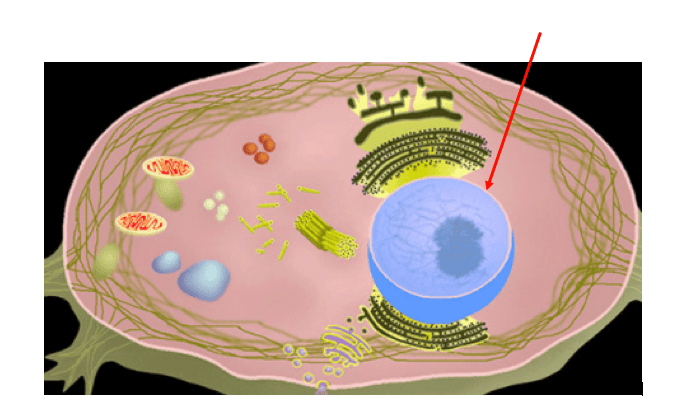
Identify the structure at the end of the arrow.
Mitochondria
Nucleus
Ribosome
Endoplasmic Reticulum
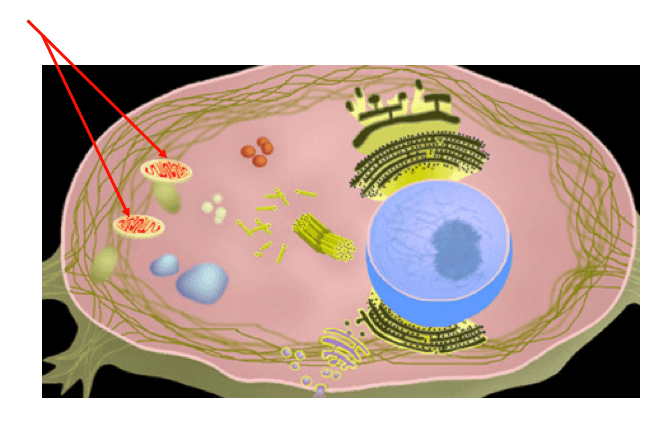
Identify the structures at the bottom of the arrows.
Ribosomes
Golgi Bodies
Mitochondria
Chloroplasts
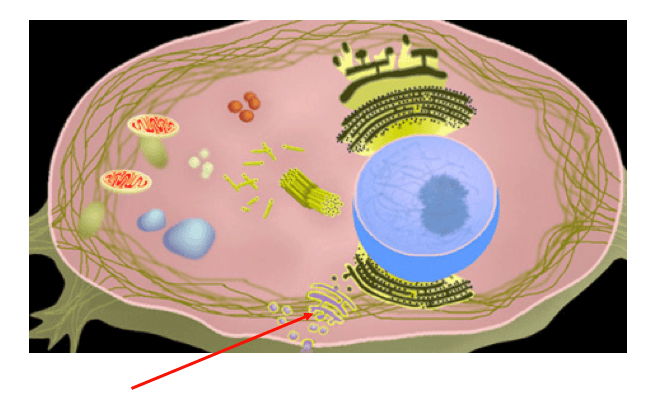
Identify the structure that the arrow is pointing to.
Endoplasmic Reticulum
Golgi Body
Ribosome
Mitochondria


This cell would be classified as a(n) ________________ cell.
prokaryotic
eukaryotic
animal
virus

organelle that contains digestive enzymes to
breakdown harmful substances
Chloroplast
Vacuole
Lysosome
Centriole
long hair like projection used for movement in
cells; uses a whip-like motion
Cilia
Flagella
Microsome
Vesicle


This image is an example of a phospholipid. Which part of a phospholipid is HYDROPHILIC?
the phosphate "head"
the lipid "tails"
The cell membrane is made up of:
Polar phosphate heads, non-polar lipid tails
Non-polar protein heads, polar fatty acid tails
Polar hydrogen heads, polar fatty acid tails
Non-polar protein heads, non-polar lipid tails
Which statement was NOT included in cell theory?
All living things are composed of cells.
Living cells come only from other living cells.
Each cell contains a cell membrane, cytoplasm, nucleus, mitochondria, and endoplasmic reticulum.
Cells are the smallest structure of living things that can perform the functions necessary for life.
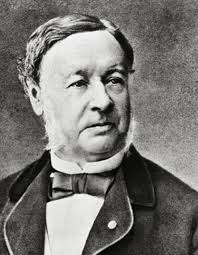
Who discovered that all cells come from other living cells and had research that lead to the last major principle of cell theory?
Matthias Schleiden
Theodore Schwann
Robert Hooke
Rudolf Virchow
Which of the following describes the structure and function of a cell membrane?
I. semipermeable bilayer of phospholipids that regulates what enters and exits the ribosomes during protein synthesis
II. phospholipid bilayer that has hydrophobic and hydrophilic regions to regulate the movement of substances across the membrane
III. proteins embedded with organelles that allow big molecules to cross using passive diffusion.
II only
I and II
III only
II and III
Endocytosis is different from facilitated diffusion. Which of the following accurately describes the main differences between the two types of transport?
I. Facilitated diffusion uses energy to help carrier molecules across the membrane, but endocytosis uses energy to export large molecules from the cell.
II. Endocytosis is an example of active transport while facilitated diffusion is passive.
III. Both are methods of active transport; endocytosis uses transport molecules to ingest large molecules and facilitated diffusion uses carrier proteins to export water.
No answer is correct
II only
I and III
II and III

Which of these is true about the enzyme in Figure 1 above?
It has become denatured after the process
The enzyme is unaffected and can be used again
The enzyme is the pointed molecule
The enzyme is combining molecules of the substrate
How do carrier proteins facilitate active transport?
Carrier proteins move substances from a low to high concentration.
Carrier proteins create an hypertonic solution.
Carrier proteins move substances from a high to low concentration.
Carrier proteins block the plasma membrane
The cell has a lower concentration of solute, and the net movement of water is into the cell.
Hypotonic solution
Hypertonic solution
Isotonic solution

Which means of particle transport is shown in Figure 7–4?
diffusion
osmosis
facilitated diffusion
active transport


Essential nutrients move through a cell membrane by both passive transport and active transport. Which of the following correctly describes the transport of materials across a cell membrane?
Active transport requires chemical energy to move nutrients from areas of low concentration to areas of high concentration.
Passive transport requires chemical energy to move nutrients from areas of low concentration to areas of high concentration.
Active transport moves nutrients from areas of high concentration to areas of low concentration without the use of chemical energy.
Passive transport moves nutrients from areas of low concentration to areas of high concentration without the use of chemical energy.

Trichondia is a eukaryotic organism that attaches itself to fish and eats bacteria. Which of the following distinguishes Trichodina from all prokaryotes?
Trichodina is unicellular
Trichodina has a nucleus
Trichodina has cytoplasm
Trichodina is heterotrophic
A type membrane protein that can pump one substance in one direction, while transporting another substance in the opposite direction.
pump transport
bulk transport
diffusion
osmosis

Which one is the definition of active transport?
movement of particles through the cell membrane from a region of lower concentration to a region of higher concentration using energy in the form of ATP.
passage of water molecules from a region of their higher concentration to a region of their lower concentration through a partially permeable membrane
net movement of molecule from a region of higher concentration to region of lower concentration. Molecule down a concentration gradient
net movement of molecule from a region of lower concentration to region of higher concentration. Molecule down a concentration gradient
Organize the levels into the least complex to the most complex:
organelle
cell
tissue
organ
organ system
If you eat meat for dinner, the organic molecules in the meat would be found in new molecules of...
glucose
protein
starch
fatty acids
Label the function of each organelle:
storage
synthesizes enzymes
produces ATP
regulates flow of molecules
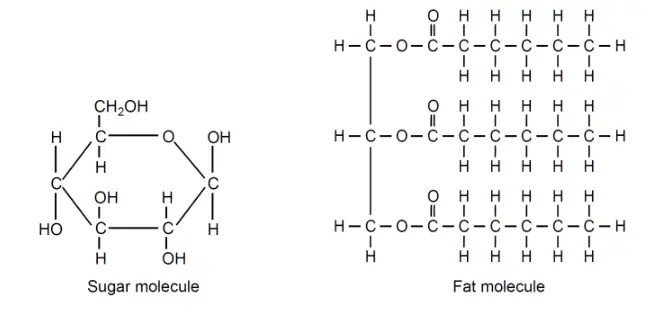
Which two answer choices describe sugar & fat molecules?
Fat molecules are inorganic
Sugar molecules provide us with energy
Fat molecules store extra energy
Sugar molecules produce proteins
If enzymes change shape, they will no lomnger function. Two factors that can change the shape of enzymes are (a) and (b)

Process X represents (a) which occurs in the (b) . Process Y represents (c) which occurs in the (d) . Do both plant and animals cells complete cellular respiration? (e)

The actions of cells X and Y help the plant to control (a) loss, which helps them maintain (b)
At which point on the graph does the enzyme denature?
When looking at an onion cell under the microscope, in lower power you will see (a) cells and they will be (b) . In high power, you will see (c) cells and they will be (d) .
Match the following:
active transport
requires ATP
passive transport
does not require ATP
diffusion
molecules move from high to low
endocytosis
molecules move from low to high
Label each organelle:
mitochondria
nucleus
ribosome
cell membrane

Three potato slices with the same mass were each placed in three beakers, each labeled with its number and contents. After 30 minutes, the potato slices were removed from the solutions, dried with a paper towel, and the mass was determined. The results are shown in the table.
Why did the potato in Beaker 1 gain mass but the potatoes in Beaker 2 and Beaker 3 did not?

Why is Molecule A able to diffuse across the cell membrane but Molecule B is not?
Cells employ different methods to transport substances in and out of the cell. Facilitated diffusion is one such method. Explain what facilitated diffusion is and how it operates within the cell membrane to transport specific molecules, such as glucose, into the cell. Describe the role of transport proteins in this process.
Cells use different methods to move materials into and out of the cell. The sodium-potassium pump is an example of one of these methods. What type of transport method does the sodium-potassium pump use and explain this method?
Vegetables at the grocery store are sprayed with water to prevent wilting. What transport method do the celery cells undergo when sprayed with water? Explain why this process occurs.

