

wayground logo

Free Printable Worksheets

NEW

Font size

S
M
L
XL
Worksheets

Plant Structure and Function Unit Review

Total questions: 65

Worksheet time: 55mins
Name
Class
Date
1.
what is the function of cuticle?
a)
protects the underlying tissues
b)
transport water
c)
transport mineral and nutrients
d)
reduce loss of water through transpiration
2.
which of this tissues are not known as ground tissue?
a)
perenchyma tissue
b)
collenchyma tissue
c)
epidermal tissue
d)
sclerenchyma tissue
3.
Located at tip of stem & roots for primary growth
a)
lateral meristem
b)
apical meristem
c)
root hair
d)
hypocotyl
4.
What is the function of phloem tissue?
a)
Transport water and minerals
b)
Support plants
c)
Photosynthesis process occur
d)
Transports glucose and other nutrients
5.
Xylem and phloem are examples of what tissue type?
a)
Vascular tissue
b)
Root tissue
c)
Dermal tissue
d)
Ground tissue
6.
What plant tissue transports material between the root and the shoot of the plant?
a)
Ground tissue
b)
Apical tissue
c)
Dermal tissue
d)
Vascular tissue 
7.
What are the xylem and phloem created by?
a)
Dermal
b)
Cambium
c)
Root cap
d)
Meristematic
8.
The process by which water evaporates out of a leaf is called...
a)
Transpiration
b)
Absorption
c)
Transport
d)
Vascular tissue
9.
___ open and close the stomata.
a)
Guard cells
b)
Xylem
c)
Roots
d)
Phloem
10.
What plant tissue on the roots and stems helps increase the plant's length?
a)
Meristematic
b)
Epidermis
c)
Guard Cells
d)
Xylem
11.
Regions containing actively dividing cells.
a)
Phloem
b)
Guard Cells
c)
Meristem
d)
Xylem
12.
Which tissue type does a majority of the photosynthesis?
a)
Dermis
b)
Ground
c)
Mersitematic
d)
Vascular
13.
Which type of plant tissue covers the outer surface of the plant and acts as a protective layer?
a)
Dermal
b)
Vascular
c)
Ground
d)
Connective
14.
Which plant structure is the primary site of photosynthesis?
a)
Root
b)
Stem
c)
Leaf
d)
Flower
15.
The tissues of the plant that store food and water are called...
a)
Dermal
b)
Vascular
c)
Ground
d)
Meristematic
16.
What type of vascular tissue is responsible for transporting water from the roots to the leaves?
a)
Cuticle
b)
Phloem
c)
Stomata
d)
Xylem
17.
What type of vascular tissue is responsible for transporting the sugars made in photosynthesis from the leaves to the roots?
a)
Cuticle
b)
Phloem
c)
Stomata
d)
Xylem
18.
Which of the following structures allows for gas exchange between a leaf and the atmosphere?
a)
Cuticle
b)
Phloem
c)
Stomata
d)
Xylem
19.
Which of the following terms refers to the waxy coating on the outside of leaves?
a)
Cuticle
b)
Phloem
c)
Stomata
d)
Xylem
20.
Which of the following is not a function of plant roots
a)
anchor the plant to the ground
b)
absorb water
c)
perform photosynthesis
21.
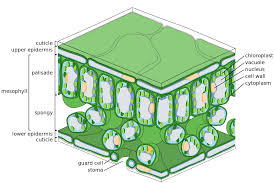
Name part 1
a)
Cuticle 
b)
Epidermis
c)
Palisdae
d)
Chloroplast
22.
Name part 3
a)
Palisade cells
b)
Spongy mesophyll
c)
Palisade mesophyll
d)
Stomata
23.
Name part 4
a)
Spongy mesophyll
b)
Palisade mesophyll
c)
Upper cuticle
d)
Upper epidermis
24.
Name part 6
a)
Palisade mesophyll
b)
Spongy mesophyll
c)
Stomata
d)
Stoma
25.
Name part 8
a)
Guard cell
b)
Stoma
c)
Air space
d)
Lower Epidermis
26.
Name part 9
a)
Guard cell
b)
Stoma
c)
Air space
d)
Lower Epidermis
27.
Tissue in a plant that is neither vascular nor dermal is
a)
Vascular tissue
b)
Ground tissue
c)
Filler tissue
d)
Dermal tissue
28.

If the xylem in a tree is damaged, which process would affected?

a)

performing photosynthesis

b)

transporting sugar to the roots

c)

protecting the plant

d)

transporting water to the leaves

29.
Its job is to support the plant and hold its leaves up to the sun.
a)
root
b)
stem
c)
flower
d)
leaf
30.

What are the 3 main plant organs?

a)

dermal, vascular, ground

b)

roots, stems, leaves

c)

roots, stems, flowers

d)

roots, ground, vascular

31.
Which organelle belongs in plant cells only?
a)
Cytoplasm
b)
Mitochondrion
c)
Cell Wall
d)
Nucleus
32.
Identify A
a)
cortex
b)
endodermis
c)
epidermis
d)
phloem
33.
Identify C
a)
cortex
b)
endodermis
c)
epidermis
d)
phloem
34.
Identify B
a)
cortex
b)
endodermis
c)
epidermis
d)
phloem
35.
Which correctly matches a plant organ and its function?
a)
Roots- Capture energy from the sun
b)
Stem-Anchor plant and absorb nutrients
c)
Leaves- The site of photosynthesis
36.
Where are stomata located on the plant?
a)
On the stem
b)
Top of the plant leaves
c)
Bottom of the plant leaves
d)
On the xylem
37.
What three things does a plant need to take in to be able to go through photosynthesis?
a)
sunlight, water, and carbon dioxide
b)
sunlight, water, and oxygen
c)
oxygen, carbon, and hydrogen
d)
water, oxygen, and glucose
38.
The two structures that limit transpiration  are known as
a)
Guard cells and xylem
b)
Stomata and guard cells
c)
xylem and phloem
d)
stomata and phloem
39.
Which is not a type of tissue in plants?
a)
Dermal
b)
Connective
c)
Vascular
d)
Ground
40.

Primary growth is the result of growth of cells made by the ..

a)

cork cambium.

b)

vascular cambium.

c)

primary xylem.

d)

apical meristems.

41.
what is the function of root hair?
a)
it is place to store the food
b)
it has large surface area to absorb more water
c)
it increases the root's anchorage
d)
It prevents the loss of water
42.

Where does sugar transport begin?

a)

Roots

b)

Leaves

c)

Root hairs

d)

Vascular bundles

43.

If a plant's xylem were destroyed, it would not be able to

a)

transport sugar to the roots.

b)

transport minerals from the leaves to the roots.

c)

transport water and nutrients from the roots through the shoot system to the leaves.

d)

transport sugar from the roots through the shoots system to the leaves.

44.

Once sugar is produced during photosynthesis, it is

a)

used up by the plant for energy.

b)

transported to the "sinks" for storage.

c)

transported from the leaves to the stalk for storage.

d)

transported out of the stomata to attract pollinators.

45.

What are leaves referred to as when discussing movement of sugars through the phloem?

a)

Sources

b)

Sinks

46.
Keith puts a plant with white flowers in a container fi lled with green liquid for a few hours. After a day, he observes that the white flowers have turned green. What has caused the flowers to turn green?
a)
The chlorophyll in the leaves turned the flowers green. 
b)
The flowers have been infected by a disease.
c)
The roots absorbed the green liquid and transport it to the flowers.
d)
The roots absorbed the green liquid and the stem transport the liquid to the flowers.
47.
An example of adhesion is
a)
Water molecules sticking to each other
b)
Water molecules sticking to cellulose in xylem walls
c)
Magnets sticking to a metal wall
d)
Gravity pulling water down
48.
Grass has roots that are made up of thin branching roots called
a)
aerial roots
b)
prop roots
c)
fibrous roots
d)
tap roots 
49.
Carrots are examples of this kind of root
a)
aerial root
b)
prop root
c)
fibrous root
d)
tap root
50.
What drives the flow of water through the xylem? 
a)
passive transport by the endodermis
b)
the number of companion cells in the phloem 
c)
the evaporation of water from the leaves
d)
active transport by sieve-tube elements
51.

How are the xylem and phloem arranged in plant roots?

a)

In the centre of the root

b)

In bundles near the edge of the root

c)

Evenly spaced out across the root

d)

Randomly arranged in the root

52.
 The accumulation of food on the top portion of a plant when the bark is remove is because the _______________ tissue is missing
a)
Xylem 
b)
Cambium 
c)
Phloem 
53.
The sap collected from maple trees which is used to make syrup flows in the ______________________________
a)
Xylem 
b)
Phloem
c)
Cambium 
d)
Root 
54.
A tree would die if the bark is removed because it is unable to get _____________________________ and ____________ transported around it
a)
Water and Oxygen 
b)
Water and Food
c)
Food and Oxygen 
d)
Carbon Dioxide and Water 
55.
Thin layer of tissue; where new cells are formed.
a)
bulbs
b)
node
c)
cambium
d)
leaf scar
56.
Where new leaves or other stems are attached.
a)
node
b)
stolon
c)
stem
d)
tuber
57.
Which is NOT as function of the stem?
a)
Transports water and nutrients
b)
Supports the plant
c)
Absorbs water from soil
d)
Stores food 
58.
Several layers of cells, protects the roots as it grows through the soil.
a)
tap root
b)
primary root
c)
fibrous root
d)
root cap
59.
The image represents an example of a ________________________.
a)
dicot
b)
monocot
c)
tree
d)
cambium
60.

Will produce a new leaf or stem.

a)

node

b)

bud

c)

cambium

d)

pith

61.

What is the name for the ground tissue in leaves where photosynthesis takes place?

a)

Meristem

b)

Cortex

c)

Mesophyll

d)

Pith

62.

Root pressure

a)

is produced in the vascular cylinder by active transport.

b)

forces water in the xylem downward.

c)

is produced within the cortex of the root.

d)

causes a plant's roots to absorb water.

63.

There is one way movement of water and minerals from the cortex into the vascular cylinder of roots because

a)

water molecules are high in concentration in the cortex.

b)

the root pressure is low.

c)

nutrients are in low concentration in the cortex.

d)

the Casparian strip is waterproof.

64.

What best describes the process depicted in the image?

a)

osmosis of water from the xylem into the phloem, as explained by the pressure-flow hypothesis

b)

diffusion of sugar from the xylem, as explained by the pressure-flow hypothesis

c)

diffusion of water from the phloem, as explained by the pressure-flow hypothesis

d)

osmosis of water into the xylem from the phloem, as explained by the pressure-flow hypothesis

65.

How do the functions of the three types of ground tissue differ?

a)

They all store substances, but parenchyma and collenchyma also provide support.

b)

They form roots, stems, and leaves.

c)

The all store substances, but collenchyma and sclerenchyma also provide support.

d)

They form the vascular cylinder.
