Wayground logo

Free Printable Worksheets

Font size

S
M
L
XL
Worksheets

4C Physics Exam Review

Total questions: 76

Worksheet time: 1hrs 23mins

Name
Class
Date
1.
According to Newton's First Law, an object at rest will tend to do which of the following?
a)
stay at rest
b)
stay in motion
c)
speed up
d)
change in direction
2.
What are the two ways we can have UNBALANCED forces?
a)
1) unequal forces in opposite directions  and 2) forces in same direction
b)
1) forces in same direction and 2) equal forces in opposite direction
c)
1) unequal forces in opposite directions and 2) forces in opposite directions but same sizes
d)
you can't have unbalanced forces, forces will always balance each other out
3.

The biker travels at constant velocity. All of the following are true except-

a)

he has a net force acting on him.

b)

the normal force is equal to his weight.

c)

the force of friction acts opposite the direction of his motion.

d)

the force of friction is equal to the forward force he applies.

4.

In the free-body diagram, which of the following is the gravitational force acting on the balloon?

a)

5120 N

b)

950 N

c)

1520 N

d)

4050 N

5.
Which of the following could cause an acceleration?
a)
A balance between two forces
b)
A balance between three forces
c)
An imbalance between two forces
d)
Zero forces
6.
A child pulls on a toy with a force of 25 N to the right. Another child pulls the toy with 15 N to the left. The net force is:
a)
1.7 N to the right
b)
1.7 N to the left
c)
10 N to the right
d)
10 N to the left
7.

The type of friction that prevents an object from moving is called _______ friction.

a)

rolling

b)

fluid

c)

kinetic

d)

static

8.
A book rests on a table. The normal force points:
a)
Up
b)
Down
c)
Left
d)
Right
9.

Inertia is directly related to ____________

a)

Weight

b)

Gravity

c)

Mass

d)

Friction

10.
Name the missing force...
a)
tension force
b)
frictional force
c)
normal force
d)
spring force
11.

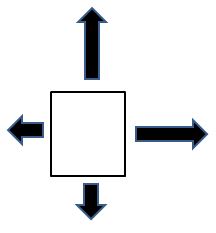
This object would be moving (pick all that are correct):

a)

up

b)

down

c)

left

d)

right

12.
A box slides across a perfectly smooth floor at a constant velocity. (The phrase "perfectly smooth" suggests that there is NO friction). What forces act on the box?
a)
tension, gravity
b)
tension, gravity, normal force
c)
tension, gravity, normal force, friction
d)
gravity, normal force, friction
13.

A squirrel sits on the ground and eats a donut. We know the forces on him must be balanced because...

a)

Forces are always balanced

b)

the squirrel is not accelerating

c)

squirrels are projectiles

d)

he's eating a donut

14.

The person in the picture wants the crate to move to the right at 4.0 m/s. A friction force of 9.0 N to the left is acting on the crate as it slides. The person needs to pull to the right with a force of ---.

a)

4.0 N

b)

9.0 N

c)

13.0 N

d)

anything more than 9.0 N

15.

Friction is a contact force that acts _______ to the surfaces in contact.

a)

parallel

b)

perpendicular

c)

equal

d)

at an acute angle

16.

When an object is moving, friction acts in the _______ direction as the motion.

a)

perpendicular

b)

same

c)

opposite

d)

precise

17.

The type of friction that prevents an object from moving is called _______ friction.

a)

rolling

b)

fluid

c)

kinetic

d)

static

18.

A type of friction that occurs when air pushes against a moving object it to decelerate.

a)

surface area

b)

air resistance

c)

velocity

d)

gravity

19.

How would the absence of friction affect the motion of a marble on a long, straight path?

a)

The marble's speed would decrease.

b)

The marble's speed would remain constant.

c)

The marble's speed would increase.

d)

The marble would stop immediately.

20.

Which of the following is an example of rolling kinetic friction?

a)

A box sliding across the floor.

b)

A car skidding to a stop.

c)

A soccer player making a slide tackle.

d)

A bike being ridden on a road.

21.

What affect would decreasing the normal force between two objects have on the force of friction?

a)

The force of friction would increase.

b)

The force of friction would decrease.

c)

The force of friction would remain the same.

d)

The force of friction would disappear completely.

22.
What does the strength of gravity between two objects depend upon?
a)
Mass & distance
b)
Mass & weight
c)
Gravity & inertia
d)
Inertia & mass
23.
The unit of force is
a)
m/s
b)
m/s^2
c)
newton
d)
kg
24.

Friction is a contact force that acts _______ to the surfaces in contact.

a)

parallel

b)

perpendicular

c)

equal

d)

at an acute angle

25.

A sled is at rest on a slope, held by a rope attached to a pole, as shown. Which forces should be shown on a FBD for the sled?

a)

gravity and the tension in the rope

b)

gravity, the tension in the rope, and the normal force

c)

gravity only

d)

gravity, the tension in the rope, the normal force, and the net force

26.

You are riding on a “free-fall” ride at an amusement park. You hold a coin in front of you and let it go. What will the coin do?

a)

move upward relative you

b)

stay in front of you

c)

move downward relative to you

d)

move outward away from you

27.
A ramp.
a)
Lever
b)
Inclined Plane
c)
Wedge
d)
Screw
28.
What type of simple machine is shown here?
a)
Pulley
b)
Wheel and Axle
c)
Lever
d)
Wedge
29.
Mechanical Advantage:  To reduce the friction of moving something.
a)
Lever
b)
Inclined Plane
c)
Screw
d)
Wheel and Axle
30.
Something similar to a see-saw that can lift an object.
a)
Wedge
b)
Screw
c)
Lever
d)
Wheel and Axle
31.
Mechanical Advantage:  To increase or decrease the applied force.
a)
Lever
b)
Pulley
c)
Wheel and Axle
d)
Screw
32.
Mechanical Advantage:  To change the direction of a force.
a)
Wedge
b)
Pulley
c)
Screw
d)
Wheel and Axle
33.
What type of simple machine is this?
a)
Inclined Plane
b)
Wheel and Axle
c)
Screw
d)
Pulley
34.
What type of simple machine is this?
a)
Pulley
b)
Screw
c)
Inclined Plane
d)
Lever
35.

helps humans to perform tasks much easier in terms of the force they need to apply

a)

Mechanical Advantage

b)

Applied force

c)

newtons 1st law

d)

your mom

36.

What is the difference between Series Circuit and a Parallel Curcuit

a)

Nothing

b)

a Parallel circuit has two or more paths for current to flow through.

c)

the connection isn't as strong like brivas

d)

a series circuit has two or more paths for current to flow through.

37.

resistance is

a)

a force that counteracts the flow of current.

b)

darth vader's army

c)

saying no

d)

the amount of weight something will hold

38.

Work=

a)

A job

b)

Force x mass

c)

Accelaration

d)

FOrce X Distance

39.
Which of the following is not an example of work?
a)
an ice hockey puck laying on an ice rink
b)
ship movement that causes ripples in the water
c)
a man pushing a heavy box across the floor
d)
a magnet repelling a compass needle
40.
Which of the following is not an inclined plane?
a)
wrench
b)
axe
c)
chisel
d)
ramp
41.
In a first-class lever, ...
a)
the effort is located between the fulcrum and the resistance
b)
the fulcrum is located at the end of the lever
c)
the resistance is located between the fulcrum and the effort
d)
the fulcrum is located between the effort and the resistance
42.
First- and second-class levers amplify effort or force. Third-class levers amplify ...
a)
friction
b)
distance
c)
pitch
d)
power
43.
A mechanical advantage of <1 indicates...
a)
you are unable to determine just by the number value
b)
you are at a disadvantage when you use the machine
c)
the whole system is in balance
d)
you are at an advantage when you use the machine
44.
"The total kinetic energies of all particles in an object" describes what kind of energy?
a)
radiant
b)
thermal
c)
electrical
d)
magnetic
45.
A mechanical advantage of 1 indicates ...
a)
you are at an advantage when using the machine
b)
you are unable to determine just by the number value
c)
you are at a disadvantage when using the mcahine
d)
the system is in balance
46.
Which has kinetic energy?
a)
a compressed spring
b)
a book on the bookshelf
c)
an avalanche
d)
a case of dynamite
47.
The majority of the appendage-joint combinations in the human body ...
a)
are 2nd class levers
b)
are 1st class levers
c)
cannot be classified as a specific lever type
d)
are 3rd class levers
48.
Mechanical advantage is expressed ...
a)
in newtons squared
b)
in joules
c)
without any units
d)
in joules squared
49.
In a second-class lever, ...
a)
the effort is located between the fulcrum and the resistance
b)
the resistance is located between the fulcrum and the effort
c)
the fulcrum is located between the effort and the resistance
d)
the resistance is located at the end of the lever
50.
The unit for power is the ...
a)
watt
b)
joule
c)
newton
d)
dyne
51.
Which of the following items represents a second-class lever?
a)
seesaw
b)
tweezers
c)
crowbar
d)
nutcracker
52.

While using a pulley, we apply force in downward direction and bucket of water is lifted in upward direction, is the example of which of the following purpose of machine?

a)

Transfer of force

b)

Enlargement of the effect of force

c)

Change in the speed of work

d)

Change in the direction of force

53.

By using a bicycle we can travel larger distance then by foot in the same interval of time, is the example of which of the following purpose of machine?

a)

Transfer of force

b)

Enlargement of the effect of force

c)

Change in the speed of work

d)

Change in the direction of force

54.

The work done by machine is called:

a)

Effort

b)

Load

c)

Input

d)

Output

55.

The force applied to a machine for doing work is called:

a)

Effort

b)

Load

c)

Input

d)

Output

56.

The ratio between load and effort is called:

a)

Input

b)

Output

c)

Efficiency

d)

Mechanical Advantage

57.

The ratio between output and input is called:

a)

Input

b)

Output

c)

Efficiency

d)

Mechanical Advantage

58.

The efficiency of real machine is always:

a)

Less than 1

b)

Greater than 1

c)

Equal to 1

d)

None of these

59.

Potential energy is associated with ---.

a)

speed

b)

position

c)

direction

d)

temperature

60.

A block starts at rest at point P at the top of a ramp which is height h above the ground. The block slides down one side and up the other, stopping at a point less than h above the ground.

a)

The block did not go as high on the other side because gravity pulls down.

b)

The block did not go as high on the other side because potential energy always has to decrease.

c)

The block did not go as high on the other side because work from friction made the mechanical energy less.

d)

The situation as described is impossible to happen.

61.

If there is no friction on this track, at which point would the coaster have the most kinetic energy?

a)

A

b)

B

c)

C

d)

D

62.

Where is the roller coaster gaining potential energy?

a)

A to B

b)

B to C

c)

C to D

d)

The roller coaster is always losing potential energy

63.
Energy of a rock perched on a cliff is an example of...
a)
gravitational
b)
elastic
c)
chemical
d)
kinetic
64.
Energy from a compressed spring would be an example of...
a)
kinetic
b)
elastic
c)
gravitational
d)
chemical
65.

The SI Unit for Energy is

a)

Joule

b)

Newton

c)

Calorie

d)

Watt

66.
What is the difference between calculating power and work?
a)
Power takes into account the time it takes to complete a task
b)
Work takes into account the time it takes to complete a task
c)
Power is force/area
d)
Work is force/area
67.
During which interval is the object not moving?
a)
B to C
b)
C to D
c)
D to E
d)
only at point A
68.
During which interval is the object traveling at a constant velocity?
a)
B to C
b)
D to E
c)
F to G
d)
it traveling at a constant velocity during all of the intervals shown.
69.
During which interval is the object speeding up?
a)
A to B
b)
B to C
c)
D to E
d)
E to F
70.
Acceleration occurs when an object changes its speed or ______.
a)
direction
b)
force
c)
inertia
d)
mass
71.
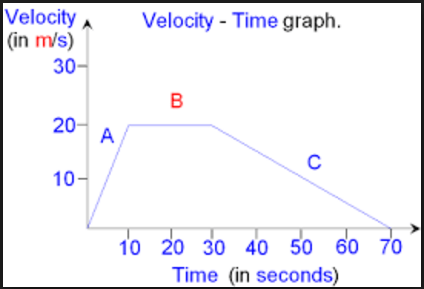
This is a velocity-time graph.  What is the object doing in segment A?
a)
Positive acceleration
b)
Negative acceleration
c)
Constant Velocity
d)
Not moving
72.
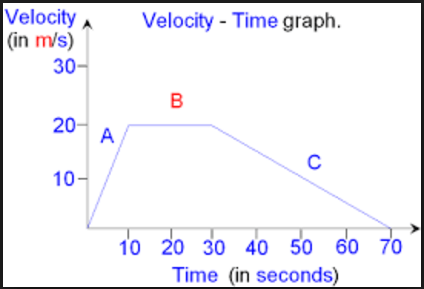
This is a velocity-time graph.  What is the object doing in segment C?
a)
Positive acceleration
b)
Negative acceleration
c)
Constant Velocity
d)
Not moving
73.
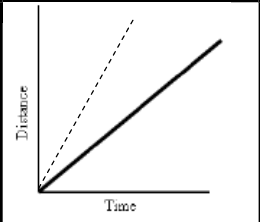
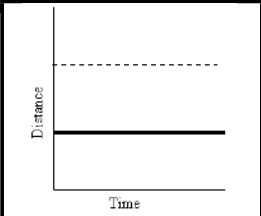
What does this graph represent?
a)
Constant Speed
b)
Acceleration
c)
Not moving
74.
What does this graph represent?
a)
Constant speed
b)
Acceleration
c)
Not moving
75.
The SI unit for acceleration is
a)
mph
b)
m/s
c)
m/s2
76.
Acceleration: is the rate of change in ___________.
a)
speed
b)
distance
c)
velocity 
d)
displacement