wayground logo

Free Printable Worksheets

Font size

S
M
L
XL
Worksheets

Unit 4 Mendel Study Quizizz

Total questions: 100

Worksheet time: 1hrs 16mins

Name
Class
Date
1.
What is true-breeding?
a)
When pollen from a flower fertilizes itself or another flower on the same plant
b)
When pollen from one flower fertilizes a flower on a different plant
c)
A plant whose offspring share the same traits as the parent
d)
A plant whose offspring is genetically different from the parent.
2.
What did Gregor Mendel do in his first experiment?
a)
Self-Pollinated two pea plants
b)
Self-Pollinated two true-breeding pea plants
c)
Cross-pollinated two pea plants
d)
Cross pollinated two true-breeding pea plants
3.
If Mendel's first experiment involved cross-pollinated a true-breeding round pea plant and a true-breeding wrinkled pea plant, what would the genotypes of the parents have to be?
a)
RR x Rr
b)
Rr x Rr
c)
rr x rr
d)
RR x rr
4.
What did Gregor Mendel discovery in the results of his first experiment?
a)
Only the dominant trait appeared!
b)
The offspring were all different!
c)
Only the recessive trait appeared!
d)
The plants were more healthy
5.
What did Gregor Mendel do in his second experiment?
a)
Allowed the first generation to self-pollinate
b)
Allowed the first generation to cross-pollinate
c)
Allowed the first generation to become true-breeding
d)
Allowed the first generation to both self-and-cross pollinate
6.
Originally, Mendel crossed two true breeding plants (RR x rr) for Round and Wrinkled peas. What is the genotype(s) of the offspring that he then allowed to self-pollinate in the first generation?
a)
RR x Rr
b)
Rr x Rr
c)
rr x RR
d)
rr x Rr
7.
What did Mendel discovery in his second experiment?
a)
The recessive trait reappeared!
b)
The dominant trait reappeared!
c)
The ratio was a 1:4
d)
All the offspring were true-breeding
8.
If you cross two heterozygous traits (Rr x Rr), as Mendel did in his second experiment, what ratio will you get between offspring with the dominant and recessive phenotypes
a)
1:1
b)
2:1
c)
3:1
d)
4:1
9.
A trait that is expressed over other traits.
a)
Recessive
b)
Co-dominant
c)
Incomplete Dominant
d)
Dominant
10.
A trait that is not expressed when a dominant allele is present.
a)
Recessive
b)
Co-dominant
c)
Incomplete Dominant
d)
Dominant
11.
The combination of alleles.
a)
DNA
b)
Phenotype
c)
Genotype
d)
Genetics
12.
The physical or behavioral appearance of a trait
a)
Phenotype
b)
DNA
c)
Genotype
d)
Genetics
13.
Two or more combinations of the same gene
a)
Gene
b)
Genotype
c)
Phenotype
d)
Alleles
14.

Humans have _______ pairs of chromosomes, for a total of _______ chromosomes.

a)

10, 20

b)

25, 100

c)

23, 46

d)

46, 92

15.

When an organism has two different alleles, it is called

a)

homozygous

b)

heterozygous

c)

recessive

d)

dominant

16.

When an organism has two of the same alleles, it is called

a)

homozygous

b)

heterozygous

c)

recessive

d)

dominant

17.
T - tall and t = short
In the punnett square below, what belongs in the missing square
a)
tt
b)
Tt
c)
Bb
d)
TT
18.
B = brown fur  b = white fur
In the punnett square, what is the probability for white fur? 
a)
0%
b)
25%
c)
50%
d)
75%
19.
Dominant or recessive?
tt
a)
Dominant 
b)
Recessive
20.
What is the probability of heterozygous offspring?
a)
25%
b)
50%
c)
0%
d)
100%
21.
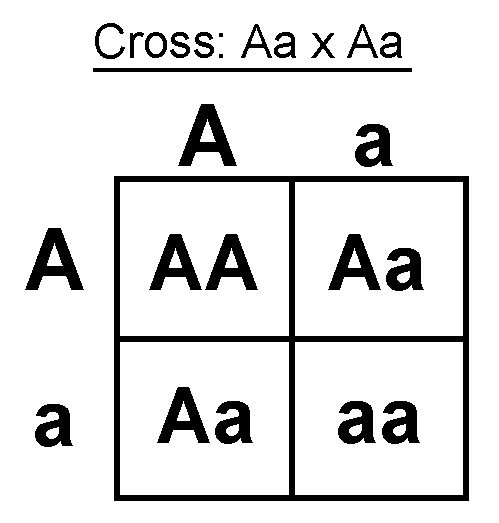
What allele combination should go in the missing box?
a)
AA
b)
Aa
c)
aa
d)
none of these
22.
What is the phenotype of the offspring? (A-Brown hair; a-blond hair) 
a)
50 % Brown Hair and 50% Blond Hair 
b)
25 % Brown Hair and 75% Blond Hair 
c)
75 % Brown Hair and 25% Blond Hair 
d)
0% Brown Hair and 100% Blond Hair 
23.
This image shows a...
a)
Punnett Square
b)
Phenotype
c)
Genotype
d)
Dominant allele
24.

If a heterozygous parent and a homozygous recessive parent mate, what percentage of their offspring will be dominant?

a)

25%

b)

50%

c)

75%

d)

100%

25.
Two brown eyed parents (Bb) have a baby. What is the chance the baby is blue eyed?
a)
0 %
b)
25%
c)
50%
d)
75%
26.
An individual's sex is determined by 
a)
1 of 23 chromosomes
b)
2 of 46 chromosomes
c)
4 of 92 chromosomes
27.
Why is the gene for a disease or disorder more likely to be found on the X chromosome than Y?
a)
The X chromosome has many more genes
b)
The Y chromosome has many more genes
28.
Males are more likely to suffer from a sex-linked disease or disorder because
a)
males are the weaker sex
b)
males have less DNA
c)
males have 1 X chromosome, so the disorder is more likely to be expressed
29.
If a gene is found only on the X chromosome and not the Y chromosome, it is said to be 
a)
sex-linked trait
b)
polygenic trait
c)
codominant trait
d)
incomplete dominance trait
30.
Hemophilia is a recessive x-linked disorder.
Which genotype represents a female who is a carrier for hemophilia?
a)
XHXh
b)
XhXh
c)
XHXH
d)
XhY
31.
Hemophilia is a recessive x-linked disorder.
Which genotype represents a male with hemophilia?
a)
XHXh
b)
XhXh
c)
XHY
d)
XhY
32.

Which chromosome contains more genes?

a)

The X chromosome

b)

The Y chromosome

c)

They are homologous, so they contain the same amount of genes.

33.

Males can be heterozygous for sex-linked traits.

a)

True

b)

False

34.
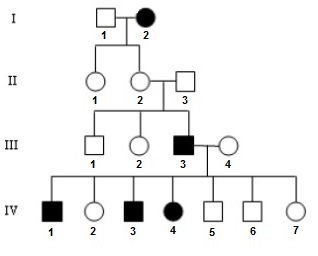
How many generations are shown in this pedigree?
a)
1
b)
2
c)
3
d)
4
35.
How many kids did the mother and father from the first generation have?
a)
2
b)
4
c)
5
d)
6
36.
This pedigree represents the inheritance of hemophilia in this family. How many of the females have the hemophilia trait?
a)
8
b)
5
c)
2
d)
3
37.
What do half colored symbols represent?
a)
The individual is a carrier (heterozygous).
b)
The individual expresses the trait.
c)
The individual has both recessive alleles.
d)
The individual has both dominant alleles.
38.
What does an open circle represent?
a)
Not Affected Male
b)
Not Affected Female
c)
Affected Male
d)
Affected Female
39.
Is this trait (the shaded individuals) dominant or recessive?
a)
dominant
b)
recessive
40.
In the second generation-how many people are carriers of the trait?
a)
2
b)
3
c)
5
d)
6
41.

In this pedigree, which gender can be carriers of colorblindness and not have it?

a)

Just males

b)

Just females

c)

Both genders

42.

Objective #13

This is a pedigree that follows blue eyes which is a recessive trait. What is the genotype of the father (square) in generation 1?

a)

Aa

b)

AA

c)

aa

d)

A?

43.

Huntington's Disease is a dominant trait.

What is the correct genotype for individual I-2?

a)

HH

b)

Hh

c)

hh

d)

H?

44.
Freckles (F) are dominant over nonfreckles.   What is the phenotype of individual #3
a)
Ff
b)
ff
c)
freckles 
d)
nonfreckles 
45.
Which of the following combinations of sex chromosomes represent a female?
a)
XY
b)
XXY
c)
XX
46.

In fruit flies, eye color is a sex linked trait. Red (R) is dominant to white (r). What is the sex and eye color of flies with the following genotype: X R X r ?

a)

male with white eyes

b)

female with red eyes

c)

male with red eyes

d)

female with white eyes

47.

In fruit flies, eye color is a sex linked trait. Red (R) is dominant to white (r). What is the sex and eye color of flies with the following genotype: X R Y ?

a)

male with white eyes

b)

female with white eyes

c)

male with red eyes

d)

female with red eyes

48.

In fruit flies, eye color is a sex linked trait. Red (R) is dominant to white (r). What is the sex and eye color of flies with the following genotype: X r Y ?

a)

male with red eyes

b)

female with red eyes

c)

male with white eyes

d)

female with white eyes

49.

What are the genotypes of these flies:


white eyed, female ?

a)

X R X r

b)

X R X R

c)

Xr X r

d)

X r Y

e)

X R Y

50.

Look at this cross: XB XB x Xb Y

What proportion/percent of the male children are colorblind?

a)

100%

b)

75%

c)

25%

d)

0%

51.

Look at this cross: XBXb x XBY


What proportion of the male children are colorblind?

a)

100%

b)

75%

c)

50%

d)

25%

52.
What is NOT a possible genotype for someone with type B blood?
a)
IBIB
b)
IAIB
c)
IB i
53.

Which of the following is true about blood type O?

a)

It contains antigen A only.

b)

It contains antigen B only.

c)

It contains both antigen A and antigen B.

d)

It doesn’t contain antigen A or antigen B.

54.

In the image above, what is the percentage of the offspring has the possibility of inheriting blood type O?

a)

0%

b)

25%

c)

50%

d)

100%

55.

Which of the following codes for blood type O?

a)

IA IA

b)

IB i

c)

IA IB

d)

ii

56.

A single gene has 3 or more alternative forms. These are called

a)

heterozygotes

b)

multiple alleles

c)

epistatic

d)

polygenic

57.
In mice, the homozygous mice are black and white. The heterozygous mice are gray. What pattern of inheritance is expressed in fur color in mice?
a)
complete dominance and recessiveness
b)
co-dominance
c)
incomplete dominance
d)
pleiotropy
58.
If this image were real, it would represent what type of inheritance?
a)
incomplete dominance
b)
codominance
c)
polygenic inheritance
d)
compete dominance
59.
AB blood type is an example of what type of inheritance?
a)
complete dominance
b)
incomplete dominance
c)
codominance
d)
polygenic inheritance
60.
A red flowered plant (RR) breeds with a White flowered plant (WW). The gene for petal color in these plants expresses incomplete dominance.  What percentage of the offspring will have pink (RW) flowers?
a)
0%
b)
25%
c)
50%
d)
100%
61.
What you see, or the physical appearance.
a)
Genotype
b)
Phenotype
c)
Homozygous
d)
Heterozygous
62.
This is an example of ___________?
a)
Incomplete dominance
b)
Co-Dominance
63.
What type of inheritance is shown?
a)
complete
b)
incomplete
c)
codominance
d)
sex-linked
64.
What do you call the non-Mendelian inheritance pattern that states that neither trait is dominant and the traits appear to blend together?
a)
Codominance
b)
Incomplete dominance
c)
Polygenic traits
65.
Blood types are an example of co dominance and
a)
incomplete dominance
b)
sex linked traits
c)
multiple alleles
d)
polygenics
66.

Which cross could produce a child with blood type A?

a)

IAi x ii

b)

IAi x IBIB

c)

IAIA x IBIB

d)

IBIB x ii

67.
Aa, DD, bB, yy are all examples of
a)
genotypes
b)
phenotypes
68.

What is an allele?

a)

a form of a gene

b)

site of photosynthesis

c)

uses food and oxygen to release energy

d)

controls what enters and exits the cell

69.

Even though a gene may have multiple alleles, a person can can only carry __ of those alleles (one from each parent).

a)

0

b)

1

c)

2

d)

3

70.

Which one is NOT a blood type?

a)

A

b)

AB

c)

O

d)

R

71.

If a person inherits an A allele from one parent, and a B allele from the other parent, what will be their blood type?

a)

A

b)

B

c)

AB

d)

O

72.

If a gene has multiple alleles, WHY can a person only have 2 alleles for the gene?

a)

It's a form of energy.

b)

Chromosomes exist in pairs.

c)

It is the variable being tested.

d)

A person can have more than 2 alleles.

73.

What are the alleles of highlighted box?

(a)  

74.

What are the alleles of highlighted box?

(a)  

75.

What are the alleles of highlighted box?

(a)  

76.

What are the alleles of highlighted box?

(a)  

77.

What are the alleles of highlighted box?

(a)  

78.

What are the alleles of highlighted box?

(a)  

79.

What are the alleles of highlighted box?

(a)  

80.

What are the alleles of highlighted box?

(a)  

81.

What are the alleles of highlighted box?

(a)  

82.

What is the missing allele for this parent?

(a)  

83.

What are the alleles for this parent?

(a)  

84.

ee

a)

Dominant

b)

Recessive

85.

Phenotype or Genotype? HH

a)

Phenotype

b)

Genotype

86.

Phenotype or Genotype? Blue eyes

a)

Phenotype

b)

Genotype

87.

Phenotype or Genotype? Brown skin

a)

Phenotype

b)

Genotype

88.

Phenotype or Genotype? The combination of alleles/letters

a)

Phenotype

b)

Genotype

89.

Phenotype or Genotype? The physical expression/appearance of a gene

a)

Phenotype

b)

Genotype

90.

Phenotype or Genotype? bb

a)

Phenotype

b)

Genotype

91.

What phase of Meiosis is this?

a)

Telophase I

b)

Anaphase I

c)

Anaphase II

d)

Telophase II

92.

What phase is the picture showing?

a)

Metaphase I

b)

Metaphase II

c)

Prophase II

d)

Anaphase I

93.

How many chromosomes are in an egg or sperm cell at the end of Meiosis?

a)

23

b)

46

c)

64

d)

32

94.

In what phase is the DNA of the cell replicated or copied?

a)

Interphase

b)

Prophase I

c)

Telophase I

d)

Metaphase I

95.

Crossing over occurs in what phase of Meiosis?

a)

Prophase I

b)

Prophase II

c)

Metaphase I

d)

Interphase

96.

Homologous pairs line up in the middle of the cell in what phase of Meiosis?

a)

Metaphase I

b)

Metaphase II

c)

Mitosis

d)

Prophase II

97.

When chromosomes cross over they form what?

a)

A tetrad

b)

A spindle fiber

c)

A chromatid

98.

What phase of Meiosis is the picture showing?

a)

Metaphase I

b)

Telophase I

c)

Anaphase II

d)

Telophase II

99.

What phase is shown in the picture?

a)

Prophase I

b)

Prophase II

c)

Telophase II

d)

Anaphase I

100.

What phase is in the picture?

a)

Metaphase 1

b)

Metaphase 2

c)

Prophase 1

d)

Prophase 2