wayground logo

Free Printable Worksheets

NEW

Font size

S
M
L
XL
Worksheets

Central Nervous System _Tenney

Total questions: 50

Worksheet time: 3hrs 47mins

Name
Class
Date
1.
What letter represents the Temporal Lobe?
a)
B
b)
C
c)
D
d)
F
2.

The part of the brain responsible for voluntary movement, conscious though, thinking, learning, and recognizing emotions:

a)

diencephalon

b)

ventricles

c)

cerebrum

d)

cerebellum

3.

On the cerebral cortex, the grooves or valleys that result from an embryological increase in surface area and folding of the cortex:

a)

sulci

b)

gyri

c)

csf

d)

cord

4.
What letter represents the Parietal Lobe?
a)
A
b)
B
c)
C
d)
E
5.

Integrating sensory information and deciding how to respond to it are the primary functions of this part of the body:

a)

central nervous system

b)

sympathetic nervous system

c)

somatic nervous system

d)

peripheral nervous system

6.

Automatic reflex centers for the heart rate, blood pressure, breathing, swallowing, and vomiting

a)

Medulla Oblongata

b)

Pons

c)

Hypothalamus

d)

Thalamus

7.

On the cerebral cortex, the grooves or valleys that result from an embryological increase in surface area and folding of the cortex:

a)

sulci

b)

gyri

c)

csf

d)

cord

8.

Most posterior part of the cerebrum, this process visual information:

a)

occipital lobe

b)

temporal lobe

c)

mamillary body

d)

frontal lobe

9.

What is the name of the structure that connects the two hemispheres?

a)

Cerebrum

b)

Cerebellum

c)

Corpus Callosum

10.

On the cerebral cortex, the ridges that result from an embryological increase in surface area and folding of the cortex:

a)

hemispheres

b)

sulci

c)

gyri

d)

lobes

11.

Superior posterior region of the cerebrum processes sensory information from the body like touch, pressure, and pain:

a)

temporal lobe

b)

occipital lobe

c)

parietal lobe

d)

frontal lobe

12.

Part of the brain stem, serves as a pathway for nerve impulses. It also helps to regulate rate/depth of breathing.

a)

midbrain

b)

pons

c)

medulla oblongata

d)

hippocampus

13.
What is the largest part of the brain?
a)
Thalamus
b)
Cerebellum
c)
Spinal Cord
d)
Cerebrum
14.

Part of the CNS conducts signals between your brain and the rest of the body, and governs many reflexes and muscle patterns like walking:

a)

autonomic nervous system

b)

sympathetic nervous system

c)

spinal cord

d)

parasympathetic nervous system

15.
The nervous system_________
a)
receives information about what is going on in your body as well as what is going on around you. 
b)
tells your body how to react to the information it receives. 
c)
helps your body maintain homeostasis. 
d)
all of the above.
16.
Name the two major parts of the central nervous system.
a)
The brain and the skull. 
b)
The brain and the body.
c)
The spinal cord and the brain.
d)
The spinal cord and the body. 
17.
What are the two divisions of the nervous system?
a)
The brain and spinal cord. 
b)
The central nervous system and the skeletal system. 
c)
The central and peripheral nervous systems. 
18.
A bundle of nerve tissue that links the brain to the nerves in peripheral nerve system is called the________________
a)
brain stem. 
b)
central nervous system. 
c)
spinal cord. 
19.
The brain is made up of three major parts. What are they?
a)
The occipital lobe, the parietal lobe, and the frontal lobe. 
b)
The spinal cord, the cerebrum, and the cerebellum. 
c)
The brain stem, the cerebrum, and the cerebellum. 
20.
The frontal, parietal, occipital, and temporal lobes make up the_______
a)
brain stem.
b)
cerebrum.
c)
cerebellum. 
21.
Which part of the brain controls all involuntary actions?
a)
brain stem
b)
cerebrum
c)
cerebellum
22.
Which part of the brain coordinates the actions of muscles and helps you maintain balance?
a)
brain stem
b)
cerebrum
c)
cerebellum
23.
Which is the stimuli and which is the response?
Sweating
Heat from the sun
a)
Sweating is the stimuli, heat is the response
b)
Heat is the stimuli, sweating is the response
24.

Logical decision making is processed here.

a)

occipital lobe

b)

visual cortex

c)

frontal lobe

d)

thalamus

25.
What part of the brain is Letter B pointing to?
a)
Frontal Lobe
b)
Temporal Lobe
c)
Medulla Oblongata
d)
Parietal Lobe
26.
What is the function of the nervous system?
a)
Transport nutrients around the body
b)
Send and receive messages to respond to a change in an organisms environment
c)
Brings oxygen into the body
d)
Moves body parts
27.
The Brain and Spinal Cord make up the 
a)
Peripheral NErvous System
b)
Central Nervous System
c)
Sensory Nervous System
d)
Motor Nervous system
28.
Controls automatic functions like breathing, heart rate, body temperature, wake and sleep cycles, etc.
a)
cerebrum
b)
cerebellum
c)
basal ganglia
d)
brainstem
29.

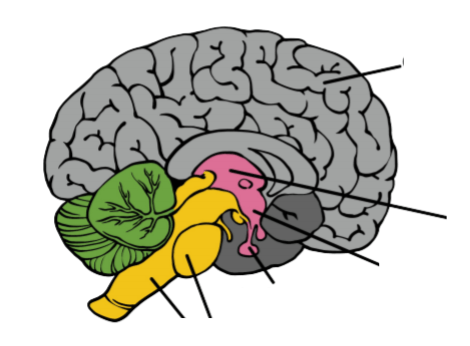
What structure is yellow in this picture. It controls movement of information from brain to rest of body.

a)

Cerebrum

b)

Cerebellum

c)

Brain Stem

30.

Which lobe of your brain are you using to see this question?

a)

frontal

b)

parietal

c)

temporal

d)

occipital

31.

What part of the Brain plays an important role in emotions, especially fear?

a)

Amygdala

b)

Brain Stem

c)

Cerebrum

d)

Hypothalamus

32.

What part of the brain is vital body functions, such as heartbeat, respiration, body temperature and digestion monitored?

a)

Brain Stem

b)

Cerebellum

c)

Frontal Lobe

d)

Hippocampus

33.

Latin for "little brain", the cerebellum is responsible for what actions?

a)

coordinating automated movements

b)

speech

c)

personality

d)

releasing hormones

34.

What is the largest area of the brain?

a)

Cerebrum

b)

Cerebellum

c)

Thalamus

d)

Amygdala

35.

They hypothalamus controls the release of hormones but also does what?

a)

moderates body functions such as sleeping and body temperature

b)

checks information relayed to working memory

c)

controls the excess of the emotional system

d)

fine tunes our thoughts, emotions, and senses

36.

What is the thalamus responsible for?

a)

directs all incoming sensory information to other parts of the brain

b)

moderates body functions such as sleeping

c)

monitors higher order thinking

d)

controls muscle movement

37.
What part of the brain is Letter F pointing to?
a)
Pons
b)
Cerebellum
c)
Medulla Oblongata
d)
Parietal Lobe
38.
What part of the brain is Letter E pointing to?
a)
Frontal Lobe
b)
Temporal Lobe
c)
Occipital Lobe
d)
Parietal Lobe
39.
What part of the brain is Letter E pointing to?
a)
Temporal Lobe
b)
Cerebellum
c)
Medulla Oblongata
d)
Parietal Lobe
40.
What part of the brain is Letter B pointing to?
a)
Frontal Lobe
b)
Temporal Lobe
c)
Medulla Oblongata
d)
Parietal Lobe
41.
What part of the brain is Letter B pointing to?
a)
Temporal Lobe
b)
Cerebellum
c)
Occipital Lobe
d)
Parietal Lobe
42.
What part of the brain is Letter F pointing to?
a)
Pons
b)
Cerebellum
c)
Medulla Oblongata
d)
Parietal Lobe
43.
What part of the brain is Letter D pointing to?
a)
Temporal Lobe
b)
Cerebellum
c)
Occipital Lobe
d)
Frontal Lobe
44.
What part of the brain is Letter A pointing to?
a)
Frontal Lobe
b)
Cerebellum
c)
Medulla Oblongata
d)
Parietal Lobe
45.
What part of the brain is Letter A pointing to?
a)
Temporal Lobe
b)
Parietal Lobe
c)
Occipital Lobe
d)
Frontal Lobe
46.
What part of the brain is Letter D pointing to?
a)
Frontal Lobe
b)
Temporal Lobe
c)
Occipital Lobe
d)
Cerebellum
47.
What part of the brain is Letter G pointing to?
a)
Frontal Lobe
b)
Parietal Lobe
c)
Occipital Lobe
d)
Temporal Lobe
48.
What part of the brain is Letter C pointing to?
a)
Frontal Lobe
b)
Parietal Lobe
c)
Occipital Lobe
d)
Temporal Lobe
49.

Which lobe of the brain is the main decision maker of the brain and controls voluntary movement?

a)

Frontal

b)

Temporal

c)

Parietal

d)

Occipital

50.

Which lobe of the brain primarily processes auditory information?

a)

Frontal

b)

Temporal

c)

Parietal

d)

Occipital