
 Worksheets
Bio 4th 6 Weeks Review
Total questions: 199
Worksheet time: 4hrs 24mins
Human body cells each have 46 chromosomes in their nuclei. Meiosis is necessary in order to ensure that each gamete produced in the human body has —
12 chromosomes
23 chromosomes
46 chromosomes
92 chormosmes
Which would be considered a somatic cell?
Bone cell
Muscle Cell
Skin Cell
Sperm cell
Neuron (Brain cell)

The diagram above shows the process of meiosis. The segregation that occurs during meiosis results in a —
decrease in the total number of cells per organism
reduction in the number of chromosomes per cell
single fertilized egg cell
group of genetically identical cells
Which two biological processes would MOST LIKELY result in offspring genetically different from their parents?
Select TWO correct answers.
DNA replication
Independent assortment
Mitosis
Crossing-over
Asexual reproduction
Gametes produced by an organism contain a combination of genes from that organism. In every gamete, this combination is —
the same because it is created from the same DNA
the same because chromosomes are copied prior to meiosis
different due to DNA replication prior to mitosis
different due to independent assortment during meiosis

Independent (a) occurs in metaphase I. This is where (b) are randomly (c) . Each (d) will have 1 of many different possible (e) of chromosomes.
Which diagram demonstrates how crossing-over contributes to genetic variety during meiosis?


A cellular process is shown.
Which statement best describes the significance of this process?
The process allows organisms to grow and heal.
The process produces clones of the parent organism.
The process copies DNA before cell division.
The process creates genetic variation in the resulting cells.

The diagram illustrates a process that occurs often during meiosis.
The most likely result of this process is —
mutation in gametes
genetically diverse gametes
new types of cells forming
cancer in the ovaries

In the early 1900s, Thomas Hunt Morgan was among the first scientists to contribute to the chromosome theory of heredity. Morgan’s investigations into heredity in fruit flies led him to propose that the event represented in the diagram sometimes occurs. Which statement about the event represented in the diagram is valid?
The event represents RNA translation in the smooth endoplasmic reticulum
The event takes place in bacterial cells
The event produces genetically identical daughter cells
The event provides genetic diversity in eukaryotic cells.


Which table headings should the student use for the two groups?


Which structure can be found in both eukaryotic and prokaryotic cells?
mitochondrion
nucleic acid
nucleus
chloroplast

What additional characteristic (X) belongs in the central section of the Venn diagram?
mitochondrion
chloroplast
ribosome
endoplasmic reticulum

Identify the Venn diagram section(s) which includes prokaryotic cells.
I
II, III, IV
I, II, III, IV
IV
What type of cell is described below?
*contains mitochondria
*contains ribosomes
*reproduces by meiosis
*performs photosynthesis
bacteria
prokaryote
virus
eukaryote

The cell structure labeled X is found only in –
animal cells
eukaryotic cells
plant cells
prokaryotic cells
Which of these is a defining characteristic in a eukaryotic cell?
presence of a membrane bound nucleus
DNA is present
absence of membrane bound mitochondria
reproduces asexually

Is this a picture of a prokaryotic cell or eukaryotic cell?
prokaryotic
eukaryotic

Is this a picture of a prokaryotic cell or eukaryotic cell?
prokaryotic
eukaryotic
When does a concentration gradient occur?
when a solute is equally concentrated in an area
when a solute is more concentrated in one area than another
Molecules always move down a concentration gradient in what direction ?
high to low
low to high
Which of the following are examples of diffusion? (select all that apply
oxygen is moved into the cell
carbon dioxide is moved out the cell
perfume is sprayed and the scent fills the room
water travels across the cell membrane
a large sugar molecule passes across the cell membrane

Some students used vinegar to dissolve away the shells of three eggs and used these eggs as models of human red blood cells. The students observed the changes in the eggs when they were placed in different solutions. Which statement best describes the role of the cell membrane?
The cell membrane allows water to enter and leave the cell.
The cell membrane removes solutes from the environment.
The cell membrane allows solutes to enter the cell, which causes the cell to shrink.
The cell membrane removes solutes from the environment.
What is the movement of particles with the concentration gradient using protein "helpers"?
diffusion
facilitated diffusion
How is facilitated diffusion different from simple diffusion?
facilitated uses membrane proteins for transporting things in and out of the cell
facilitated does not use membrane proteins for transporting things in and out of the cell
What is osmosis?
The diffusion of water across a membrane
The diffusion of gas across a memembrane
When a cell is in a hypotonic solution, there is _____ water on the outside of the cell, and ____ solutes (large molecules) on the inside of the cell
more,
less
less,
more
equal,
equal


What type of solution is this cell in? There is water coming in and the cell has burst.
Isotonic
Hypertonic
Hypotonic
diffused

This egg has shrunk, what type of solution was it placed in?
hypotonic solution
hypertonic solution
isotonic solution

Nemo and other ocean dwelling fish cannot survive in freshwater because......
freshwater is hypertonic to Nemo's cells and will result in water leaving them causing the cells to shrink
freshwater is hypotonic to Nemo's cells and will result in water leaving them causing the cells to shrink
freshwater is hypertonic to Nemo's cells and will result in water entering them causing the cells to swell and burst
freshwater is hypotonic to Nemo's cells and will result in water enter them causing the cells to swell and burst
The cellular process known as the sodium-potassium pump was discovered in the 1950s by Jens Christian Skou, a Danish scientist. This process is a form of active transport that moves three sodium ions to the outside of a cell for every two potassium ions that it moves into the cell. Which of these best explains why energy is needed for active transport?
Ions are moved against the concentration gradient.
Ions are trapped inside the plasma membrane.

A type of cellular transport is shown of energy being used to move a molecules across the cell membrane. Which description best identifies this type of cellular transport?
Active transport, because energy is being used to move molecules against the concentration gradient
Facilitated diffusion, because energy is being used to move molecules with the concentration gradient

A table comparing the characteristics of four samples is shown on the left.
Which sample most likely contains viruses?
Click on the image to enlarge.
Sample 3
Viruses do not have a nucleus, chloroplast or ribosomes
Sample 1
All viruses have a nucleus, chloroplast, and ribosome
Sample 2
Viruses do not have a nucleus nor chloroplast but they have ribosomes
Which structure do cells and viruses have in common?
capsid (outer protein coat)
cytoplasm
ribosomes
genetic material (DNA & RNA)
nucleus
Eukaryotic Cell
nucleus
organelles
DNA
cytoplasm
ribosomes
proteins
Prokaryotic cell
DNA
ribosomes
cytoplasm
proteins
Virus
DNA/RNA
Capsid
proteins
Viruses are much (a) than bacteria (b) . In fact, viruses called bacteriophages attack bacteria cells and use them as a (c) cell to (d) more (e) .

A student states that the capsid has a function similar to the nuclear membrane found in animal cells.
Which of these describes the similar functions of capsids and nuclear membranes? (click on image)
Both transport proteins throughout the structures.
Both provide energy for activities in the structures.
Both protect genetic information for the structures.
Both code for the proteins needed for reproduction of the structures.

The picture shows a 3-D model of a virus called a bacteriophage. Bacteriophages can infect bacteria such as E. coli.
In what way are the bacteriophage and E. coli alike? Select all that apply.
They lack membrane-bound organelles.
They lack a nucleus.
They have nucleic acids.
They reproduce by mitosis.
They contain antibodies.
Which are found in both viruses and cells? (Select all that apply)
Nucleic Acids (DNA/RNA)
Proteins
Ribosomes
Nucleus
Match the following:

bacteria
prokaryotic cell
living

virus
not a cell
non-living

plant cell
eukaryotic cell
living

animal cell
eukaryotic cell
living

The outer structure of a virus is called the ...
capsid (protein coat)
plasma membrane
phospholipid bilayer
cell membrane
The (a) on the surface of the (b) are made out of (c) . Those structures are used to (d) to its host (e) .

A photograph of a virus is shown.
The projections on the surface of this virus allow the virus to —
move inside a host cell
attach to a host cell
control a host cell’s DNA
signal other viruses to infect a host cell
Severe acute respiratory syndrome (SARS) is an illness caused by a coronavirus. Symptoms including a high fever, headaches, and body aches typically occur two to seven days after infection by the virus. SARS is more serious in elderly patients. This information suggests that the reproductive cycle of the SARS virus is —
lysogenic, because the virus is a coronavirus
lytic, because of the quick onset of symptoms after infection
lytic, because the virus causes respiratory illness
lysogenic, because the virus primarily affects older people
Can a virus stay in the lysogenic cycle for a long time?
yes
no
During the lysogenic cycle, a virus can remain domrmant inside the cell for a long time. When it does activate, it will move into the_________ cycle.
copy cycle
lytic cycle
lysogenic cycle
When HIV initially infects a cell, the viral RNA is converted into DNA and then the newly formed DNA is integrated into the host cell’s own DNA. During this time, the infected person might feel flu-like symptoms. After the symptoms go away, the infected person may not have any other symptoms of HIV infection for many years. The integration process that the genetic information from HIV undergoes is part of the —
lysogenic cycle
lytic cycle
What are 2 main parts of the cell cycle?
interphase and M phase
telophase and anaphase
mitosis and meiosis

What phase is this cell in? Chromosomes condense and nuclear envelope breaks down.
Mitosis
Interphase
Prophase
Telophase

What phase is this cell in? Chromosomes are lined up in the middle.
Cytokinesis
Mitosis
Prophase
Metaphase

What phase is this cell in? Chromosomes are being pulled apart towards opposite ends of the cell.
Mitosis
Interphase
Anaphase
Telophase

What phase is this cell in? Two nuclei are now visible, but cell has not yet divided.
Mitosis
Cytokinesis
Prophase
Telophase

What part of the cell cycle is this cell in? Cleavage furrow present , cytoplasm has divided.
Mitosis
Interphase
Telophase
Cytokinesis

In what phase does chromatin condense and coil to form chromosomes?
Mitosis
Interphase
Prophase
Anaphase

Metaphase
Prophase
Anaphase
Telophase

Cytokinesis
Metaphase
Prophase
Telophase

Prophase
Interphase
Metaphase
Anaphase

mitosis
interphase
cytokinesis
somatic
Reorder the following stages of mitosis.


Which of these must occur during S phase of the cell cycle so that two daughter cells can be produced during M phase?
The DNA must be replicated.
The chromosomes must be joined.
The cytoplasm must be separated.
The cell membrane must be expanded.

What is the next phase of mitosis comes after this picture?
Which image shows anaphase?


Oncogenes are mutated forms of genes. Oncogenes can transform a cell into a tumor cell. Some tumor cells are benign, while others are malignant. How does the presence of an oncogene lead to the formation of a tumor?
ATP production is inhibited.
Cell division is unregulated.
Somatic cell growth is inhibited.
Antibody activity is unregulated.
What are mutations?
changes in the cell's DNA
changes in the cytoplasm
normal DNA
normal RNA
Why are cancer cells never in the G0 phase?
they are always dividing
they never divide
they divide too slowly
they replicate their cytoplasm


In what phase of the cell cycle does DNA replication occur?
G1
S
G2
M
DNA double helix is unwound/unzipped by the enzyme ....
helicase
betaglactase
lipase
RNA polymerase
What is the purpose of DNA replication?
Cut the DNA
Make more cells
Apoptosis
Make a copy (duplicate) the DNA
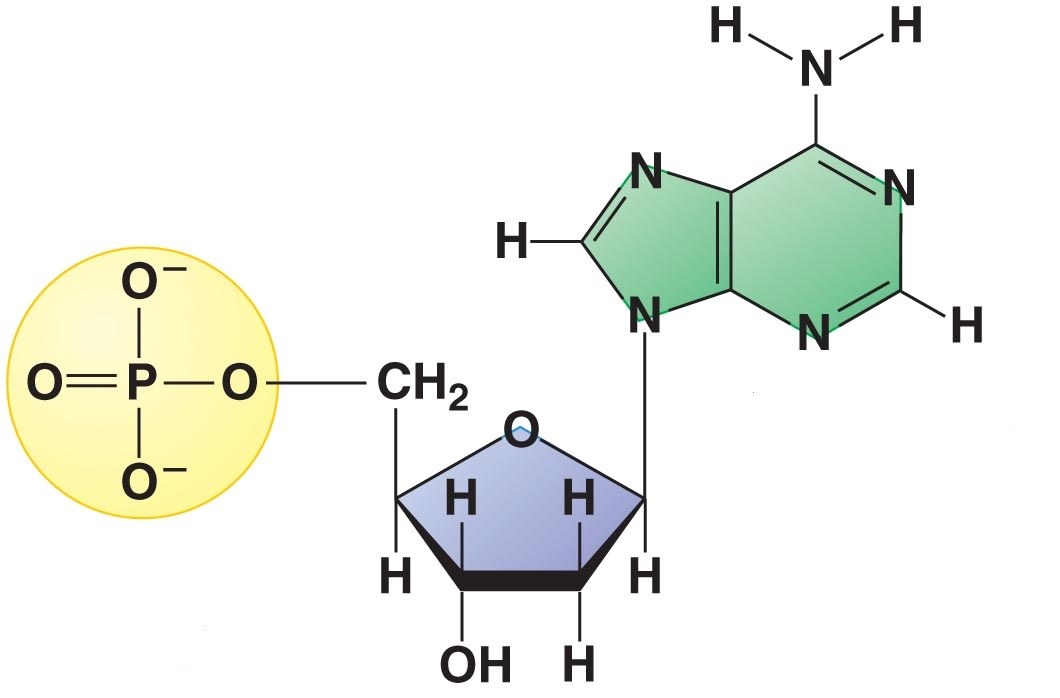
What 3 things make up a nucleotide? (select 3)
sugar (ribose or deoxyribose)
nitrogen base
phosphate group
sulfur group
magic

Who took an X-ray diffraction pattern photo of DNA ?
Rosalind Franklin
James Watson
Fredrick Grifiith
Francics Crick
The genetic code is based on the order and arrangement of
nucleotides (specifically the nitrogen bases ATCG)
the phosphate group
the helical structure
the proteins
The DNA code consists of 4 nucleotides (determined by the bases )which are represented by the letters:
GCTA
ABCD
GTCU
AUTC

Which of the following is a base pair?
Adenine - Cytosine
Cytosine - Thymine
Deoxyribose - Cytosine
Cytosine - Guanine


G = green, g = yellow
The genotype for a yellow plant is...
GG (two capital G's)
Gg ( a capital and lower case G)
gg ( two lower case g's)
all of the choices result in yellow

An organism that has two identical (THE SAME) alleles for a trait (purebred)
homozygous
heterozygous

An organism that has two different alleles for a trait (hybrid)
homozygous
heterozygous
Tt
Enzymes are what biological biomolecule (macromolecule)?
lipid
nucleic acid
protein
carbohydrate
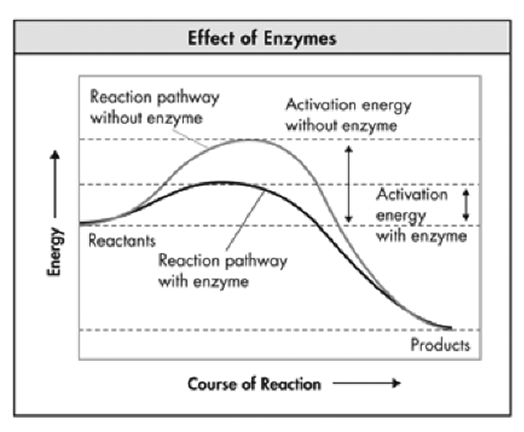
Do enzymes lower or raise the activation energy?
rasie
lower
What is the function of an enzyme?
to speed up reactions
to slow down reactions
Can a change in pH alter the active site of an enzyme?
yes
no
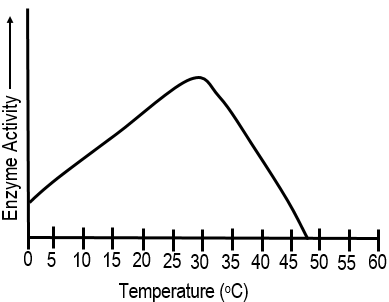
What does a lower temperature do to an enzyme?
nothing
just slows it down
denatures it
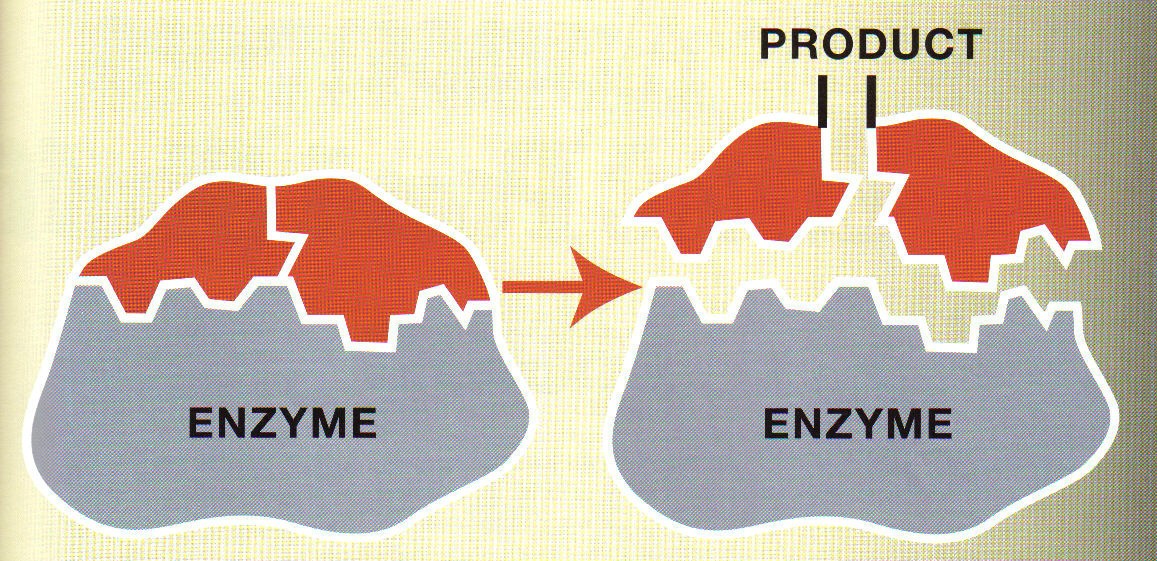
Enzymes speed up reaction rates by lowering the...
activation Energy
hydrogen Bonds
kinetic Energy
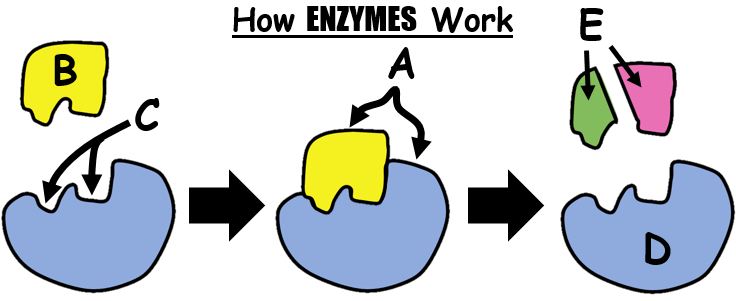
In the diagram, what is letter A? (click on picture to enlarge)
product
substrate
enzyme-substrate complex
active site
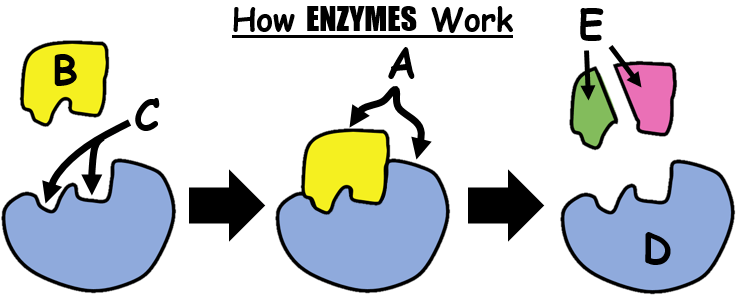
Letter D is the ... (click on picture to enlarge)
active site
enzyme
substrate
products
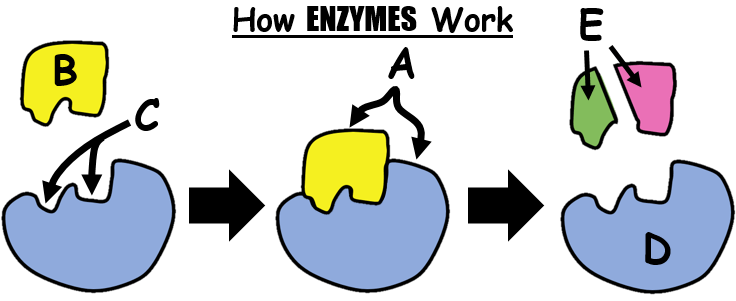
Letter B is the ... (click on picture to enlarge)
active site
enzyme
substrate
products
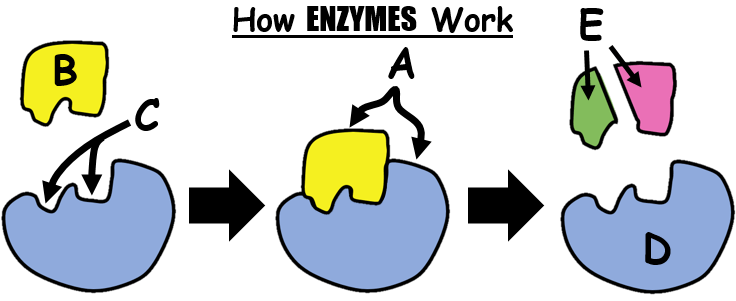
Letter C is the... (click on picture to enlarge)
active site
enzymes
substrate
products
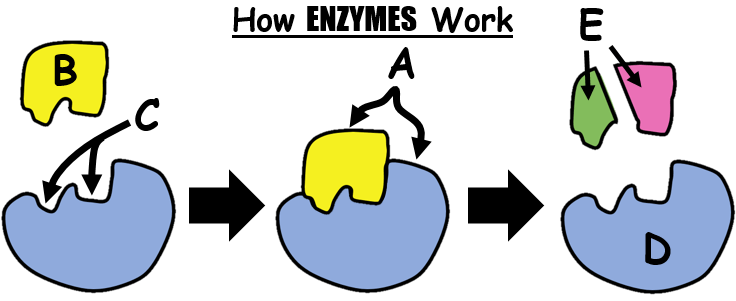
Letter E is the... (click on picture to enlarge)
active site
enzyme
substrate
products

A substance that lowers the activation energy of a reaction is referred to as a:
catalyst
deactivator
inhibitor
a lower activationer
What is activation energy?
minimum energy needed for a reaction to stop
minimum energy needed for a reaction to get started
The reactants in a chemical reaction are known as the ....
substrate
product
A substrate that has been altered (changed) in a chemical reaction are known as the ....
substrate
product
Although enzymes go into reactions, they are never used up. They are recycled. True or False?
True
Falsw
The area where substrate binds to enzyme is called the ...
active site
binding site
enzyme site
catalyst site
During a reaction, when the substrate(reactants) and enzyme come together, what is formed?
enzyme-substrate complex
binary fission
an explosion
substrate enzyme products
Molecules that bind to enzymes and increase their activity are referred to as...
activators
inhibitors
A molecule that binds to an enzyme and decreases its activity is called an...
activator
inhibitor
Our stomachs use an enzyme called _________ that likes acidic environments, and helps break down proteins into smaller peptides and amino acids.
pepsin
amylase
lactase
termilase
An alteration of a protein shape through some form of external stress is know as
denature
premature
enzymatic
hydrophobic
In the CHNOPS abbreviation, what does the N stand for?
Nickel
Nitrogen
All living things on Earth are based on which element?
Carbon
Hydrogen
In CHNOPS, what does the P stand for?
Potassium
Phosphorus
In CHNOPS, what does the O stand for?
Oxygen
Orphium
In CHNOPS, what does the C stand for?
Calcium
Carbon
In CHNOPS, what does the S stand for?
Sulfur
Strontium
In CHNOPS, what does the H stand for?
Hydrogen
Hafnium

What is the primary function of carbohydrates in your body?
Speed up chemical reactions.
Give immediate energy.
A type of biological molecule that includes fats, oils, hormones, waxes, and components of cellular membranes ...
lipids
proteins
Which polymer group is used as STORED, long term energy?
carbohydrate
lipid
Which biomolecule helps form muscles?
Protein
Carbohydrate
Which macromolecule is found in grains, fruits, and vegetables in high amounts?
Carbohydrates
Lipids
Nucleic Acids
What are the 4 most abundant elements in living things?
hydrogen, oxygen, nitrogen, carbon
carbon, manganese, iron, hydrogen
The element _______is found in all of the organic compounds.
Carbon
Nitrogen
Oxygen
Sugars, starches and chitin are examples of
Carbohydrates
Lipids
Glycerol and fatty acids are the building blocks (monomers) of _____.
Carbohydrates
Lipids
The organic molecules that stores and transmits hereditary and genetic information are
_____________.
Nucleic Acids
Proteins
What is the function of proteins?
build skin, hair, nails, muscles
store energy (long-term)
What is the function of carbohydrates?
store energy (short-term)
store energy (long-term)
What is the function of lipids?
store energy (short-term)
store energy (long-term)
Which biomolecule is also known as enzymes?
Protein
Lipid
Nucleic Acid
Which of these are examples of carbohydrates?
starches, glucose, chitin
Fats, hormones
amino acids
Which is a Carbohydrate's monomer?
Monosacharide
Amino acids
Besides being a quick source of energy, carbohydrates also provide:
structural support
long term energy storage
genetic information
Which biomolecule does the subunit amino acids belong to?
Lipids
Proteins
Which biomolecule is made of nucleotides and contain your DNA?
Nucleic Acid
Lipids
Protein
What are the polymers of proteins called?
nucleic acids
polypeptides
What is the carbohydrate that gives plants support called?
cellulose
chitin
glucose
sucrose
Which biomolecules catalyze chemical reactions (enzymes) ?
nucleic acids
proteins
Which biomolecule provides protective waxy coatings, and make up hormones required for communication?
lipids
DNA

Atom → molecule → organelle → cell→ tissue → organ
→ system → organism
→ population → community
→ ecosystem → biosphere.
Taxonomic System
Classification system
Levels of Organization
Periodic Table

The smallest unit that makes up the known elements. (non living)
Molecule
Organelle
Cell
Atom

The smallest unit
of a compound consisting of two or more atoms
bonded together.
Organelle
Cell
Molecule
Atom

Structures in a cell that have specialized jobs.
Similar concept to organs for the human body.
Elevated Chemical Beings
Molecules
Atoms
Organelles

The basic building block of living things, made up of organelles.
Tissue
Organelle
Cell
Atom

Groups of cells with similar functions.
Organs
Molecules
Tissues
Organelles

Group of tissues with similar functions.
Organelles
Cells
Tissues
Organs

Group of organs with similar functions.
Organism
Cell
Organ
System
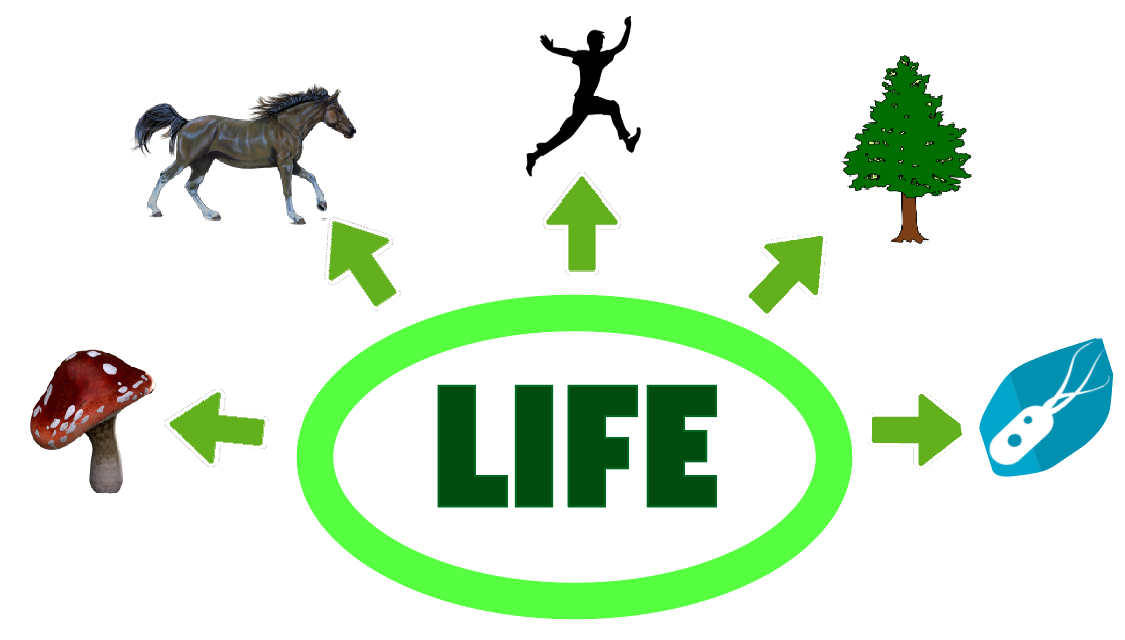
Any single living individual, and can refer to a single human, animal, plant, Protista, bacteria, or fungi.
Community
Cell
Population
Organism/Individual

Organisms who are members of the same species in an ecosystem.
Organism
Population
Organ
Community

Group of populations in an area.
Organism
Ecosystem
Community
Biosphere

A biological community that includes various species and their physical environment (Biotic and Abiotic Factors).
Organism
Community
Biosphere
Ecosystem

Where life is found on earth.
Community
Habitat
Ecosystem
Biosphere

