
 Worksheets
Geoscience process
Total questions: 40
Worksheet time: 36mins
What plate tectonic process creates a deep ocean trench?
Conduction
Deduction
induction
subduction
reduction
What causes plates to move?
Convection under Earth's mantle.
Reversal of Earth's polarity.
Currents in the ocean
Rotation of the Earth's axis.
A new ocean crust forms and old oceanic crust moves away from the mid-ocean ridges during
Convergence
magnetic reversal
sea floor spreading
sea floor not spreading
Two plates of equal density form mountains ranges such as the Himalayan Mountains along
Near divergent boundaries
Continent to oceanic convergent boun
Continent to continent convergent boundaries
Oceanic to oceanic convergent boundaries
Mid-ocean ridges are associated with
divergent boundaries
convergent boundaries
Hot spots
transform boundaries
The ridge in the middle of the Atlantic Ocean formed along a ___________________ boundary.
convergent
transform
divergent
None of these are true

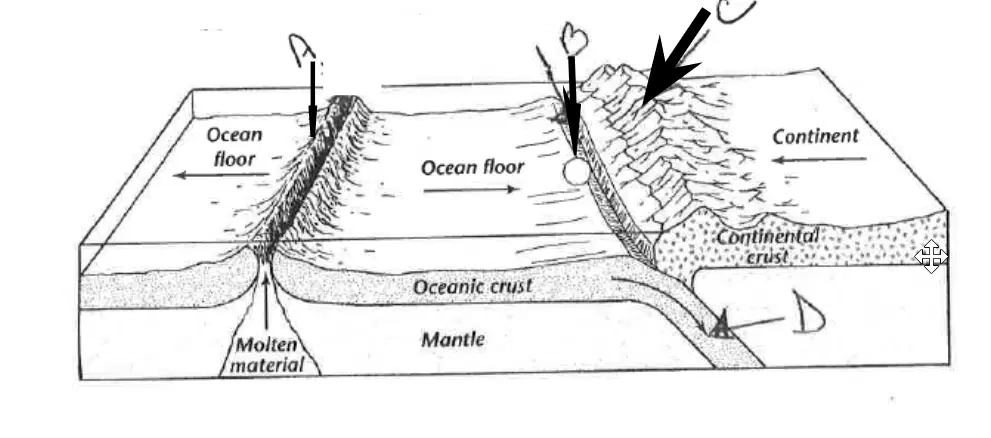
Which feature is represented by “A” in the figure?
Rift
mid ocean rift
trench
None of these.
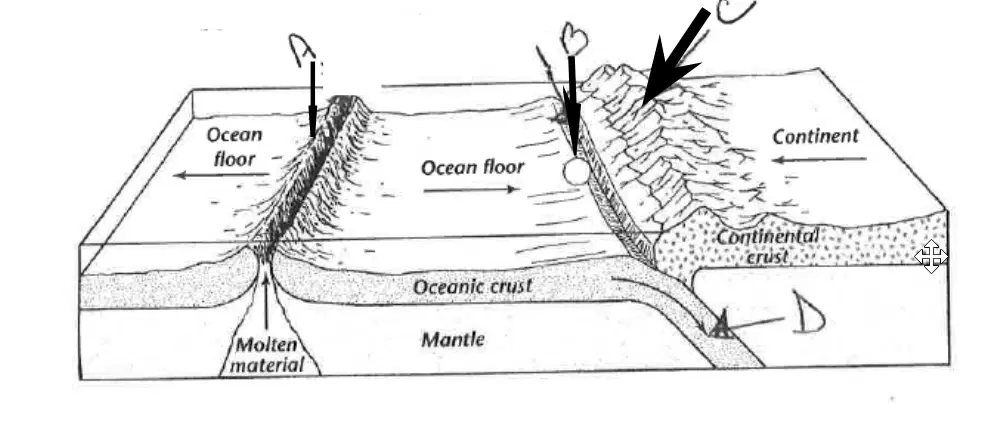
Which feature is represented by “B" the figure?
Rift
Mid-ocean ridge
trench
None of these

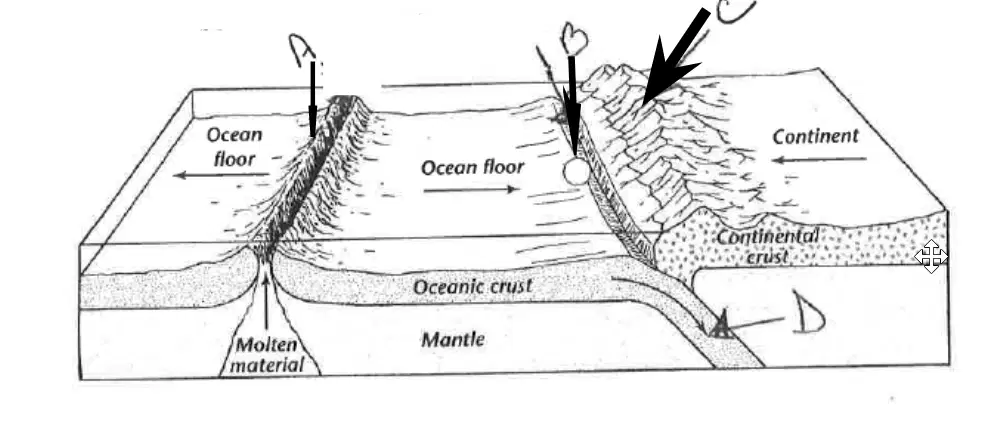
Which feature is represented by “C’ in the figure?
rift
trench
mid-ocean ridge
volcano
None of these
What is process is happening at point “D” in the diagram?
ea floor spreading
subduction
subtraction
forming of very tall mountains like the Himalaya Mountains
forming of mid-ocean ridges

Which statement explains why the oceanic crust in the diagram moves downward
The oceanic crust is less dense than the continental, so it moves downward.
The continental crust is denser than the oceanic, so it moves upward.
The oceanic crust is denser than the continental, so it moves downward.
All are true
None are true
Where is new crust being formed in the diagram?
A
B
C
D
E

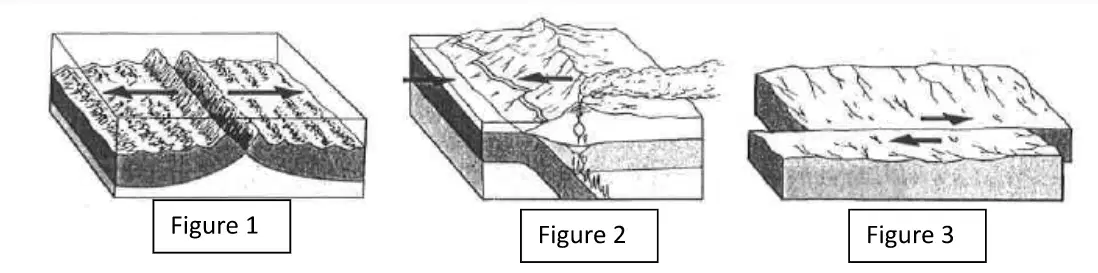
Which figure shows a transform boundary?
1
2
3
NONE OF THEM
Which figure shows a divergent boundary?
1
2
3
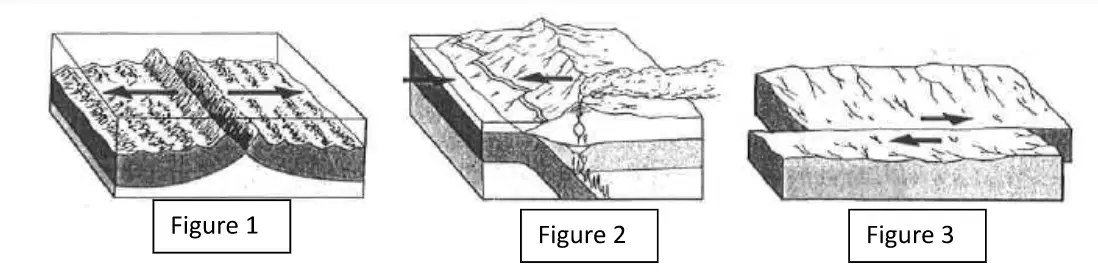
Which figure shows a convergent boundary?
1
2
3
Which type of crust is most dense?
continental
oceanic
both are equally dense
Which is not true?
Continental plates subduct below oceanic plates
Oceanic plates subduct below continental plates
More dense plates subduct below less dense plates
The San Andreas Fault is a result of a ________________boundary.
Divergent
convergent
transform
subduction
mid-ocean ridge
____________ are underwater mountains.
A) riftsB) trenchesC) mid-ocean ridges
rifts
trenches
mid-ocean ridges
convergent plates (coninent to continent)
Which is most correct?
Convection currents have less dense semi-plastic material moving the top and staying there
Mountains are cause by divergent plate boundaries
Convergent plate boundaries can be oceanic to continental
transform plate boundaries create mountains
Mountains cannot stop growing
False
True
Which is an example of weathering
Rain, Sun,
A river washing away shoreline
A landslide
Rain water creating a midslide.
Which is not example of erosion?
Rain, Sun,
A river washing away shoreline
A landslide
Rain water creating a midslide.
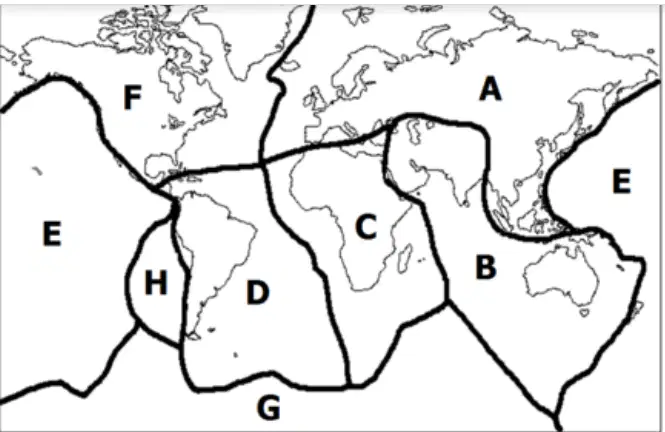
What is the name of the plate with letter A?
African plate
Pacific plate
North American Plate
Austrialian plate
Eurasian
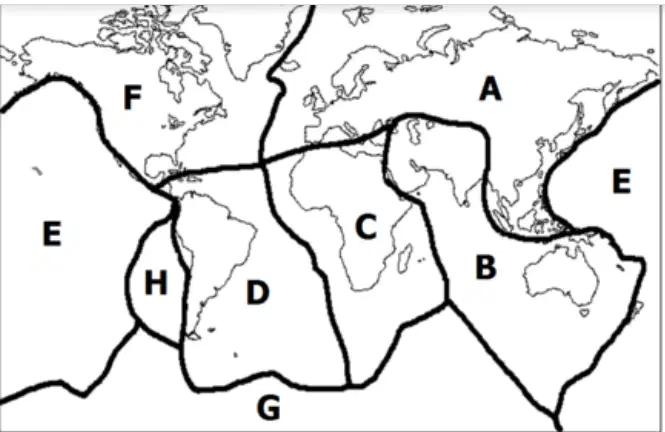
What is the name of the plate with letter B?
African Plate
North American Plate
Indonesia-Austrailian Plate
Eurasian Plate d
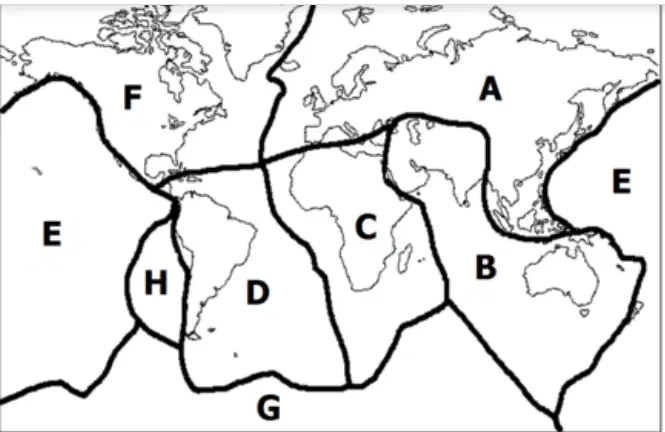
What is the name of the plate with letter C?
African Plate
North American Plate
South American Plate
Pacific plate
Eurasian Plate
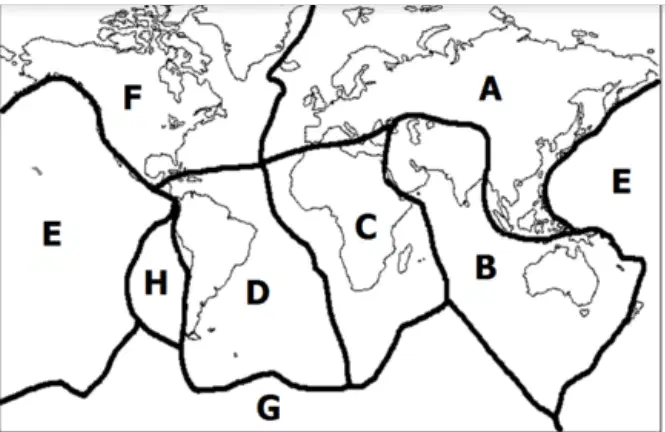
What is the name of plate G
Eurasian Plate
Pacific Plate
Antartic Plate
South American Plate
Juan de Fuca
When Continental plates of equal density collide they form
Rift Valleys
Subduction Zones
Convection Currents
Mountains
Deep ocean trenches.
Magma formed at a subduction zone rises up through magma chambers, where it creates
volcanoes
rifts
trenches
convection currents
When 2 continental plates "diverge" they form
Mountains
convection currents
rifts
Transform boundaries and resulting ______, produce many ______.
faults, earthquakes
Mountains, rivers
subduction zones, earthquakes
_______ are cause as a result of quick release of stress that builds up at a ______.
Earthquakes, Mountains
Mountains, rivers
Earthquakes, transform boundary.
Transform boundary, Earthquake.

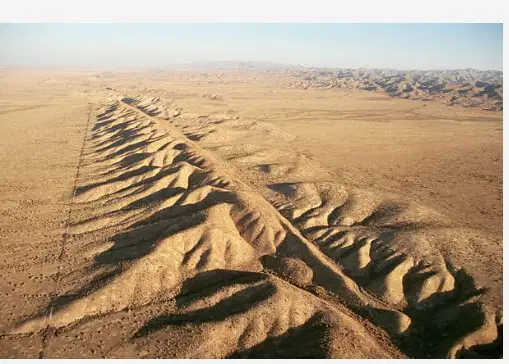
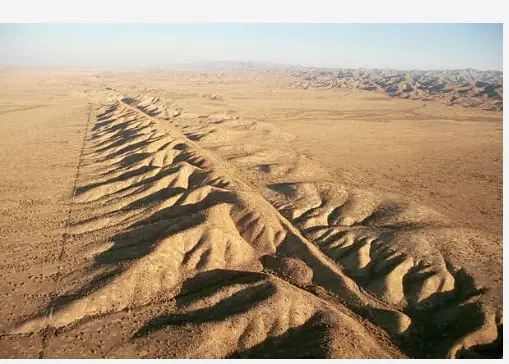
What's the name of this landform?
Deep ocean trench
Mid ocean ridges
fault
Mountain

This is the San Andreas Fault. What type of plate boundary forms this?
Convergent
(oceanic-oceanic)
Convergent
(continent-oceanic)
Divergent
Transform
Direction of plate movement
apart (opposite directions away from each other)
together (towards each other)
opposite (sliding next to each other)
How long to create (time frame)
Slow
catastrophic (fast)

What type of landform is this?
Fault line
Deep ocean trench
Mountain
subduction
What is the directions of the plate movements for this landform?
apart
together
opposite (sliding past each other)
What timeframe does it take for this to occur?
slowly (millions of years)
catastrophic (quickly)
What type of plate boundary forms this this type of landform?
transform
divergent
convergent (oceanic - oceanic)
convergent (continental-continental)

