
 Worksheets
Nervous System Rev Quiz
Total questions: 68
Worksheet time: 28mins
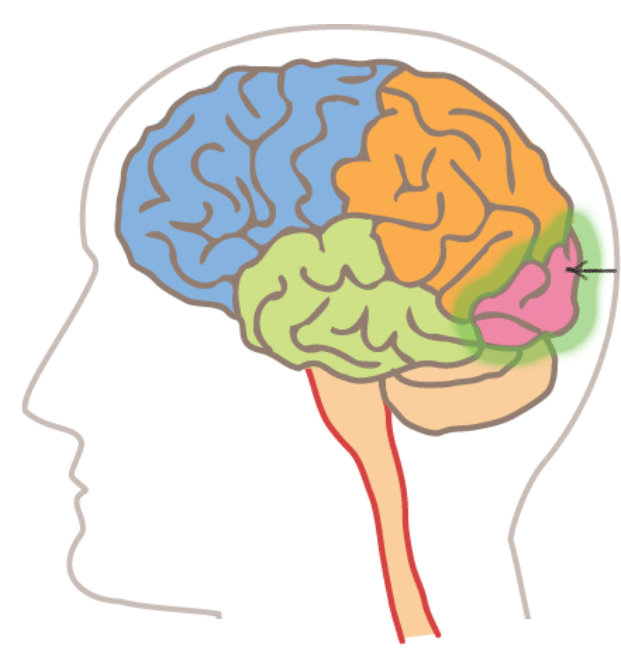
Identify the lobe of the brain highlighted.
Frontal lobe
Parietal lobe
Occipital lobe
Temporal lobe
Responsible for integrating sensory information, including touch, temperature, pressure and pain.
Frontal lobe
Parietal lobe
Occipital lobe
Temporal lobe
Possesses the somotoensory Cortex
Frontal Lobe
Occipital Lobe
Temporal Lobe
Parietal Lobe
Contains a Respiratory Center that controls skeletal muscles associated with breathing.
Cerebellum
Cerebrum
Pons
Medulla Oblongata
Brain Stem
Contains a Respiratory Center that controls smooth muscles that control one's respiratory rate.
Cerebellum
Cerebrum
Pons
Medulla Oblongata
Brain Stem
Contains a Vasomotor Center that controls smooth muscles in blood vessel walls to regulate blood pressure.
Cerebellum
Cerebrum
Pons
Medulla Oblongata
Brain Stem
Contains a Cardiac Center that controls cardiac muscles in the heart to control heart hate and the strength of cardiac contractions.
Cerebellum
Cerebrum
Pons
Medulla Oblongata
Brain Stem
Coordinates and fine-tunes skeletal muscle movements to ensure that muscle contractions lead to smooth movements
Cerebellum
Cerebrum
Pons
Medulla Oblongata
Brain Stem
Damage to the medulla would most likely result in
impaired planning abilities
death
loss of language
blindness
What part of the brain determines emotional reaction, especially involving excitement or fear?
Brain stem
Prefrontal cortex
Hypothalamus
Amygdala
Involved in the formation of new memories and information.
Amygdala
Hypothalamus
Hippocamus
Prefrontal cortex
Controls the secretion of endocrine hormones.
Hippocampus
Amygdala
Hypothalamus
Olfactory bulb
What type of memory would be affected by a lesion to the hippocampus?
Explicit or declarative memory
Implicit or nondeclarative memory
Emotional memory
Smell memory

A
Cell Body
Dendrite
Axon
Schwann Cell
Myelin

E
Cell body
Dendrite
Axon
Schwann cell
Node of Ranvier

F
Neurofibrils
Nissl bodies
Myelin
Nucleus of Schwann cell
Nodes of Ranvier

H
Cell body
Schwann cell
Nodes of Ranvier
Myelin

Unipolar neuron
Bipolar neuron
Multipolar neuron

Unipolar neuron
Bipolar neuron
Multipolar neuron

Unipolar neuron
Bipolar neuron
Multipolar neuron

E
synaptic cleft
neurotransmitter
synaptic vesicle
postsynaptic receptor
axon membrane
After depolarization what happens to restore resting potential? Don't pick the answer with &
Sodium channels open & sodium ions diffuse out of the neuron.
Potassium channels open & potassium ions diffuse into the neuron.
Potassium channels open and potassium ions diffuse into the neuron.
Sodium channels open and sodium ions diffuse into the neuron.
Small cells that engulf and destroy microbes and cellular debris in the CNS
microglia
horns
neuroglia
astrocytes
If you picked up a hot coal, the signal from the sensory neurons in your fingertips would travel to ____________ in your spinal cord.
Sensory Neurons
Motor Neurons
Interneurons
Type of neuron that perceive information about your environment.
Motor Neuron
Interneuron
Sensory Neuron
Type of neuron that sends nerve impulses to muscles and gland, by the command of other neurons.
Motor Neurons
Interneurons
Sensory Neurons
What direction does an electrical signal move?
Dendrite, Cell body, Axon
Cell body, Axon, Dendrite
Cell body, Dendrite, Axon
Axon, Cell Body, Dendrite
A _______ is the specialized sensory receptor that processes chemicals.
photoreceptors
mechanoreceptors
thermoreceptors
chemoreceptors
What type of receptors use the eyes to detect light?
photoreceptors
videoreceptors
thermoreceptors
chemoreceptors
What type of receptors will detect the internal and external temperature of the body?
photoreceptors
mechanoreceptors
light receptors
thermoreceptors
Where are the majority of the sense receptors located in the body?
hair and nails
ears and stomach
hands, feet and face
face and legs
How is the sense of smell related to memory?
There is no connection
Strong memories are associated with feelings that are stored in the brain near smells so they have a strong connection
Memories are built by smell receptors and stored there
Memories and smell use the same receptors
What type of sensory receptors detects touch, pressure and muscle movement?
photoreceptors
mechanoreceptors
chemoreceptors
thermoreceptors
What 2 things determine the speed of conduction of nerve?
Size of diameter of axon
Myelin sheath
Length of axon
Numbers of neurotransmitters
What kind of synapse is faster, has little control and has the neurons touching
chemical
electrical
Mechanical
Pain Neurons
The motor system breaks down into what two systems
CNS/ PNS
Somatic / Autonomic
Parasympathetic/ sympathetic
Afferent/ Efferent
Mediates emotional response and is involved in memory processing.
Limbic system
Hypothalamus
thalamus
Cerebellum
Contains a Cardiac Center that controls cardiac muscles in the heart to control heart hate and the strength of cardiac contractions.
Cerebellum
Cerebrum
Pons
Medulla Oblongata
Brain Stem
taste
frontal lobe
parietal lobe
occipital lobe
temporal lobe

What quality is the LEFT side of the brain NOT responsible for?
Logical Thinking
Language
Exploring
Step by step processes

The RIGHT side of the brain LIKES...
Visualization & Music
Creativity & Exploration
Intuition & Imagination
All of these
The brain is considered fully developed by which age?
6
16
26
36
Damage to which lobe can affect personality and social behaviors?
Parietal Lobe
Frontal Lobe
Temporal Lobe
Occipital Lobe
A patient with no __________ would not feal fear, disgust, or any negative emotions
Cerebellum
Prefrontal cortex
Central sulcus
Amygdala
What layer of mengie is directly on the brain?
Pia
Dura
Arachnoid
1. association neuron
2. skeletal muscle
3. afferent neuron
4. efferent neuron
5. sensory receptor
Choose the sequence below that best represents the order followed in a reflex, from stimulus to response.
What do Axon Terminals do?
Intakes information from other neurons
Produces fatty tissue for the Myelin Sheath
Sends information to the next cell
Controls the speed of electrical signal through the axon
The protective layer around the brain
blood brain barrier
meniges
cerebral spinal fluid
reticular formation
Clear colourless fluid found in the brain and spinal cord that acts as a cushion and buffer providing mechanical and immunological protection
blood brain barrier
meniges
cerebral spinal fluid
reticular formation

