wayground logo

Free Printable Worksheets

Font size

S
M
L
XL
Worksheets

Genetics

Total questions: 87

Worksheet time: 1hrs 25mins

Name
Class
Date
1.
Class period
a)
1
b)
2
c)
3
d)
4
e)
7
2.

Select the phenotype (s)

a)

Hair color

b)

Height

c)

DNA

d)

gg

3.

a gene that can hide the effect of a recessive gene

a)

dominant gene

b)

recessive gene

4.

Which is homozygous

a)

Number one

b)

Number two

c)

Number three

5.

Select the genotype (s)

a)

Hair color

b)

Height

c)

DNA

d)

gg

6.

If something is heterozygous, it is also _____

a)

purebred

b)

hybrid

c)

dominant

d)

recessive

7.

Which is a Heterozygous recessive allele?

a)

TT

b)

Tt

c)

tt

d)

tT

8.
What is the meaning of homozygous?
a)
Combination of the same alleles
b)
Combination of different alleles
c)
Expressed with a single copy of the allele
d)
Requires two alleles to be expressed
9.

Which of the following is a phenotype

a)

bb

b)

Bb

c)

BB

d)

blue eyes

10.

A specific version of a gene is an ______

a)

gene

b)

allele

c)

protein

d)

polypeptide

11.

What is another term for homozygous?

a)

recessive

b)

hybrid

c)

purebred

d)

dominant

12.
What are chromosomes?
a)
the study of heredity
b)
units of inheritance that carry instructions for traits
c)
genetic material that makes up genes
d)
threadlike structures in the nucleus that carry genes
13.

Based on the results in the Punnett square, what are the chances that this couple will have a child with type O blood?

a)

0%

b)

25%

c)

50%

d)

100%

14.

Which is a heterozygous dominant allele?

a)

TT

b)

Tt

c)

tt

d)

tT

15.
Which of the following is a phenotype?
a)
BB
b)
Bb
c)
bb
d)
Blue eyes
16.

When does DNA replication occur? *

a)

S phase

b)

G1

c)

G2

d)

M

17.
Which genotype represents a recessive trait?
a)
AA
b)
Aa
c)
aa
18.

the child or young of two parents

a)

phenotype

b)

species

c)

purebred

d)

offspring

19.

Aa, DD, Bb, yy are all examples of _______

a)

genotypes

b)

phenotypes

20.
Which of the following is a phenotype?
a)
BB
b)
Bb
c)
bb
d)
Blue eyes
21.
Which of the following genotypes would be considered heterozygous?
a)
BB
b)
gg
c)
Ff
d)
TT
22.

Which is heterozygous

a)

Number one

b)

Number two

c)

Number three

23.

A micrograph of the complete diploid set of chromosomes grouped together in pairs, arranged in order of decreasing size.

a)

amniocentesis

b)

karyotype

c)

cytograph

d)

ultrsound

24.
Define the term - Dominant allele.
a)
Combination of the same alleles
b)
Combination of different alleles
c)
Expressed with a single copy of the allele
d)
Requires two alleles to be expressed
25.
A person heterozygous for wet earwax (Ww) mates with a person homozygous recessive for dry earwax (ww). What is the chance their baby is heterozygous?
a)
0%
b)
25%
c)
50%
d)
100%
26.
What is a Punnett Square?
a)
Genetic make-up of a trait.
b)
Physical expression of a trait.
c)
Tool used to display potential probabilities for offspring.
d)
The amount of genes in a given population.
27.

a gene whose expression can be hidden

a)

recessive gene

b)

dominant gene

28.
having two different genes for a trait (sometimes called hybrid).
a)
protein
b)
homozygous
c)
heterozygous
d)
genotype
29.

A homozygous red flower is crossed with a homozygous white flower. Use a Punnett square to determine the probability of one of their offspring having red color.

a)

0%

b)

25%

c)

50%

d)

75%

e)

100%

30.
DNA codes for...
a)
cholesterol
b)
proteins
c)
fatty acids
d)
a sandwich
31.

What is the allele that is ALWAYS expressed?

a)

recessive

b)

dominant

c)

homozygous

d)

heterozygous

32.

Which is a recessive letter

a)

Uppercase : C

b)

Lowercase : c

33.
T - tall and t = short
In the punnett square below, what belongs in the missing square
a)
tt
b)
Tt
c)
Bb
d)
TT
34.
What is genetics?
a)
The study of heredity.
b)
The unit of inheritance that carries instructions for traits.
c)
Structures in the nucleus that carry genes.
d)
Genetic materials that make up genes.
35.

What are different forms of a gene?

a)

hybrid

b)

heterozygous

c)

allele

d)

recessive

36.
How would the DNA sequence GCTATA be transcribed to mRNA?
a)
GCUAUA
b)
CGATAT
c)
CGAUAU
d)
GCUTUT
37.

Which represents the genotype of a homozygous condition? (Choose 2)

a)

BB

b)

Bb

c)

bb

38.

What is the correct order to make a protein?

a)

Protein, DNA, RNA

b)

RNA, DNA, Protein

c)

DNA, RNA, Protein

d)

Protein, RNA, DNA

39.
A phenotype is the...
a)
letter combination
b)
dominant gene
c)
recessive gene
d)
physical appearance
40.

What is the allele that is NOT expressed in a mixed pair?

a)

recessive

b)

dominant

c)

hybrid

d)

heterozygous

41.

One flower is heterozygous red and it is crossed with a heterozygous red plant. Use a Punnett square to determine the probability of one of their offspring having a red color.

a)

0%

b)

25%

c)

50%

d)

75%

e)

100%

42.

Which is a dominant allele?

a)

Lowercase : c

b)

Uppercase : C

43.

When one dominant and one recessive allele are inherited together, the offspring is considered ________.

a)

recessive

b)

homozygous

c)

dominant

d)

heterozygous

44.
Define genotype.
a)
Genetic make-up of a trait.
b)
Physical expression of a trait.
c)
Tool used to display potential probabilities for offspring.
d)
The amount of genes in a given population.
45.
Define phenotype.
a)
Genetic make-up of a trait.
b)
Physical expression of a trait.
c)
Tool used to display potential probabilities for offspring.
d)
The amount of genes in a given population.
46.
Tt is-
a)
homozygous dominant
b)
homozygous recessive
c)
heterozygous
d)
none of these
47.

Having two of the same genes for the same trait

a)

heterozygous

b)

chromosome

c)

protein

d)

homozygous

48.
 Recessive alleles are-
a)
capital
b)
lowercase
c)
both
d)
neither
49.

What do Punnett Squares show

a)

The DNA of organisms.

b)

The probability of offspring inheriting particular genetic combinations.

c)

The mutation that is being processed.

d)

Protein synthesis.

50.

When the genotype consists of a dominant and a recessive allele, the phenotype will be made of a _________________ allele.

a)

Recessive

b)

Dominant

c)

Allele

d)

Homozygous

51.
Tall plants are dominant.  Which statement is true of the plant offspring using this Punnett Square?
a)
50% of the offspring will be short.
b)
75% of the offspring will be tall.
c)
100% of the offspring will be heterozygous.
d)
25% of the offspring will be tall.
52.

An allele that is masked, or hidden, when inherited alongside a dominant allele is considered ________.

a)

recessive

b)

homozygous

c)

dominant

d)

heterozygous

53.
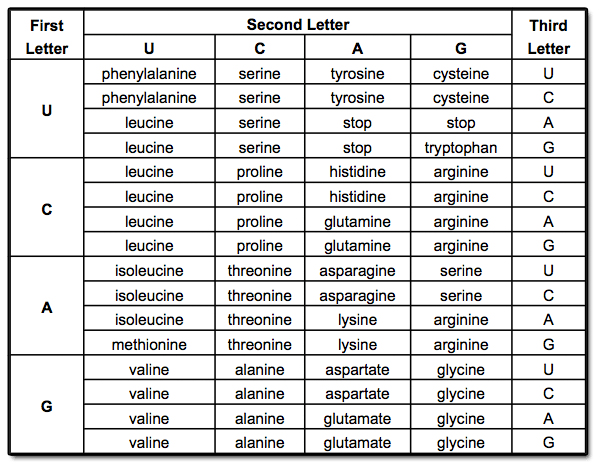
What amino acid is represented by the codon UUA?
a)
Phenylalanine
b)
Tyrosine
c)
Leucine
d)
Stop codon
54.

What is a condition in which an organism inherits two different alleles for a trait?

a)

purebred

b)

homozygous

c)

heterozygous

d)

dominant

55.

What are the base-pairing rules?

a)

principle that bonds in DNA can form only between thymine/guanine and cytosine/adenine

b)

principle that bonds in DNA can form only between cytosine/thymine and adenine/guanine

c)

principle that bonds in DNA can form only between adenine/thymine and between guanine/cytosine

d)

principle that bonds in DAN can form only between two different nitrogenous bases

56.

What is another term for heterozygous?

a)

purebred

b)

allele

c)

homozygous

d)

hybrid

57.

One of two or more alternative forms of a gene that arise by mutation and are found at the same place on a chromosome.

a)

alleles

b)

DNA

c)

dominant gene

d)

inherited

58.

What amino acid does the mRNA AGG get?

a)

SER

b)

ARG

c)

VAL

d)

PRO

59.
Which is the correct phenotype for this organism?
a)
BB
b)
blue
c)
green
d)
bb
60.
What do we call the table used to calculate the probability of an offspring's genotype?
a)
Punnett square
b)
Venn diagram
c)
Golden ratio
d)
Fibonacci sequence
61.

A cell with two complete sets of chromosomes is a ______ cell.

a)

haploid

b)

complete

c)

diploid

d)

organized

62.
What determines the code, or information, of a DNA molecule?
a)
the shape (structure) of the nitrogen bases
b)
the order (sequence) of the nitrogen bases
c)
the color of the nitrogen bases
d)
the frequency (number) of nitrogen bases
63.

Deoxyribonucleic acid, a double stranded helical molecule that carries genetic information.

a)

dominant gene

b)

chromosomes

c)

DNA

d)

gene

64.

An allele that is always expressed when it is present is considered ________.

a)

recessive

b)

homozygous

c)

dominant

d)

visible

65.
Given the following sequence of mRNA, what series of amino acids are coded for?
mRNA: CUCAAGUGCUUC
a)
Ser-Tyr-Arg-Gly
b)
Val-Asp-Pro-His
c)
Leu-Lys-Cys-Phe
d)
Pro-Glu-Leu-Val
66.

TRANSLATION:

This is

a)

tRNA

b)

mRNA

c)

DNA

d)

a ribosome

67.
If one strand of DNA has the sequence TTACCG, the sequence of the other strand of the same molecule will be
a)
AATGGC
b)
TTACCG
c)
AACGGC
d)
AATGGG
68.

What is the "backbone" in RNA made out of?

a)

ribose and phosphate

b)

deoxyrobose and sugar

c)

sugar and nitorgenous bases

69.
What is the genotype for this organism?
(E= 3 eyes, e= 1 eye)
a)
EE
b)
Ee
c)
ee
d)
EE or Ee
70.
Genotype refers to the ...
a)
physical expression of the genes
b)
the possible combination of alleles in a gene
c)
whether an allele is dominant or recessive
d)
how an organism will appear
71.

One flower is heterozygous red and it is crossed with a heterozygous red plant. Use a Punnett square to determine the probability of one of their offspring having a white color.

a)

0%

b)

25%

c)

50%

d)

75%

e)

100%

72.

Sex chromosomes determine an organism’s _______________. All other chromosomes, which do not directly affect an organism’s sex, are called _______________.

(a)  

73.
Sex-linked genes are located on the _____________________.
4 lines
74.
The genes on the Y chromosome are responsible for male / female characteristics.
a)
Male
b)
Female
75.
Gene linkage describes genes that are on the same chromosome and tend to be inherited separately / together.
a)
separately
b)
together
76.

Morgan made several conclusions from his research on fruit flies: Linked genes are on the same _________________. Chromosomes, not genes, assort ________________ during meiosis. Homologous genes can be exchanged through _________________ during meiosis.

(a)  

77.
Select all of the following statements that are true about incomplete dominance.
a)
b. Neither allele is completely dominant.
b)
d. One allele is not hidden in a heterozygote.
c)
f. Heterozygous phenotype is somewhere between the homozygous phenotypes.
d)
a. Both alleles are completely expressed.
e)
c. Neither allele is expressed.
78.
Circle the letter of all of the following statements that are true about codominance.
a)
a. Both alleles are completely expressed.
b)
e. Heterozygous phenotype contains the separate products of both alleles.
c)
b. Neither allele is completely dominant.
d)
c. Neither allele is expressed.
e)
d. One allele is not hidden in a heterozygote.
79.
With a multiple-allele trait, the gene has less than / only / more than two alleles.
a)
less than
b)
only
c)
more than
80.

Genotype is not the only factor that affects phenotype. The (a)   can affect gene expression, which will influence phenotype.

81.

Complete the following sentences, which give examples of how environment and genotype can interact. In sea turtles, sex determination depends on both genes and the __________________ at which sea turtle eggs mature. In humans, height is affected by both genes and factors such as __________________.

(a)  

82.
Select two ways in which genetic inheritance follows similar patterns in all sexually reproducing organisms.
a)
a. All chromosomes can be mapped on a single linkage map.
b)
b. Chromosomes assort independently during meiosis.
c)
c. Genes determine the same phenotypes.
d)
d. Relationships among alleles are the same.
83.
Single-gene traits are useful in studying human genetics because:
a)
a. inheritance is always recessive.
b)
b. inheritance is independent of the gene.
c)
c. inheritance is straight-forward.
d)
d. inheritance is exponential.
84.
Both males and females with a recessive disorder-causing allele can be carriers of a(n) sex-linked / autosomal disorder and pass on the disorder to their offspring.
a)
sex-linked
b)
autosomal
85.
Males / Females are not carriers of sex-linked genetic disorders, because they cannot have a normal, dominant allele to mask the effect of a recessive, disorder-causing allele.
a)
Males
b)
Females
86.

A pedigree is a chart that traces phenotypes and (a)   in a family.

87.
A pedigree can tell you whether a gene is most likely on an autosome or on a sex chromosome. The gene is most likely autosomal if:
a)
a. only males show the phenotype.
b)
b. all females and a few males show the phenotype.
c)
c. all males and a few females show the phenotype.
d)
d. approximately the same number of males and females show the phenotype.