wayground logo

Free Printable Worksheets

NEW

Font size

S
M
L
XL
Worksheets

HB Genetics Review 2023

Total questions: 42

Worksheet time: 42mins

Name
Class
Date
1.
What do we call the result of the genotype (for example, the color of the peas)?
a)
Visible traits
b)
Physiotrait
c)
Genotype 2
d)
Phenotype
2.
If green is dominant over purple, then what is the genotype for this individual?
a)
Purple
b)
Green
c)
GG
d)
gg
3.
Tt is-
a)
homozygous dominant
b)
homozygous recessive
c)
heterozygous
d)
none of these
4.
this image is an example of
a)
codominance
b)
dominance
c)
incomplete dominance
5.
A breed of chicken shows codominance for feather color. One allele codes for black feathers, another codes for white feathers. The feathers of heterozygous chickens of this breed will be:
a)
all black
b)
all white
c)
all gray
d)
speckled black and white
6.
Based off this punnett square, what fraction of the offspring will have wrinkled, yellow seeds?
a)
9/16
b)
3/16
c)
1/16
d)
16/16
7.

What goes in box 3

a)

Aabb

b)

AABB

c)

AAbb

d)

aaBb

8.

A white mouse with red eyes is crossed with a black mouse with brown eyes. The white mouse is recessive for both of its traits. The black mouse is dominant for both of its traits.

This cross would be

a)

BBEE x bbee

b)

BBEe x BbEe

c)

BbEE x BbEe

d)

BBee x BBEE

9.
If two parents are heterozygous for type A blood, what is the probability that their offspring would have type O blood?
a)
100 %
b)
75%
c)
50%
d)
25%
10.
What types of blood can a person with AB RECEIVE?
a)
B only
b)
AB, A, B, O
c)
AB and O only
d)
A only
11.
If a red blood cell has no antigens on its surface, what is its blood type?
a)
A
b)
B
c)
AB
d)
O
12.
What type of inheritance is determined by multiple genes located at different loci on different chromosomes and there can be a range of traits?
a)
Codominance
b)
Incomplete dominance
c)
Polygenic traits
13.
An interaction where one gene masks another gene is called:
a)
Polygenic Traits
b)
Epistasis
c)
X-Chromosome Inactivation
d)
X-linked traits (same as sex-linked)
14.
What causes genetic variation in meiosis?
a)
chromosomes lining up
b)
crossing over of chromosomes
c)
separation of chromosomes
d)
chromosomes pulling apart
15.
What kind of cells are made in MEIOSIS?
a)
Haploid cells
b)
Diploid Cells
c)
Skin Cells
d)
Liver Cells
16.
The chromosomes that pair up during meiosis, are called __________ chromosomes.  
a)
homozygous 
b)
asexual
c)
homologous
d)
genes
17.
When homologous chromosomes match up, they form a structure call a ___________.
a)
tetrad (pair of chromosomes, one from mom and one from dad)
b)
triad
c)
diploid
d)
quad (group of 4 replicated chromosomes, 2 from mom and 2 from dad)
18.
What phase is represented?
a)
metaphase 1
b)
metaphase 2
c)
anaphase 1
d)
anaphase 2
19.
A male shark has 40 chromosomes in each of its sex cells. How many would be present in its body cells?
a)
20
b)
40
c)
80
d)
160
20.
The result of meiosis is:
a)
two diploid cells
b)
two haploid cells
c)
four diploid cells
d)
four haploid cells
21.
What phase is shown here?
a)
Telophase II
b)
Anaphase II
c)
Metaphase I
d)
Interphase I
22.
What phase is shown here?
a)
Telophase I
b)
Metaphase II
c)
Telophase II
d)
Anaphase I
23.
The visual representation of an individual's chromosomes is a 
a)
phenotype
b)
genotype
c)
karyotype
d)
stereotype
24.
Hemophilia is a recessive x-linked disorder.
Which genotype represents a female who is a carrier for hemophilia?
a)
XHXh
b)
XhXh
c)
XHXH
d)
XhY
25.
Hemophilia is a recessive x-linked disorder.
Which genotype represents a male with hemophilia?
a)
XHXh
b)
XhXh
c)
XHY
d)
XhY
26.

In fruit flies, eye color is a sex linked trait. Red (R) is dominant to white (r). What is the sex and eye color of flies with the following genotype: X R X r ?

a)

male with white eyes

b)

female with red eyes

c)

male with red eyes

d)

female with white eyes

27.
Duchenne muscular dystrophy is a recessive x-linked disorder.
According to the Punnett square, what percentage of male offspring will have the disorder?
a)
0%
b)
25%
c)
50%
d)
100%
28.
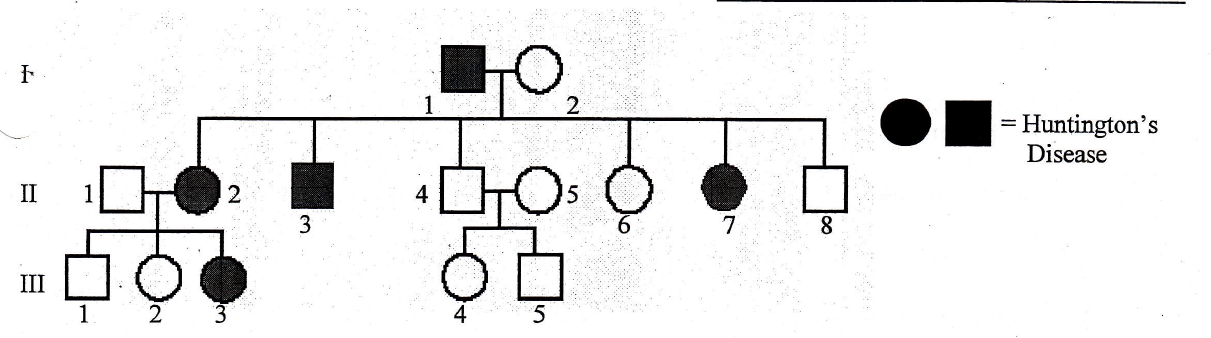
There are no carriers for Huntington's Disease- you either have it or you don't. Is Huntington's disease caused by a dominant or recessive trait?
a)
Dominant
b)
Recessive
29.

The pedigree shows the inheritance of a recessive disorder. If indivduals 5 & 6 have another child, what is the chance that their second child will inherit the disorder?

a)

0%

b)

25%

c)

50%

d)

75%

30.
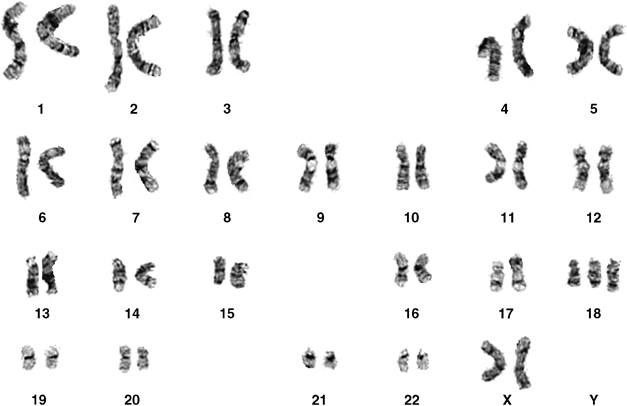
What is the chromosomal condition of the individual whose karyotype is seen in the image?
a)
Monosomy X (Turner's Syndrome)
b)
Trisomy 21 (Down's Syndrome)
c)
Trisomy 13 (Patau Syndrome)
d)
Trisomy 18 (Edwards's Syndrome)
31.
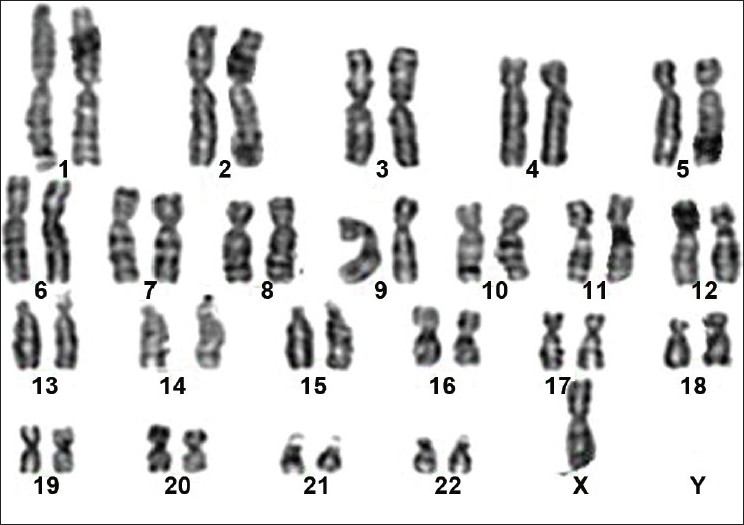
a)
This karyotype shows Trisomy 21
b)
This karyotype has no abnormality
c)
This karyotype is missing a sex chromosome (monosomy x)
d)
This karyotype is from a gamete
32.

Error in meiosis in which the homologous chromosomes fail to separate properly

a)

Meiosis

b)

Gametogenesis

c)

Polar Body

d)

Nondisjunction

33.

Which process does the creation of polar bodies happen?

a)

cytokinesis

b)

mitosis

c)

oogenesis

d)

spermatogenesis

34.

What is the process in which homologous chromosomes pair up during prophase I?

a)

synapsis

b)

tetrad

c)

spermatogenesis

35.

What is the process of maturing the four haploid cells produced by meiosis into mature sperm called?

a)

Spermatogenesis

b)

tetrad

c)

synapsis

d)

polar bodies

36.
all the cells that make up an organism except for the gametes
a)
glial
b)
gametes
c)
somatic
d)
neurons
37.
chromosomes that contain genes for characteristics not directly related to the sex of an organism
a)
homologous chromosomes 
b)
somatic cells
c)
autosomes
d)
sex chromosomes 
38.
organisms only donate one copy of a gene to their gametes
a)
law of segregation
b)
law of independent assortment
c)
crossing over
d)
meiosis
39.
alternative forms of a gene
a)
traits
b)
alleles
c)
phenotype
d)
chromosome
40.
allele pairs separate independently of each other during meiosis
a)
law of segregation
b)
law of independent assortment
c)
homozygous
d)
heterozygous
41.

Q. What gamete possibilities could come from this parent's genotype?

AaBB

a)

AB, AB, aB, aB

b)

Ab, AB, Ab, ab

c)

Ab, Ab, Ab, Ab

d)

AB, aB, ab, aB

42.

A scientist crosses two tall plants and gets the following offspring: 693 tall and 307 short. If the calculated Chi Square is 17.3, is the Ho accepted or rejected?

\

a)

Rejected, the calculated Chi2 exceeds the CV

b)

Accepted, the calculated Chi2 is less than the CV

c)

Accepted, the calculated Chi2 exceeds the CV

d)

Rejected, the calculated Chi2 is less than the CV