Wayground logo

Free Printable Worksheets

Font size

S
M
L
XL
Worksheets

Unit 8 Review - Plate Tectonics

Total questions: 54

Worksheet time: 46mins

Name
Class
Date
1.

Who is the scientist who proposed Continental Drift Theory?

a)
Albert Einstein
b)
Alfred Wegener
c)
Isaac Newton
d)
John Dalton
2.

Alfred Wegener named his single supercontinent ____________, which means "all Earth" in ancient Greek.

a)

Pandora

b)

Gandowandaland

c)

Pangea

d)

Percia

3.
What was Wegener's hypothesis called?
a)

The Theory of Pangea 

b)

The Theory of Moving Continents

c)

The Theory of Continental Drift

d)

The Theory of Techtonic Plates

4.

What type of fossils were noticed by Wegener to be found on two different continents?

a)
Leaves and flowers
b)
Ice and mountains
c)
Plants and animals
d)
Dinosaurs and reptiles
5.

True or False: The continental plates move so quickly that we can feel them.

a)

True

b)

False

6.

Most geologists think that the movement of Earth's tectonic plates is caused by

a)

the rotation of the Earth.

b)

the Earth's magnetic field.

c)

subduction.

d)

convection currents.

7.
A location where two tectonic plates collide is known as a _________ boundary.
a)
Convergent
b)
Divergent
c)
Transform
d)
Spreading
8.

Which layer of Earth flows slowly and causes the crust to move?

a)

Crust

b)

Mantle

c)

Inner Core

d)

Outer core

9.

What is the correct order (starting from the surface) of Earth’s layers?

a)

crust, outer core, inner core, mantle

b)

mantle, outer core, inner core, crust

c)

crust, mantle, outer core, inner core

d)

outer core, inner core, crust, mantle

10.

Subduction means.....

a)

one plate goes under another plate

b)

two plates slide past each other

c)

two plate collide and form folded mountains

11.

Sea-floor spreading explains how.....

a)

new crust is created at a divergent boundary

b)

volcanoes are formed on continents

c)

deep sea trenches are formed

12.
Which of the following causes Earth's tectonic plates to move?
a)
Energy from the Sun
b)
Magnetic Pole Reversal
c)
Convection currents in the mantle
d)
Faults in Mountain Ranges
13.
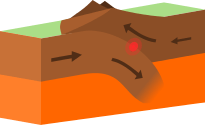
What type of plate boundary is this?
a)
Plate
b)
Divergent
c)
Convergent
d)
Transform
14.
A divergent boundary occurs when plates ....
a)
Pull apart
b)
Come together
c)
Slide past each other
d)
subducting
15.

Which of the following is the name of the ancient supercontinent formed 280 Million Years ago.

a)

Pangea

b)

Gondwanda

c)

Laurasia

d)

Neverland

16.
What geologic feature/event would you most likely to find at a divergent boundary between two pieces of oceanic crust?
a)
Rift Valley
b)
Mid-Ocean Ridge
c)
Island Arc
d)
Flat land
17.
The core is mostly made up mostly of which elements?
a)
Oxygen and Silicon
b)
Silicon and Magnesium
c)
Nickel and Iron
d)
Iron and Magnesium
18.
How are scientist able to estimate the thickness of each layer of the Earth?By studying __________
a)
 radio waves
b)
sonar waves
c)
laser waves
d)
seismic waves
19.
This is the plastic layer of the mantle on which pieces of the lithosphere move.
a)
Lithosphere
b)
Asthenosphere
c)
Mesosphere
d)
Crust
20.
This layer is divided into pieces called tectonic plates.
a)
Mesosphere
b)
Asthenosphere
c)
Mantle
d)
Lithosphere
21.
As you travel from the inner core to the crust, how would temperature, pressure and density of the material change?
a)
The would all increase
b)
The would all decrease.
c)
Nothing, the layers are made of the same material throughout
d)
Temperature would decrease, but pressure and density would increase
22.
Convection currents in the mantle are thought to be the driving force behind tectonic movement. At which location do the convection currents cause the plates to diverge?
a)
strike-slip fault
b)
subduction zone
c)
mid oceanic ridges
d)
folded mountains.
23.
The diagram shows what can occur when two continental plates collide.Which characteristic of the Indian Plate explains why it moves under the Eurasian Plate?
a)
It is larger.
b)
It is denser.
c)
It is molten.
d)
It is younger.
24.

Rocky or rigid outer part of Earth consisting of the brittle crust and the top part of the upper mantle

a)

Lithosphere

b)

Oceanic Crust

c)

Continental Crust

d)

Asthenosphere

25.

Solid, outer layer and is made of both the oceanic and continental crust.

a)

Hydrosphere

b)

Core

c)

Mantle

d)

Crust

26.

Hot fluid or semi-fluid material below or within the earth's crust from which lava and other igneous rock is formed on cooling.

a)

Convection Current

b)

Lithosphere

c)

Core

d)

Magma

27.
What is the process in which hot molten rock rises, then cools and sinks back to the core?
a)
plate tectonics
b)
continental drift
c)
convection
d)
divergence
28.
What type of boundary occurs when two plates slide past each other?
a)
divergent
b)
transform
c)
lateral
d)
convergent
29.
What type of boundary is shown at A?
a)
transform
b)
convergent
c)
divergent
d)
subduction
30.
What is happening at point B?
a)
subduction
b)
a divergent boundary
c)
convection
d)
an earthquake
31.

A map is provided that presents information on a certain region of the Earth. Based on the information on the map, at which location are mountains most likely to form?

a)

A

b)

B

c)

C

d)

D

32.

Tectonic plates:

a)

can move towards each other

b)

can move away from each other

c)

can slide past each other

d)

All of the above

33.

What happens at a divergent boundary?

a)

Crust is destroyed

b)

Crust is created

c)

Crust is neither created nor destroyed

34.
What are the puzzle pieces of the Earth's surface called?
a)
Tectonic plates
b)
Puzzles
c)
Earthquakes
35.

What type of boundary is shown in the diagram?

a)

Divergent

b)

Convergent

c)

Transform

36.

What type of boundary is shown in the diagram?

a)

Divergent

b)

Convergent

c)

Slide/Transform

37.

What type of boundary is shown in the diagram?

a)

Divergent

b)

Convergent

c)

Slide/Transform

38.
The outer layer of the Earth is called the __________.
a)
core
b)
crust
c)
mantle
d)
plates
39.
The liquid layer below the Earth's crust is the
a)
core
b)
lava
c)
magma
d)
mantle
40.

What were 2 kinds of evidence were used to prove that the seafloor spread?

a)

rock formations, WWII shipwrecks

b)

magnetic seafloor stripes, WWII ship logs

c)

magnetic seafloor stripes, age of rocks

41.

Process by which new ocean crust forms.

a)

Seafloor spreading

b)

Continental drift

c)

Mid-ocean ridge

d)

Rift

42.
The OLDEST seafloor is located? 
a)
Closest to the mid-ocean ridge
b)
Farthest from the mid-ocean ridge
43.

The youngest rocks on the ocean floor are located ____.

a)

near continents

b)

at mid-ocean ridges

c)

far from mid-ocean ridges

d)

near Asia

44.

Scientists have observed that the continents move apart or come together at speeds of a few centimeters per ____.

a)

century

b)

year

c)

day

d)

decade

45.

Seafloor spreading occurs because ____.

a)

new material is being added to the asthenosphere

b)

earthquakes break apart the ocean floor

c)

sediments accumulate at the area of spreading

d)

molten material beneath Earth's crust rises to the surface

46.

The process of ___________ continually adds new crust to the ocean floor along both sides of the mid-ocean ridge.

a)

plate tectonics

b)

seafloor spreading

c)

continental drift

d)

convection

47.

Which of the following supports the theory of seafloor spreading? (Choose ONE)

a)

Correlation of rock layers

b)

Continents fitting together like puzzle pieces

c)

Magnetic Reversal recorded in the rocks on both sides of the mid-ocean ridge

d)

Continuous Mountain Chains

48.

The magnetic pattern or stripes of rocks on one side of the mid-ocean ridge are_____________.

a)

the same as the rocks on the other side

b)

younger than other side

c)

much different pattern

d)

at right angles to the ridge

49.
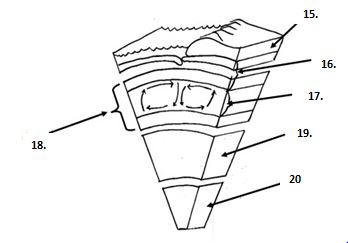
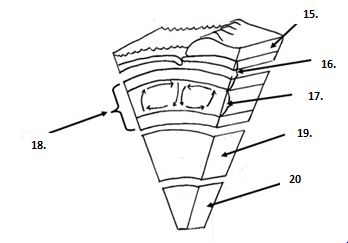
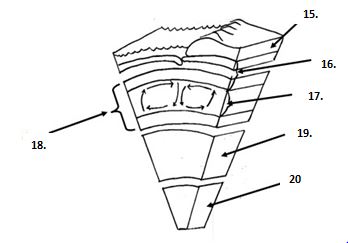
Identify each layer - #20.
a)
mantle
b)
asthenosphere
c)
inner core
d)
outer core
50.
Identify each layer - #15.
a)
Lithosphere
b)
Mantle
c)
Crust
d)
Asthenosphere
51.
Identify each layer - #19.
a)
mantle
b)
lithosphere
c)
inner core
d)
outer core
52.
The soft layer of the mantle on which the tectonic plates move
a)
Asthenosphere
b)
Outer Core
c)
Mantle
d)
Mesosphere
53.
What is the thinnest layer of the earth’s composition?
a)
mantle
b)
inner core
c)
crust
d)
outer core
54.
The thickest layer of the earth is the 
a)
crust
b)
mantle
c)
inner core
d)
outer core