
 Worksheets
Evolution
Total questions: 59
Worksheet time: 43mins
Name
Class
Date
1.
Which of the following terms refers to life coming from other living things?
a)
Abiogenesis
b)
Biogenesis
c)
Spontaneous generation
d)
Endosymbiosis
2.
Which of the following terms is another name for spontaneous generation?
a)
Abiogenesis
b)
Biogenesis
c)
Chemical evolution
d)
Organic evolution
3.
The gradual change in a population/species over time is...
a)
mutation
b)
evolution
c)
adaptation
d)
variation
4.
What is an adaptation?
a)
Any change in an organism
b)
The gradual change in a species
c)
Trait that helps an organism survive and reproduce
d)
When recessive genes are eliminated from a population
5.
Who first introduced the concept of evolution by means of natural selection?
a)
Charles Darwin
b)
Albert Einstein
c)
Gregor Mendel
d)
Francis Crick
6.
Sea turtles lay more than 100 egg at a time. Most of them will not survive. What is this an example of?
a)
Overproduction
b)
Competition
c)
Variation
d)
Natural Selection
7.
In the wild, many organisms have to fight for the same resources. What is this an example of?
a)
Overproduction
b)
Competition
c)
Variation
d)
Natural Selection
8.
What is the role of genes in evolution?
a)
Only traits that are controlled by genes, not behaviors, can be acted upon by natural selection
b)
Changes that organisms acquire during their lifetime are passed down to their offspring through genes
c)
Recessive genes are selected against in evolution
d)
Dominant genes are selected against in evolution
9.

There are green and brown bugs in equal amounts. Birds eat the bugs. Over time, there are more brown bugs than green bugs. What best explains why?
a)
Green bugs were better at hiding
b)
Green bugs were not eaten by the birds and were able to survive and reproduce
c)
Brown bugs are overproducers, making it more likely that they will survive
d)
Brown bugs were not eaten by the birds and were able to survive and reproduce
10.
Suppose after sometime, birds that eat the brown bugs move into the area. Which of the following would you expect as a result?
a)
An increase in brown bugs
b)
An increase in green bugs
c)
A decrease in green bugs
d)
Not enough information given
11.

What type of selection is illustrated by this graph?
a)
Directional
b)
Disruptive
c)
Stabilizing
12.

What type of selection is illustrated by this graph?
a)
Directional
b)
Disruptive
c)
Stabilizing
13.
Process by which individuals that are better adapted to their environment survive a reproduce passing on their genes to the next generation.
a)
Overproduction
b)
Competition
c)
Variation
d)
Natural selection
14.
Most of what scientists know about EXTINCT species is based on...
a)
the fossil record
b)
sedimentary rock
c)
natural selection
d)
variations
15.
Which of the following is NOT a type of evidence used to determine evolutionary relationships?
a)
DNA Sequencing
b)
Overproduction
c)
Embryonic Development
d)
Anatomical Structions
16.
What is theorized to be the first form of life on Earth?
a)
Photosynthesizing Bacteria
b)
Unicellular Eukaryotes
c)
Archaebacteria
d)
Multicellular Eukaryotes
17.
What is theorized to be the last form of life to appear on Earth?
a)
Photosynthesizing Bacteria
b)
Unicellular Eukaryotes
c)
Archaebacteria
d)
Multicellular Eukaryotes
18.
Which of the following best describes a theory?
a)
What scientists believe
b)
An educated guess
c)
Supported by little research
d)
Explanation for a large body of evidence
19.

Using the diagram, which of the following best describes antibiotic resistance?
a)
The virus (orange) causing the sickness will survive and reproduce while taking the antibiotic
b)
Certain bacteria (blue) are resistant to the antibiotic. They survive and reproduce creating a new resistant strain
c)
The virus (blue) causing the sickness will survive and reproduce while taking the antibiotic
d)
Certain bacteria (orange) are resistant to the antibiotic. They survive and reproduce creating a new resistant strain.
20.

What is this diagram called?
a)
Cladogram
b)
Genetic Map
c)
Evolutionary Map
d)
Family Tree
21.
In the diagram, what does Y represent?
a)
Evolution
b)
Speciation
c)
Extinction
d)
Time
22.
Which of the following is true about this diagram?
a)
Fish and sharks are closely related to each other
b)
T-Rex and Dimetredon are most closely related than T-Rex and birds
c)
Reptiles evolve after whales
d)
Whales and fish are closely related to each other
23.
As species evolve, they tend to...
a)
become more complex and better adapted to their environment
b)
become more complex and poorly adapted to their environment
c)
become less complex and poorly adapted to their environment
d)
become less complex and more adapted to their environment
24.

Humans, birds, and reptiles have many bone structures in common. These similar structures are referred to as:
a)
Homologous structures
b)
Embryonic comparisons
c)
Vestigial structures
d)
Analogous structures
25.

Reduced hind legs in snakes are an example of ___ because they no longer sere a purpose in the snake.
a)
Homologous structures
b)
Embryonic comparisons
c)
Vestigial structures
d)
Analogous structures
26.
The evolutionary advantage of sexual reproduction is..
a)
to produce offspring that will be genetically identical to the parents
b)
to produce offspring that will be stronger than the parents
c)
to produce more offspring than with asexual reproduction
d)
to produce offspring that will be genetically varied from the parents
27.
When an organism completely dies out, it is called.....
a)
Adaption
b)
Extinction
c)
Mutation
28.

In the graph shown, how many species of lizards seem to have beneficial adaptations?
a)
1
b)
2
c)
3
d)
4
29.
Mistakes or changes that occur int he DNA sequence are called....
a)
adatations
b)
Darwinism
c)
mutations
d)
natural selection
30.
What do we call similar physical structures that indicate a link to a common ancestor?
a)
adaptations
b)
gradualism
c)
homologous structures
31.

What does this picture model?
a)
DNA structure of the horse
b)
Evolution of the horse
c)
Extinction of the horse
d)
Singular traite of the horse
32.
Which of the following is NOT an example of natural selection?
a)
People selectively breeding hamsters.
b)
Insect populations developing resistance to certain pesticides.
c)
Bacteria becoming resistant to antibiotics.
d)
Male birds of certain species developing colorful feathers to attract female mates.
33.
What characteristic did Darwin observe about the finches on the Galapagos Islands?
a)
Their feathers
b)
Genotypes
c)
Their beaks
d)
Their body sizes
34.
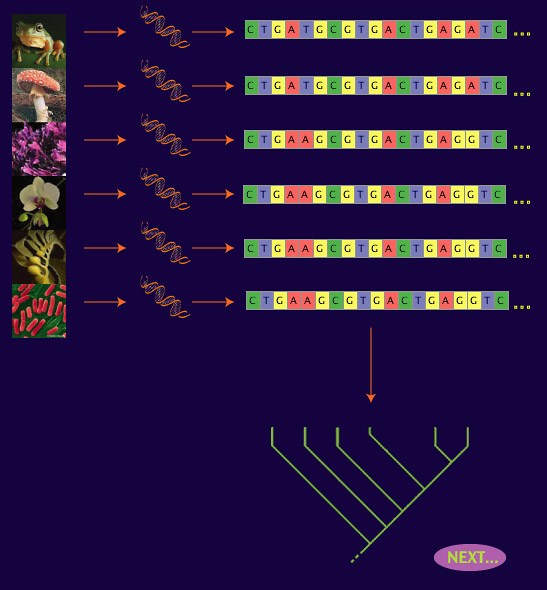
Two organisms that are closely related would have
a)
very similar DNA sequence
b)
exactly the same DNA sequences
c)
no proteins in common
d)
completely different DNA sequence
35.
In natural selection, the selective agent is the
a)
humans
b)
mutations
c)
breeders
d)
environment
36.

Images of the embryo and adult stages of three different organisms are shown.
Which of the following is the best conclusion that can be drawn from this evidence?
a)
These organisms eat the same types of food.
b)
These organisms live in a similar environment.
c)
These organisms share a recent common ancestor.
37.

The process in which organisms with traits well suited to an environment are more likely to survive and to produce offspring is
a)
Natural Selection
b)
Origin of Species
c)
Genetic Principles
d)
Trait Mechanism
38.

Comparing human hemoglobin of chimpanzees, horses, kangaroos, and chickens, reveal that human amino acids are most similar to
a)
Kangaroos
b)
Horses
c)
chickens
d)
chimpanzees
39.
Genetic drift is a process that causes---
a)
The genetic makeup of an entire population to disappear
b)
The genetic makeup of an entire population to be altered
c)
Organisms to better adapt to their environment
d)
Organisms to have the same DNA as their parents
40.
Common baboons live on the savanna in breeding groups called troops. While females tend to stay with the troop, younger or less dominant males may leave to join a neighboring troop.
Which of these is a likely outcome of movement by young males?
Which of these is a likely outcome of movement by young males?
a)
Gene flow occurs between the populations
b)
relative genotypic frequencies reach a constant state
c)
Allele frequencies suddenly change
41.

a measure of how commonly a particular allele occurs in a population is known as the
a)
gene pool
b)
allele frequency
c)
mutation rate
d)
phenotype
42.

What type of evolution is demonstrated in this photo?
a)
Coevolution
b)
Convergent evolution
c)
Punctuated evolution
d)
Gradualistic evolution
43.
A population of chimpanzees was separated when the forest that they lived in had a section cut down and a town was built. After a long period of time, the chimpanzees came back into contact but were incapable of breeding. Which of the following best describes the process that occurred?
a)
adaptation
b)
speciation
c)
convergent selection
d)
stabilizing selection
44.
Genetic drift is change in the allele frequency of a population due to...
a)
random chance
b)
natural selection
c)
non-random mating (sexual selection)
d)
artificial selection
45.
A change in the genetic composition of a population as a result of descending from a small number of colonizing individuals is called:
a)
founder effect
b)
bottleneck
c)
genetic drift
d)
gene flow
46.
A virus killed most of the seals in the North Sea (e.g. dropped the population from 8000 to 800). In an effort to help preserve the species, scientists caught 20 of the remaining seals and used them to start a new population in the northwest Pacific Ocean. Which of the following statements would accurately describe the new population?
a)
The new seal population is genetically less diverse than the original population
b)
The new seal population is genetically more diverse than the original population
c)
There is equal genetic variety compared to the original population
d)
None of the answers
47.
Which of the following is an example of the bottle neck effect?
a)
Bald Eagles are hunted until near extinction, population recovers.
b)
Small group of iguanas floats to an island, starts a new population.
c)
Red fox pups are more likely to survive in a snowy environment if they are born white.
d)
Farmer chooses seeds from largest apples to plant next year. This results in larger apples from year to year.
48.
All of the genetic information found in a population.
a)
population
b)
genetic drift
c)
evolution
d)
gene pool
49.
According to the bead lab, Genetic drift (bottleneck or founder) tends to ___________ genetic variation (diversity)
a)
Increase
b)
Decrease
c)
Stabilize
d)
Exaggerate
50.
Which of the following pieces of evolution evidence deals with similar molecules in related individual species?
a)
fossil record
b)
comparative embryology
c)
DNA comparison
d)
comparative anatomy
51.
Which of the following pieces of evolution evidence deals with comparing similar structures in various species?
a)
fossil record
b)
comparing embryology
c)
comparing biochemistry
d)
comparing anatomy
52.
Which of the following pieces of evolution evidence deals with structures common in embryos that form differently or for different purposes in adult form?
a)
fossil record
b)
comparing embryology
c)
comparing biochemistry
d)
comparing anatomy
53.

The forelimbs of penguin, alligator, bat, human are which of the following?
a)
homologous structures
b)
vestigial structures
54.

Two organisms that are closely related would have
a)
very similar DNA sequence
b)
exactly the same DNA sequences
c)
no proteins in common
d)
completely different DNA sequence
55.

Which best describes these fossils?
a)
The oldest fossils can be found on the lower layers
b)
The oldest fossils can be found at the top layers
c)
The youngest fossils are always found on the bottom layers
d)
You can not tell the age of any of these fossils
56.

Structures with the same parts have different functions; suggests that organisms share a common ancestry
a)
vestigial structures
b)
homologous structures
c)
adaptive radiation
d)
fossil
57.

The diagram above shows an embryo of different vertebrates at different stages of development. Which field of study would support the similarities in development as evidence for evolution?
a)
comparative biochemistry
b)
paleontology
c)
comparative biogeography
d)
comparative embryology
58.
A fossil of an extinct dinosaur is found and the anatomy of the fossil shows similarities to that of a bird. What could this mean?
a)
This is purely by chance and isn't significant
b)
The extinct dinosaur and modern bird share a common ancestor
c)
All dinosaurs evolved into birds and that's why there aren't any dinosaurs alive today
d)
Dinosaurs choose to fly, and evolved into birds to escape predation and capture food
59.
Which of the following pieces of evolution evidence deals with aged and identified fossils?
a)
fossil record
b)
comparative embryology
c)
comparative biochemistry
d)
comparative anatomy
100 %

