
 Worksheets
Bacteria, Virus , & Biotech Review
Total questions: 55
Worksheet time: 54mins
What would happen to a virus if it couldn't find a host cell to invade?
It wouldn't be able to reproduce
It wouldn't be able to travel through the air
Its genetic information would wither away
It would survive indefinitely
What is the whip-like 'tail' that bacteria use for movement?
Cell wall
Ribosome
Flagella
Cytoplasm

An agent that can cause a disease is known as a?

One important way to control the spread of viruses in through
the use of vaccines
drinking a lot of tea
the use of other types of bacteria
the use of antibiotics
What is the type of archaebacteria that lives in very salty environments, such as the Dead Sea.
halophile
thermophile
methanogen
saltogen
Which processes allows for the viruses DNA to lay "dormant" or hide in the host DNA while the cell reproduces?
Lytic
Lysogenic
Enveloped
Capsid

What is the name of the bacteria shape in the image?
Bacilli
Cocci
Spirilla

What is the name of the bacteria shape in the image?
Bacilli
Cocci
Spirilla

What is the name of the bacteria shape in the image?
Bacilli
Cocci
Spirilla
A viruses are considered
Living
Non-living
The first step for both the lytic and lysogenic cycles
is for the virus to virus drill into the cell
is for the virus to explode the host cell
is for the virus to inject inject its' DNA
is for the virus to attach on to the cell
Virus' genetic information contains the code to:
make copies of itself
obtain and use energy
reproduce
grow and develop
A virus that goes through the ______ cycle will allow you to feel symptoms immediately due to the cells lysing.
Lytic
Lysogenic
Thick peptidoglycan in cell wall
Gram positive bacteria
Gram negative bacteria
Thin peptidoglycan in cell wall
Gram positive bacteria
Gram negative bacteria
A bacterium reproduces asexually by dividing to form two new bacterial cells. What is the name of the process by which bacteria reproduce?
meiosis
mitosis
budding
binary fission
Bacteria have short, fine, hairlike appendages called ______
plasmids
flagella
spirillia
pilli
What is the name of a virus that has RNA instead of DNA?
Prophage
Retrovirus
Prions
Viroids
Which of the following are identified as archaeal groups?
Methanogens
Eubacteria
Halophiles
Thermoacidophiles
Bacteria can have the following shapes:
cocci, bacilli, spirilla
cocci, helical, rods
complex, helical, polyhedral
complex, cocci, spirilla, helical
Which of the following types of bacteria live on dead organic matter?
Parasites
Saprophytes
Photoautotrophs
Chemoautotrophs
Which of the following bacteria use energy from inorganic reactions as a source of energy to build glucose?
Parasites
Saprophytes
Photoautotrophs
Chemoautotrophs
What type of bacteria will be killed in the presence of oxygen?
Obligate aerobes
Obligate anaerobes
Facultative anaerobes
Photoautotrophs
Which of the following creates genetic variation among bacteria?
binary fission
conjugation
What process occurs when bacteria break down nitrogen gas into a form that plants can use?
binary fission
conjugation
nitrogen fixation
decomposition
This structure is formed when bacteria are placed into unfavorable growth conditions....
endospore
crystallization
pili
plasmid
Which of the following is a risk of overusing antibiotics to treat infections>
Bacteria may become resistant to antibiotics.
Antibiotics increase the rate of infection.
Antibiotics cause other diseases to develop.
Antibiotics only work once.

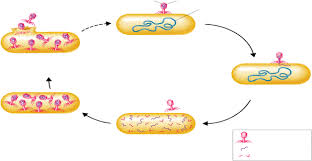
Which viral life cycle kills its host cell by lysing (bursting)?
Lysogenic Cycle
Lytic Cycle
Binary Fission
Conjugation
Which of the following is a true statement about bacteria?
Bacteria exist in only a few environments on earth
Bacteria can grow to extremely large sizes
Most bacteria are harmful to humans
Bacteria can be both harmful and helpful to humans
I have a cell wall that's made of peptidoglycan. I live in most conditions. I am also a single celled prokaryote. Which Domain do I belong to?
Domain Archaea. Only archaea live in most places like the mouth and skin of humans.
Domain bacteria. Only bacteria have cell wall made of peptidoglycan
Domain Eukarya. Only Eukarya are prokaryotes with cell walls.
I am single celled. I am prokaryotic. I have a cell wall that's not made of peptidoglycan. I also live in very extreme conditions. Which domain do I belong in?
Bacteria
Archea
Eukarya

The main difference between GRAM positive and GRAM negative bacteria is?
They have no difference
Ribosomes and nucleoid
Its cell wall
Its scourges
Which disease is caused by a segment of a protein and occurs in cattle?
Ebola
Mad Cow Disease
Flesh-Eating Bacteria
Chickenpox
The clear area around an antibiotic disc that has no bacterial growth is known as ______
Ring of inhibition
Zone of inhibition
Halo of inhibition
Halo Zone
Archaebacteria (Select all that apply)
Live in extremely harsh environments
are the most common type of bacteria
are ancient bacteria
Eubacteria (Select all that apply)
are rare
are common
can be photosynthetic, heterotrophic, or chemoautotrophic
can cause disease
Viruses are surrounded by a protein coat known as a
Capsid
Capsule
Enzyme
Nucleotide
A bacteriophage virus attacks what?
bacterial cells
not sure
animals
plants
Which of the following is a risk of overusing antibiotics to treat infections>
Bacteria may become resistant to antibiotics.
Antibiotics increase the rate of infection.
Antibiotics cause other diseases to develop.
Which statement is true about viruses?
Viruses can eat and metabolize food.
Viruses can reproduce only using a host cell.
Viruses can reproduce on their own at any time.
Viruses contain DNA, so they are alive.
Which of the following is true?
Viruses and bacteria are both prokaryotes.
Bacteria are eukaryotes and viruses are prokaryotes.
Some bacteria are prokaryotes and some are eukaryotes.
All bacteria are prokaryotes.
This is the practice of producing a genetically identical cell or organism
Cloning
Gel Electrophoresis
Genetic Engineering
DNA Fingerprinting
gel electrophoresis

Which suspect left the blood stain?
Bob
Sue
John
Lisa
The insertion of a gene of interest into a bacterial DNA loop is called
recombinant DNA
insertion technique
mutation propagation

Which kitten is most likely the offspring of this cat?
1
2
3
4

