wayground logo

Free Printable Worksheets

Font size

S
M
L
XL
Worksheets

Environmental Science Taxonomy

Total questions: 62

Worksheet time: 1hrs 4mins

Name
Class
Date
1.
Autotroph or heterotroph?
a)
Autotroph
b)
Heterotroph
2.
Autotroph or Heterotroph?
a)
Autotroph
b)
Heterotroph
3.
What is an autotroph?
a)
an organism that can make their own food. 
b)
an organism that cannot make their own food
c)
Herbivore
d)
Omnivore
4.
The 8 levels of classification, most broad to most specific.
a)
Domain, Genus, Family, Order, Class, Phylum, Kingdom, Species
b)
Domain, Species, Kingdom, Genus, Phylum, Family, Class, Order
c)
Domain, Kingdom, Phylum, Class, Order, Family, Genus, Species
d)
Order, Kingdom, Species, Domain, Phylum, Family, Class, Genus
5.
The scientific name for an organism is made from the:
a)
class and family name
b)
genus and species name
c)
domain and kingdom name
d)
kingdom and phylum name
6.
Term given to describe the 2 name naming system is:
a)
dichotmous key
b)
binomial nomenclature
c)
2 scientific names
d)
binomial key
7.
Cells that do not have a true nucleus are called....
a)
eukaryote
b)
prokaryote
c)
unicellular
d)
multicellular
8.
Cells that have a true nucleus are called....
a)
eukaryotes
b)
prokaryotes
c)
unicellular
d)
multicellular
9.
An organism that CANNOT make its own food and must consume other living things:
a)
heterotroph
b)
multicellular
c)
unicellular
d)
autotroph
10.
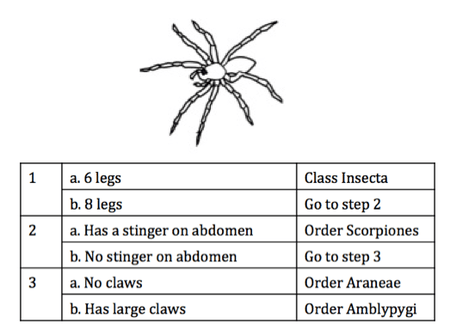
A student discovers an arachnid (spider) with a segmented abdomen, long legs, and a tail with no stinger. The student uses the dichotomous key below to identify it. Which arachnid (spider) has the student found?
a)
Whip Scorpion
b)
Wind Scorpion
c)
Daddy long legs
d)
Scorpion
11.
What is the correct way of writing our scientific name?
a)
homosapiens
b)
homo sapiens
c)
Homo Sapiens
d)
Homo sapiens
12.
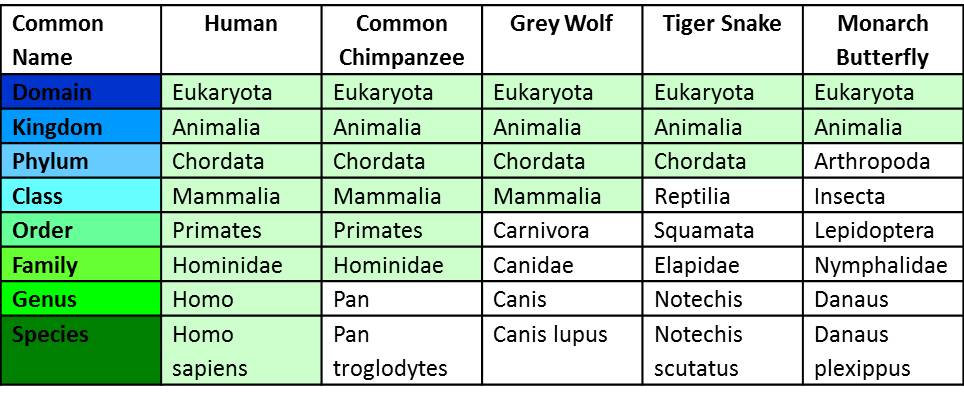
Which organism in the table shown is most closely related to the common dolphin?
a)
human
b)
killer whale
c)
giant kelp
d)
bat star
13.
Why do scientists use the taxonomic system?
a)
To torture Biology students
b)
To avoid confusion in classifying organisms
c)
Because Linnaeus made it
d)
To place organisms in different groups
14.
Which organisms are most closely related?
a)
Equus caballas (Horse) & Equus burchellii (Zebra)
b)
Cyanea artica (Jellyfish) &
Ctenodiscus crispatus (Mud Starfish)
c)
Naja naja (cobra) & Glycine max (soya bean)
d)
Ophiocomina nigra (black brittle star) & Brassica nigra (black mustard)
15.
The science of describing, classifying, and naming living things is called:
a)
Geology
b)
Biology
c)
Taxonomy
d)
Chemistry
16.
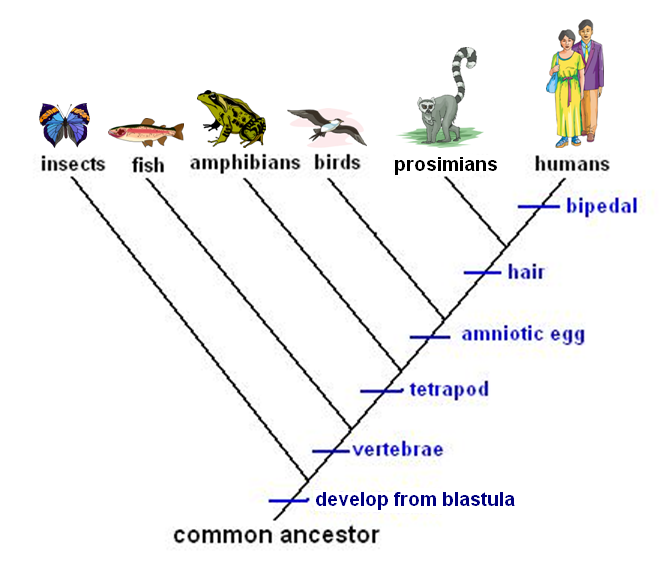
Which organisms pictured on the cladogram have hair?
a)
prosimians only
b)
prosimians and humans
c)
humans only
d)
prosimians and birds
17.
Which organism in the table is least closely related to the chimpanzee?
a)
human
b)
grey wolf
c)
tiger snake
d)
monarch butterfly
18.

Which 2 organisms would be able to reproduce and produce fertile offspring?

a)

2 organisms in the same class

b)

2 organisms in the same family

c)

2 organisms in the same genus

d)

2 organisms in the same species

19.

Some relationships between different organisms are shown in the table.


Which table correctly identifies each type of interaction described?

a)
b)
c)
d)
20.

Field of classifying organisms & assigning each organism a universally accepted name.

a)

Taxonomy

b)

Naming

c)

Phylogeny

21.

Evolutionary history of a species or a group of related species:

a)

Phylogeny

b)

Taxonomy

22.

The groups in a phylogenetic tree are called...

a)

Taxa

b)

Nodes

c)

Roots

d)

Branches

23.

Phylogenetic trees show...

a)

Homologous structures through divergent evolution

b)

Homologous structures through convergent evolution

c)

Analogous structures through divergent evolution

d)

Analogous structures through convergent evolution

24.

Places on a phylogenetic tree where organisms share a common ancestor are called...

a)

Nodes

b)

Branches

c)

Taxa

d)

Species

25.

Phylogeny is...

a)

The study of classification of different species

b)

The study of the evolutionary history of a species

c)

The study of prehistoric life

d)

The study of the distribution of different species

26.
Which organisms pictured on the cladogram have hair?
a)
prosimians only
b)
prosimians and humans
c)
humans only
d)
prosimians and birds
27.
Which organism in the table is least closely related to the chimpanzee?
a)
human
b)
grey wolf
c)
tiger snake
d)
monarch butterfly
28.

Modern Classification (Phylogeny) adds what to Linnaeus's taxonomic criteria?

a)

evolutionary relationships & DNA (biochemical characters)

b)

habitat type

c)

fewer categories than Linnaeus

d)

a naming system called binomial nomenclature

29.

Members of these 2 kingdoms can never make their own food:

a)

animal & fungi

b)

animal & plant

c)

fungi & protist

d)

archaebacteria & eubacteria

30.

From their scientific names, Quercus alba and Quercus rubra, you know that these species of oak trees are in the same _________

a)

phylogeny.

b)

Order

c)

genus

d)

protists

31.

The evolutionary history of a species is its _________, but ________ is the science that groups and names species. (2 are correct).

a)

division

b)

phylum

c)

phylogeny

d)

taxonomy

32.

Which of the following organisms are LEAST closely related?

a)

organisms that share a family

b)

organisms that share a domain

c)

organisms that share a species

d)

organisms that share a genus

33.

A lion and a tiger cannot (on their own) produce living offspring. Why not?

a)

They are not in the same family

b)

They are not he same genus

c)

They are not the same species

d)

They are the same species

34.

Scientists use the scientific name of organisms which is always written in ____ because it is universal.

a)

latin

b)

english

c)

french

d)

spanish

35.

In a cladogram -

a)

the most ancient organisms, called the origin, are found at the very base of the tree diagram.

b)

the closer the branch point is to an organism, the more distantly related those organisms are

c)

neither A nor B are true

d)

both A and B are true

36.
Which organisms are closely related? 
a)
American badger and leopard
b)
coyote and gray wolf
c)
european otter and leopard
d)
coyote and american badger
37.
Which organism in the table is least closely related to the chimpanzee?
a)
human
b)
grey wolf
c)
tiger snake
d)
monarch butterfly
38.

A _____________________ looks like a family tree and has a branching pattern that indicates how closely related a subset of taxa are thought to be.

a)

eukarya

b)

phylogenetic diagram

c)

taxonomic chart

d)

phylumic diagram

39.

The evolutionary history of an organism is its

a)

morphology.

b)

taxonomy.

c)

classification.

d)

phylogeny.

40.

An ancestry diagram made by grouping organisms according to their shared derived characters is called a

a)

phylogenetic diagram.

b)

taxonomic category.

c)

phylum.

d)

cladogram.

41.

The main criterion used by Linnaeus to classify organisms is their

a)

phylogeny.

b)

taxonomy.

c)

morphology.

d)

habitat.

42.

Did a gorilla evolve from a tiger?

a)

Yes

b)

No

43.

Which is closer related, tiger & salamander or tiger & shark?

a)

tiger & salamander

b)

tiger & shark

c)

Neither

d)

Both

44.

What is the main purpose of constructing phylogenies?

a)

To determine the age of fossils

b)

To trace connections between living things

c)

To understand the origin of life

d)

To predict future evolutionary changes

45.

What is the term for a group that includes an ancestor and all of its descendants?

a)

Clade

b)

Species

c)

Genus

d)

Family

46.

What are homologous traits?

a)

Traits that are influenced by natural selection

b)

Traits that evolved independently

c)

Traits that are consistent across species

d)

Traits that are unique to a specific species

47.

Which two groups of organisms have the MOST genetic DIFFERENCES?

a)

rotifers and nematodes

b)

mollusks and annelids

c)

mollusks and arthropods

d)

echinoderms and chordates

48.
The categories that organisms are classified into are called the ______.
a)
7 binomial categories
b)
7 phylogical categories
c)
7 taxonomical categories
d)
7 species categories
49.
If you know an insect is a butterfly but don't know its scientific name, it would be best to use a(n) ____ to find out.
a)
dictionary
b)
encyclopedia
c)
biology textbook
d)
dichotomous key
50.
Dichotomous key questions are always ______________ questions.
a)
yes/no
b)
matching
c)
multiple choice
d)
short answer
51.
The classification system used today separates organisms into ____ kingdoms.
a)
three
b)
four
c)
five
d)
six
52.
What type of tool would be the easiest and most efficient to use to identify an organism?
a)
dictionary
b)
Aristotle system
c)
dichotomous key
d)
encyclopedia
53.
An illustration and a dichotomous key are given. What is the correct classification for this organism?
a)
Class Insecta
b)
Order Amblygygi
c)
Order Araneae
d)
Order Scorpiones
54.
A table of arachnid and insect characteristics is shown. Which characteristic could be used to distinguish between
arachnids and insects?
a)
Jointed legs
b)
Body segments
c)
Presence of eyes
d)
Presence of antennae
55.
A botanist discovers a new plant in the jungle. Which of the
following observations of the plant’s characteristics would be useful in determining its identity with a dichotomous key?
a)
It was discovered in the summertime
b)
It is wet from a recent rain storm.
c)
Its leaves curl up on the edges.
d)
It is eaten by native jungle ants.
56.
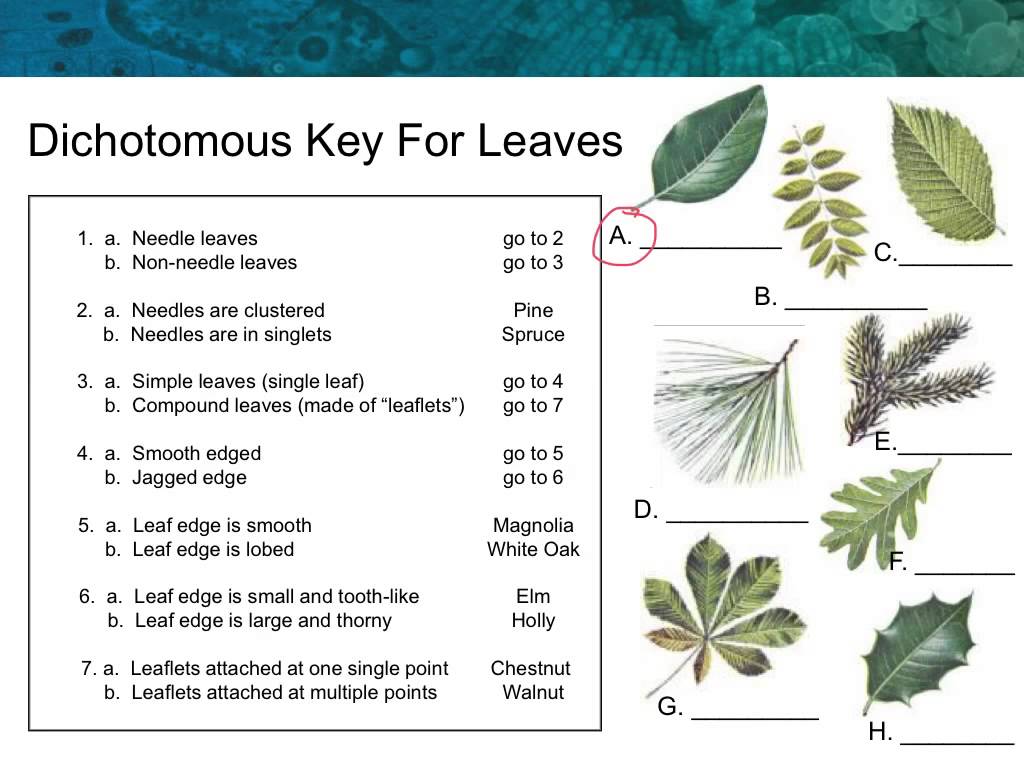
A dichotomous key for trees is provided. Hikers found a tree that has large brown cones and single sharp needles. What species of tree have the hikers found?
a)
Juniper
b)
Pine
c)
Spruce
d)
Fir
57.
What step do we always start with when using dichotomous keys?
a)
1
b)
2
c)
3
d)
4
58.
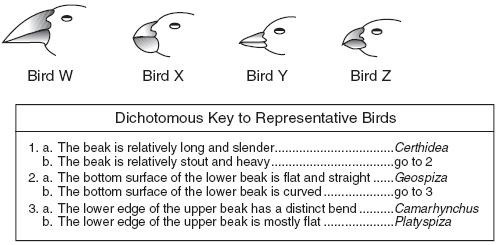
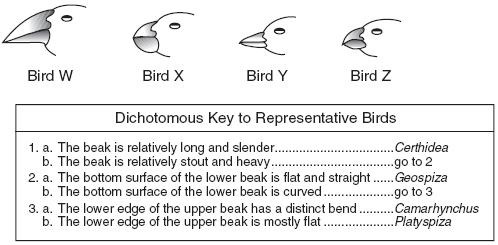
What is the name of bird W?
a)
Certhidea
b)
Geospiza
c)
Camarhynchus
d)
Platyspiza
59.
What is the name of bird Z?
a)
Certhidea
b)
Geospiza
c)
Camarhynchus
d)
Platyspiza
60.
What is a dichotomous key used for in science?
a)
To organize biomes
b)
Classify organisms
c)
Identify bacteria only
d)
None of these
61.
A student discovers an arachnid with a segmented abdomen, long legs, and a tail with no stinger. The student uses the dichotomous key below to identify it. Which arachnid has the student found?
a)
Whip Scorpion
b)
Wind Scorpion
c)
Daddy long legs
d)
Scorpion
62.
A dichotomous key for insects is given. To what order does an insect with two pairs of scaly wings belong?
a)
Coleoptera
b)
Heteroptera
c)
Diptera
d)
Lepidoptera