
 Worksheets
Muscles Review
Total questions: 82
Worksheet time: 1hrs 22mins
What are the three types of muscle?
Smooth, Hard, Cardiac
Cardiac, Smooth, Skeletal
Skeleton, Heart, Bladder
Which muscle characteristic allows the muscle to return to resting length after contraction?
Contractility
Excitability
Extensibility
Tension
What is the name of the plasma membrane surrounding each muscle fiber?
T Tubule
Sarcolemma
Sarcoplasm
Nucleus
What is the contractile unit of the muscle?
Z disk
Sarcomere
Muscle fiber
Muscle cell
What protein makes up the thick filaments?
Troponin
Tropomyosin
Myosin
Actin
What is the name of the neurotransmitter that is released from the neuron to the sarcolemma?
Acetylcholine
Acetone
ATP
Calcium
Which of these occurs first during a muscle contraction?
The nerve signal reaches the neuromuscular junction
Ach is released and opens Na ion channels
The sarcomere shortens
The myosin binds to the actin
Which of these occurs last during a muscle contraction?
The nerve signal reaches the neuromuscular junction
Ach is released and opens Na ion channels
The sarcomere shortens
The myosin binds to the actin
What is the energy source that is used for all contractions?
Glucose
Creatine
ATP
Oxygen
What is not a special characteristic of muscle cells?
Contractility
Extensibility
Excitability
Agility
What is not a function of the muscular system?
Maintaining posture
Generating heat
Movement
Storing red blood cells
What is listed from smallest to largest correctly?
Sarcomere, fascicle, muscle fiber
Myofibril, sarcomere, fascicle
Sarcomere, myofibril, muscle fiber
Myofibril, fascicle, sarcomere
Skeletal muscles are responsible for moving
The heart
The skeleton
the pancreas
The brain
Which of the following muscle types are voluntary?
Skeletal
Cardiac
Smooth muscle
During a muscle contraction, cross-bridges from between what two structures?
Actin and myosin fibers
neuron and muscle
mitochondria and actin
Muscle fatigue is likely due to the build up of
acetylcholine
cholinsterase
lactic acid
glucose
Actin in myofibril
sarcomere
thin filament
thick filament
sarcolemma
Myosin in myofibril
sarcomere
thin filament
thick filament
sarcolemma
light bands, actin only
I band
A band
H band
sarcomere
During muscle fiber contraction: Z lines __________
are unchanged
move farther apart
move closer together
line up with each other
Which type(s) of muscle tissue have striations

synaptic cleft (synapse)
sarcolemma
vesicle
Ca2+ ion
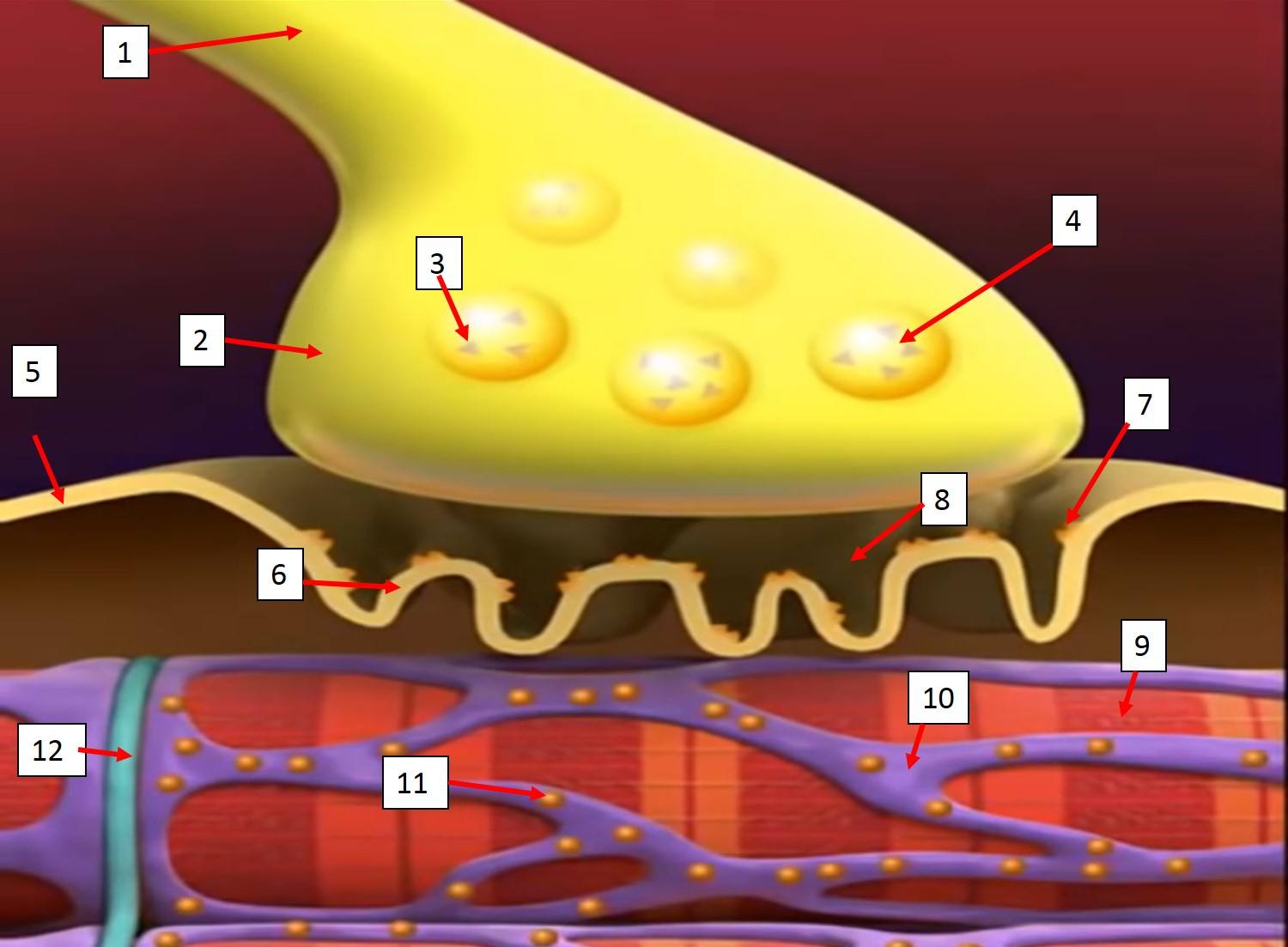
The organelle that stores Acetylcholine (ACh) in the axon is identified as #4
Motor Neuron
Axon Terminal of Motor Neuron
Sarcolemma
Synaptic Vesicle
Motor Neuron
Cardiac Muscle
Muscles are attached to bones by _____.
Ligaments
Tendons
Cartilage
Axons
Calcium binds to ___of the troponin-tropomyosin complex.
troponin
tropomyosin
actin
myosin
What layer of tissue surrounds the entire muscle?
Endomysium
Epimysium
Perimysium
myomysium
Which of the following best describes the power stoke?
actin's troponin pulls on the myosin filament
myosin filament heads pull on binding sites of the actin filament
myosin filaments pull on the Z lines of the actin filament
The A bands shrink
What is the region where a motor neuron comes in close contact with a muscle cell.
neurotransmitter
muscular dystrophy
muscle tension
neuromuscular junction
Contractile unit of a muscle which is also the functional unit of a muscle is ...
sarcomere
motor unit
fascicle
myofibril
What element is important in directly triggering contraction?
Potassium
Calcium
Sodium
Chloride
The enzyme cholinesterase causes acetylcholine to
be secreted from the motor end plate.
form cross bridges.
bind to actin.
decompose.
Which cell organelle provides energy for muscle contraction?
lysosome
nucleus
endoplasmic reticulum
mitochondria
When recruitment occurs, the number of motor units being activated
increases
decreases

What is number 4?
Myofibril
Muscle
Muscle Fiber
Fascicle

What is number 5? Hint: it is a bundle.
Muscle
Fascicle
Myofilaments
Microfilaments
Which of the following is also known as a muscle cell?
Muscle
Myofibril
Fascicle
Muscle fiber
The ability of the muscle to be stretched and then return to original shape.
excitability
contractility
extensibility
elasticity
The ability of the muscle to respond to a stimulus.
excitability
contractility
extensibility
elasticity
The ability of the muscle to shorten.
excitability
contractility
extensibility
elasticity
This type of muscle tissue is found in the walls of hollow organs such as the stomach and the digestive tract.
Skeletal
Cardiac
Smooth
Which of the following occurs When ATP binds to the myosin head?
Myosin head detaches from actin
Myosin head forms cross-bridge
Myosin undergoes power stroke
Myosin releases calcium
Which of the following decreases during muscle contraction?
M line
A band
H zone
Z line
Aerobic respiration uses this as its main energy source
creatine phosphate
glucose
lactic acid
pyruvic acid
Aerobic respiration occurs here
mitochondria
cytoplasm
muscle
blood stream
Muscle fatigue is...
when the muscle is unable to contract
when you are too tired to exercise
when the muscle is contracted more than 30 secondsd
when O2 comes from direct phosphorylation

This graph is an example of
Fused Tetanus
Unfused Tetanus
Twitch
The condition in which a muscle remains contracted between stimuli without relaxing is called
recruitment.
tetanus.
the all-or-none response.
a motor unit.
the lag phase.
What would be the correct order of the steps?
- Action potential travels down T-tubules.
- Nerve impulse reaches the muscle.
- Calcium binds to troponin.
- Tropomyosin moves.
1, 2, 3, 4
4, 3, 2, 1
3, 4, 1, 2
2, 1, 3, 4
Which typically requires the most oxygen?
Slow Twitch
Fast Twitch
Which can work for the longest period of time?
Slow Twitch
Fast Twitch
Which would be better for short periods of very hard work?
Slow Twitch
Fast Twitch
Which is known as "red muscle" fibers?
Slow Twitch
Fast Twitch
Which is considered the "main mover"
Agonist muscle
Antagonist muscle
Smooth muscle
Cardiac muscle
What type of muscle is considered the opposing muscle during a given movement
Agonist muscle
Antagonist muscle
Smooth muscle
Cardiac muscle
How do pairs of skeletal muscles work together?
One muscle in the pair pulls on a bone, while the second muscle pulls on the first muscle.
While one muscle in the pair contracts, the other returns to its original length.
Both muscles extend at the same time.
One contracts and the other stretches.

Moveable attachment of a muscle:
Teniosis
Origin
Insertion
Eversion

Attachment of a muscle that remains relatively fixed (does not move) during muscular contraction:
Origin
Dilator
Insertion
Dystonia
What is the name for the place where a motor neuron meets a muscle?
neuromuscular junction
neuropathy
myoneuroplasticity
nervous muscular tissue
A(n) ____________________ is a single stimulus-contraction-relaxation sequence in a muscle fiber. It is a single, short contraction involving only a few motor units.
twitch
origin
recruitment
antagonist
__________ motor units are found in muscles that perform precise or fine movements. Examples would be those found in the eyes and fingers.
Small
Large
Mixed
In a single muscle twitch, the ____________________ occurs when calcium (Ca2+) is being pumped back into the sarcoplasmic reticulum (SR) and actin and myosin stop the binding cycle.
latent period
contraction phase
relaxation phase
The model of muscle movement is called
Sliding Action Model
Action Potential Model
Sliding Filament Model
Action Contraction Model
Myofibrils are divided into segments called
Reticulum
Myofilament
Sarcomeres
Activities such as distance swimming and distance running are most likely to stimulate development of __.
slow fatigue muscle fibers
fast fatigue muscle fibers
slow fatigue-resistant muscle fibers
fast fatigue-resistant muscle fibers
When not have enough oxygen causes Lactic Acid to accumulate in the muscles
oxygen debt
muscle cramp
muscle fatigue
muscle tone
The change in electrical potential, passage of an impulse along the membrane (sarcolemma) of the muscle cell
motor unit
muscle tone
muscle cramp
action potential
The immovable end of a muscle.
motor unit
insertion
origin
action potential
More and more fibers contract as the intensity of the stimulus increases
recruitment
muscle cramp
hypertrophy
atrophy
Muscle loses ability to contract after prolonged exercise or strain.
muscle cramp
muscle tone
muscle loss
muscle fatigue
The movable end of the muscle.
Insertion
Origin
Motor Unit
Action Potential
Where does the energy for muscle contraction come normally from?
ATP produced by cellular respiration
ATP produced by glycolysis
ATP produced by anaerobic respiration
ATP from the direct phosphorylation of enzymes in the Krebs Cycle.

