
 Worksheets
BIO 165 EXAM 3
Total questions: 80
Worksheet time: 50mins
When a cell divides and makes two cells...
It is binary fission
It is fragmentation
It is vegatative propagation
it is meiosis II
What is the process called where a sperm and egg make a zygote?
Fertilization
Budding
Fragmentation
mitosis
Bacteria is an example of
asexual reproduction
sexual reproduction
An earthworm regrows itself.
This is an example of ...
Fertilization
Binary Fission
Fragmentation
Budding
A tree branch breaking off and growing from the broken part is called
Budding
Fertilization
Vegetative Propagation
meiosis
What is an advantage of asexual reproduction?
it's fast; there is no need to look for a mate
It uses a lot of energy
There are a lot of predators to face
It creates genetically different offsprings
In MITOSIS, the two resulting cells are
different from the starting cell and identical to each other.
identical to the starting cell and different from each other.
identical to the starting cell and identical to each other.
different from the starting cell and different from each other.
How many chromosomes are present in a cell at the end of mitosis?
23
92
46
96


How can we tell how many chromosomes are in the cell?
Count the number of sister chromatids
Count the number of centromeres
Calculate the number of times it can divide
Multiply the number of haploid and diploid chromosomes
In MEIOSIS, the four resulting cells are
different from the starting cell and identical to each other.
identical to the starting cell and different from each other.
identical to the starting cell and identical to each other.
different from the starting cell and different from each other.
How many chromosomes are in each cell at the end of meiosis I?
46
23
92
96
How many chromosomes are in each cell at the end of meiosis II?
23
46
92
96
How many sister chromatids are there in the end of meiosis I?
23
46
92
96
How many sister chromatids are there at the end of meiosis II?
46
96
23
92
Which hormone raises blood glucose levels, increases rate of metabolism, constricts certain blood vessels?
epinephrine
T3/T4
IGF
glucocorticoid
Which hormone stimulates growth of bones and muscle?
calcitonin
progesterone
thymosin
growth hormone
Which hormone increases blood glucose levels; secreted by adrenal cortex?
mineralocorticoids
glucocorticoids
insulin
parathyroid hormone
Which hormone stimulates both the ovaries and the testes?
luteinizing hormone
follicle-stimulating hormone
testosterone
estrogen
What hormone(s) increase(s) due to female birth control? (select all that apply)
progesterone
estrogen
LH
FSH
testosterone
What reproductive step causes the oocyte to exit the follicle?
ovulation
puberty
oogenesis
fertilization
spermatogenesis
Where does oogenesis occur?
in the medulla of the ovary
in the cortex of the ovary
in the follicle of the adrenal gland
in the medulla of the adrenal gland
in the cortex of the adrenal gland
What hormone do the leydig cells produce?
testosterone
inhibin
FSH
LH
estrogen
Which hormone(s) contribute(s) to the building of the endometrium? (select all that apply)
progesterone
estrogen
testosterone
LH
FSH
Once fertilization occurs, step(s) of oogenesis are completed? (select all that apply)
meiosis I
meiosis II
mitosis
spermatogenesis
Starting at puberty, during every month before ovulation, what steps of oogenesis are completed? (select all that apply)
meiosis I
meiosis II
mitosis
meiosis II (until metaphase II)
meiosis I (until anaphase I)
From 4-7 months, what steps of oogenesis are completed? (select all that apply)
mitosis
meiosis I (until prophase)
mitosis I (until metaphase I)
meiosis II (until prophase II)
meiosis I (until anaphase I)
Where are follicles found?
In the endometrium
In the myometrium
In the ovaries
In the fallopian tubes
In the cervix
What hormones(s) increases in the 14 days before ovulation? (select all that apply)
LH
FSH
estrogen
progesterone
testosterone
What builds up/increases after ovulation? (select all that apply)
myometerium
endometrium
progesterone
LH
FSH
Meiosis I starts with a _____ cell, while meiosis II starts with a _____ cell.
haploid, haploid
haploid, diploid
diploid, haploid
diploid, diploid
What hormone(s) are produced by cells found within the seminiferous tubules? (select all that apply)
inhibin
testosterone
LH
FSH
What occurs during meiosis I?
sister chromatids separate
homologous chromosomes separate
chromosomes split in half
chromatids split in half
What occurs during meiosis II?
sister chromatids separate
homologous chromosomes separate
chromosomes are split in half
chromatids split in half
Where does the sperm travel through as it exists the lumen?
1. epididymus
2. ejaculatory duct
1. epididymus
2. vas deferens
1. ejaculatory duct
2. vas deferens
1. seminiferous tubules
2. epididymus
1. vas deferens
2. urethra
What two somatic cells are found in the testes? (select all that apply)
Sertoli cells
Leydig cells
seminiferous cells
tubule cells
testosterone cells
The process of turning spermatid cells into sleek, fast spermatozoa is called...
spermatogenesis
spermiogenesis
spermatogonium
residual bodies
meiosis
This cell (_____) undergoes ______ to turn from a diploid to a haploid cell.
primary spermatocyte, meiosis II
secondary spermatocyte, meiosis I
primary spermatocyte, meiosis I
secondary spermatocyte, II
spermatid, spermiogenesis
At the end of spermatogenesis, what is present in the final cell? (select all that apply)
tail
cytoplasm
haploid nucleus
mitochondria
diploid nucleus
Which cell launches off spermatogenesis?
primary spermatocyte
secondary spermatocyte
spermatid
spermatogonium
spermatozoa
The levels of _____ dramatically _____ after _____. (select all that apply)
JH, increase, allatostatin is released.
OEH, decrease, a blood meal.
JH, decrease, a blood meal.
allatostatin, decrease, a blood meal.
ecdysone, increase, a blood meal.
Allatostatin _____ the release of _____. (select all that apply)
inhibits, JH
stimulates, allatotropin
inhibits, ecdysone
inhibits, allatotropin
stimulates, blood meal
Allatotropin _____ the release of _____. (select all that apply)
stimulates, JH
inhibits, JH
stimulates, allatostatin
inhibits, ecdysone
stimulates, blood meal

Which mosquito organ is shown by the letter "D"?
(a)
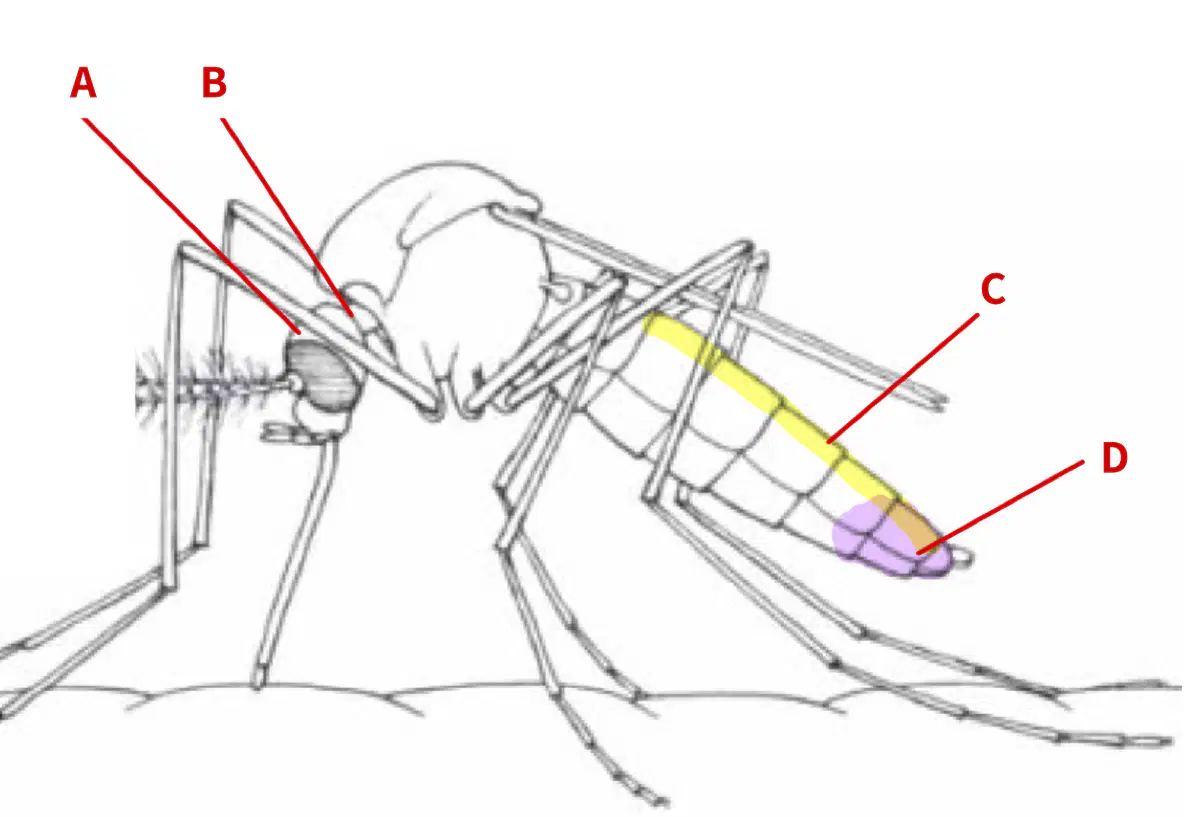
Which mosquito organ is shown by the letter "C"?
(a)

Which mosquito organ is shown by the letter "B"?
(a)

Which mosquito organ is shown by the letter "A"?
(a)
Which most accurately describes the role(s) of allatotropin and/or allatostatin? (select all that apply)
Allatostatin acts as a releasing hormone, stimulating JH to be released.
Allatotropin acts as a releasing hormone, stimulating ecdysone to be released.
Allatotropin acts as a releasing hormone, stimulating JH to be released.
Allatotropin acts as an inhibiting hormone, preventing JH from being released.
Allatostatin acts as an inhibiting hormone, preventing JH from being released.
What hormones does a mosquito's brain release? (select all that apply)
OEH (ovary ecdysteroidogenic hormone)
JH (juvenile hormone)
Allatotropin
Ecdysone
YRH (yolk-releasing hormone)
What has shown to contribute to immune system suppression?
The breakdown of fats and proteins which increases blood glucose.
Constant, high levels of epinephrine in the bloodstream.
The breakdown of glycogen to glucose for fast energy.
The retention of sodium and water in the kidneys.
What mechanism does the short-term stress pathway utilize?
Paracrine signaling
Autocrine signaling
Neuronal impulses
Antiendocrine, long-distance signaling
What causes mineralocorticoids to increase blood pressure?
The flushing out of sugars through the urine, thereby maintaining a higher water to sugar ratio in the body.
The retention of glycogen in the bloodstream.
The retention of sodium and water in the kidneys.
The breaking down of fats and proteins into glucose, thereby making the blood hypertonic and attracting water.
what organs are part of the HPA axis? (select all that apply)
adrenal gland
pancreas
hypothalamus
pineal gland
pituitary gland
Which organ-hormone pairing is correct? (select all that apply)
adrenal medulla releases testosterone
adrenal cortex releases epinephrine
adrenal medulla releases mineralocorticoids
adrenal cortex releases glucocorticoids
adrenal medulla releases epinephrine
What was the END GOAL of the drug(s) discussed in the recitation paper? (select all that apply)
to decrease IGF production in the body
to increase GH production in the body
to decrease symptoms of acromegaly
to increase the production of GHIH in the body
What drug was discussed in the recitation paper and was found to work to reduce acromegaly symptoms? (select all that apply)
GH agonist
GH antagonist
Somatostatin agonist
Somatostatin antagonist
Which hormones contribute to negative feedback in the growth hormone pathway? (select all that apply)
GHIH
IGF
GHRH
GH
What system is utilized by the endocrine system to transport signals?
digestive system
circulatory system
nervous system
respiratory system
If I designed an ACTH antagonist to reduce stress, what receptors would it bind to?
adrenal medulla
anterior pituitary
posterior pituitary
adrenal cortex
Where are GH antagonist receptors found in the cell?
On the hypothalamus
On the liver
On the anterior pituitary
On the bones
In every pathway that we have seen, what is generally secreted by the hypothalamus? (select all that apply)
releasing hormone
inhibiting hormone
tropic hormone
an agonist
Where are somatostatin receptors found?
On the liver
On the bones
On the anterior pituitary
On the hypothalamus
A) Where is insulin-like growth factor produced?
B) Where are its receptors?
A) hypothalamus
B) Liver
A) hypothalamus
B) anterior pituitary
A) Anterior pituitary
B) Liver
A) Liver
B) Bones and liver
What type of cell to cell communication is exemplified by the endocrine system?
paracrine signaling
synaptic signaling
cardiac signaling
long-distance communication

How are the offspring different in both methods?
Method A (genetically different)
Method B (genetically identical)
Method A (genetically identical to parent)
Method B (genetically different from Parent)
Method A (sexual reproduction)
Method B (Asexual reproduction)
Method A (Mitosis)
Method B (Meiosis)

Where does the following occut?
A) Meiosis?
B) Fertilization?
C) Growth & Development of Baby?
A) 5
B) 4
C) 3
A) 4
B) 5
C) 3
A) 3
B) 4
C) 5
A) 3
B) 5
C) 4
The male and female reproductive systems are regulated by...
hormones
sex drive
number of chromosomes
heredity
What is one difference between Meiosis and Mitosis?
Meiosis (4 different cells made)
Mitosis (2 identical cells made)
Meiosis (2 identical cells made)
Mitosis (4 different cells made)
Meiosis (offspring identical to parent)
Mitosis (offspring different from parent)
Meiosis (offspring have 46 chromosomes)
Mitosis (offspring have 23 chromosomes)

What is the function of A & B?
A - transport gametes (eggs)
B - Produce eggs
A - produce eggs
B - transport gametes (eggs)
A - transport gametes (sperm)
B - produce sperm
A - produce sperm
B - transport gametes (sperm)
The male hormone that regulates sex drive and male characteristics?
Progesterone
follicle-stimulating hormone
Testosterone
luteinizing hormone
Mitosis is the same as which of the following?
Meiosis I
Meiosis II
Meiosis III
Crossing Over
The "morning after pill" will only work if is taken....
(credit to Dr. Heiman!)
it is taken within a day of ovulation, before or after
before ovulation
during menstruation
immediately after menstruation at the start of a new cycle
right after relations
What are the components of the "abortion pill"? (choose all that apply)
(credit to Dr. Heiman!)
a protesterone antagonist
an estrogen agonist
an estrogen antagonist
a progesterone agonist
a paracrine signaling molecule that stimulates contraction of the uterine muscle
One difference between the morning after pill and the abortion pill is...
(credit to Dr. Heiman!)
one uses a high dose of progesterone and other blocks progesterone receptors.
One uses a high dose of estrogen and the other uses a low dose of estrogen
one blocks the sharp rise in LH and the other blocks the rise in progesterone
one blocks FSH which prevents ovulation and the other blocks progesterone from being secreted
What is the main ingredient(s) of the "morning after pill"?
(credit to Dr. Heiman!)
estrogen and progesterone
LH antagonist
high dose progesterone
high dose estrogen
Where does the yolk go after it is secreted?
To the ovaries
To the fat body
To the brain
To the ecdysone receptors
Which hormone(s) rise while egg count increases in the mosquito's body? (select all that apply)
ecdysone
JH
allatotropin
allatostatin
OEH
What organ releases progesterone and estrogen?
(credit to Vered)
corpos luteum
follicle
oocyte
hypothalamus
zygote
Which hormone(s) are involved in the short-term stress response? (select all that apply)
ACTH
epinephrine
glucocorticoids
mineralocorticoids
CRH

