
 Worksheets
Sound Wave
Total questions: 100
Worksheet time: 5hrs 0mins
Sound waves travel as ________ waves.
Transverse
Longitudinal
Surface
Sound is made when a source of energy forces the matter around it to __________.
Vibrate
Amplitude
Stay still
Pitch
Sound waves CANNOT travel through which of these:
Paper
Milk
Outer space
Loudness of waves is measured in
Hertz
Decibels
Watts
High frequency sounds have _______ pitch
HIgh
Low


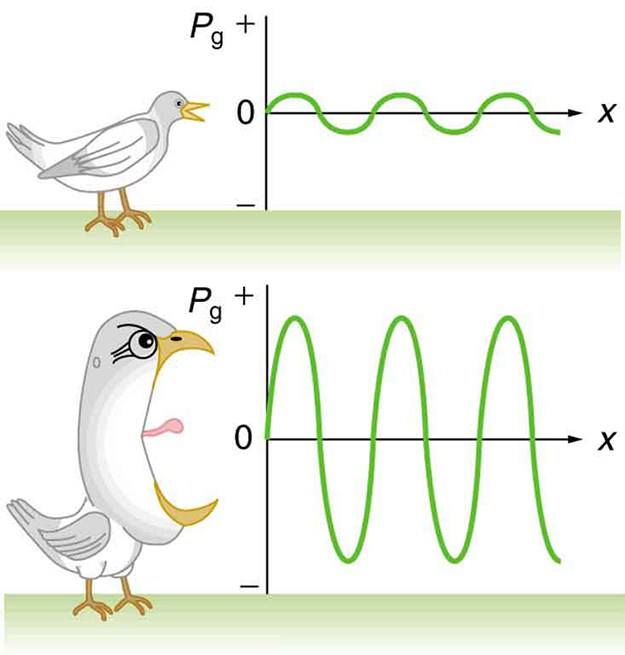
Which wave produced the loudest sound?
high Amplitude
low Amplitude
A reflected sound wave is called a(n) ______.
frequency
pitch
echo
rarefaction

Way in which sound waves are used by animals such as dolphins and bats.
Echolocation
Transverse
Doppler Effect
Longitudinal
One important characteristic of sound waves is that they are ___________________ waves.
mechanical
short
ultraviolet
primary
Sound waves must travel through ___________________.
air
a medium
an outward area
a short
Sound waves can NOT travel through
Air
Water
Earth
space
The sound that we actually hear is the vibration of molecules.
True
False
Longitudinal waves means that the disturbance of the wave travels in different directions as the wave.
True
False
This is a visual of a sound wave. It is an example of _____________________ wave.
a mechanical
a longitudinal
both a mechanical and longitudinal
If there is a loud noise in your house, the sound travels through
the air
the air and the wall
the air, the wall, the floor
the air and most everything in the house
If there is a loud noise in space, the sound travels through
the space particles
small atoms in space
space is a vacuum, so nothing
What is the source of a sound wave?
Electricity
Vibration
Light waves
Tiny nuclear explosions
The intensity of a sound wave is equal to the sound power (P) divided by the _______.
Area
Time
Distance
Energy
What type of energy does a sound wave have?
Mechanical
Radiant
Electrical
Sound
Sound is produced by -----
Heat energy
Low temperatures
Vibrations
Friction
True or False: Sound needs a medium.
True
False
Sound waves are also known as ----- waves.
Compression
Longitudinal
Neither
Both longitudinal and compression
True or False: Sound waves are faster than light.
False
True

Areas of increased pressure on a sound wave are known as a ----
Rarefaction
Compression
Frequency
Amplitude

The distance from the beginning of one compression to the beginning of the next compression is called a -----
Rarefaction
Frequency
Wavelength
Compression

Spread out areas or areas of decreased pressure on a sound wave are known as a ---
Rarefaction
Amplitude
Compression
Hertz
The number of wavelengths that pass a fixed point each second is known as ----
Hertz
Amplitude
Frequency
The unit for measuring frequency is the ---
Joule
Hertz
Gram
Newton

The measure of the amount of energy in a wave is ----
Wavelength
Hertz
Frequency
Amplitude
The Tacoma Narrows Bridge, musical instruments, and crystal stemware are examples of -----
Frequency
Resonance
Interference
Speed
The speed of sound depends on these two things:
The type of medium and the temperature of the medium
Speed of the medium and temperature of the medium
Temperature of the medium and sound of the medium
None of the above
Sound waves travel the fastest through ---
Liquids
Gases
Solids
Sound waves that are beyond the range of human ear are known as ----
Infrasonic waves
Ultrasonic waves

Sonar and echolocation use ----- to detect objects under water.
Refraction
Reflection


The speed of sound depends on these two things:
The type of medium and the temperature of the medium
Speed of the medium and temperature of the medium
Temperature of the medium and sound of the medium
None of the above
Sound waves travel the fastest through ---
Liquids
Gases
Solids
Sonar and echolocation use ----- to detect objects under water.
Refraction
Reflection
Sound waves that are beyond the range of human ear are known as ----
Infrasonic waves
Ultrasonic waves
Which state of matter do sounds travel fastest in?
Solid
Liquid
Gas
Plasma
Why does sound travel faster in solids than in liquids or gases.
They are harder.
The particles are closer together.
Solids have more energy.
Gases fill their container.
Why does sound travel faster in solids than in liquids or gases.
They are harder.
Solids are more dense.
Solids have more energy.
Gases fill their container.
Roughly what is the speed of sound in air?
The speed of light.
About 10 m/s
About 340 m/s
About 1 500 m/s

Roughly what is the speed of sound in air?
About 350 m/s
About 1 500 m/s
About 5000 m/s
About 1800 m/s
Roughly what is the speed of sound in water?
About 350 m/s
About 1 500 m/s
About 5000 m/s
About 1800 m/s
Roughly what is the speed of sound in steel?
About 350 m/s
About 1 500 m/s
About 5000 m/s
About 1800 m/s
Roughly what is the speed of sound in rubber?
About 50 m/s
About 1 500 m/s
About 5000 m/s
About 1800 m/s
Roughly what is the speed of sound in glass?
About 50 m/s
About 1 500 m/s
About 4 500 m/s
About 1800 m/s
Roughly what is the speed of sound in wood?
About 50 m/s
About 1 500 m/s
About 4 500 m/s
About 1800 m/s

Calculate the speed of sound if a sound wave travels 680 m in 2 seconds.
1360 m/s
340 m/s
The speed of sound is always the same
250 m/s
Calculate the speed of sound if a sound wave travels 1020 m in 3 seconds.
3060
365 m/s
340 m/s
250 m/s

A sound wave travels through water at a speed of 1500m/s for 2 seconds. How far does it travel?
750m
340m
3000m
300 000 000 m/s
A sound wave travels through water at a speed of 1500m/s for 3.5 seconds. What distance does it travel?
750m
4 500m
428.57m
365m

A sound wave travels through air. It travels 3 400m at a speed of 340 m/s. How long does it take to get there?
102000 seconds
666 seconds
4.25 seconds
10 seconds
A sound wave travels through air. It travels 1 700m at a speed of 340 m/s. How long does it take to get there?
578 000 seconds
666 seconds
4.25 seconds
5 seconds

A teacher tries to work out the speed of sound. She bangs two bits of wood together. She hears an echo from a wall. The wall is 25m away. How far has the sound travelled?
340 m
25 m
50 m
12.5 m
A teacher bangs two bits of wood together. She hears an echo from a wall 0.14 seconds later. The wall is 25m away. What is the rough speed of sound, ACCORDING TO THESE RESULTS?
Roughly 340 m/s
Roughly 360 m/s
Roughly 375 m/s
Roughly 330 m/s


What is the speed of light in kilometers per second?
1,000,000 km/s
300,000 km/hour
300,000 km/minute
300,000 km/s
Why does sound travel faster in solids than in liquids or gases.
They are harder.
The particles are closer together.
Solids have more energy.
Gases fill their container.
Which state of matter do sounds travel fastest in?
Solid
Liquid
Gas
Plasma
Roughly what is the speed of sound in air?
The speed of light.
About 10 m/s
About 340 m/s
About 1 500 m/s
Roughly what is the speed of sound in glass?
About 50 m/s
About 1 500 m/s
About 4 500 m/s
About 1800 m/s
Why does sound travel faster in solids than in liquids or gases.
They are harder.
Solids are more dense.
Solids have more energy.
Gases fill their container.
Calculate the speed of sound if a sound wave travels 1020 m in 3 seconds.
3060
365 m/s
340 m/s
250 m/s
A sound wave travels through water at a speed of 1500m/s for 3.5 seconds. What distance does it travel?
750m
4 500m
428.57m
365m
Calculate the speed of sound if a sound wave travels 680 m in 2 seconds.
1360 m/s
340 m/s
The speed of sound is always the same
250 m/s
A teacher tries to work out the speed of sound. She bangs two bits of wood together. She hears an echo from a wall. The wall is 25m away. How far has the sound travelled?
340 m
25 m
50 m
12.5 m
A sound wave travels through air. It travels 3 400m at a speed of 340 m/s. How long does it take to get there?
102000 seconds
666 seconds
4.25 seconds
10 seconds
A teacher bangs two bits of wood together. She hears an echo from a wall 0.14 seconds later. The wall is 25m away. What is the rough speed of sound, ACCORDING TO THESE RESULTS?
Roughly 340 m/s
Roughly 360 m/s
Roughly 375 m/s
Roughly 330 m/s
What is produce by vibration?
Sound
Light
Rhythm
Vibration
On which medium sound travels the slowest because the particles are spread out?
Solid
Liquid
Gas
Amplitude affects which characteristic of sound waves?
frequency
pitch
loudness
wave speed
Where does vibration produced when someone is speaking?
Pharynx
Larnyx
Vocal Chords
Trachea

