
 Worksheets
Grade 10 Physics final revsion
Total questions: 104
Worksheet time: 2hrs 37mins
What is the unit of measurement for resistance?
Voltage
Ampere
Watts
Ohms
What happens to resistance when the length of the wire increases?
Stays the same
Increases
Decreases
How do you calculate resistance?
Current x Voltage
Voltage x Power
Voltage ÷ Current
Current ÷ Voltage

What effect does a hotter temperature have on resistance?
No effect
Increases resistance
Decreases resistance
Stays the same
What other factor of a wire could affect its resistance?
Material its made of
How shiny it is
Colour
How do you calculate current from voltage and resistance?
Current = voltage x resistance
Current = resistance x power
Current = voltage ÷ resistance
Current = resistance ÷ voltage

Ohms
Watts
The flow of protons


2 V
5 V
10 V
20 V
The difference in electrical potential energy between two places is called …………...
resistance
friction
induction
voltage
How much work is required to move 3.0 coulombs of electric charge a distance of 0.010 meter through a potential difference of 9.0 volts?
3.0 x 10⁻² J
3.0 J
27 J
2.7 x 10³ J
Moving 4.0 coulombs of charge through a circuit requires 48 joules of electric energy. What is the potential difference across this circuit?
190 V
12 V
4.0 V
48 V

Electric potential energy is greatest at point...
A
B
Moving an electron within an electric field would change the ____ the electron.
mass of
amount of charge on
potential energy of
The electrical energy used if a charge of 5 C is supplied by a 12 V cell is....
2.2 A
60 A
2.2 J
60 J
What is the voltage of a cell if it uses 4.2 J of energy as it pushes 6 C of charge round a circuit?
0.7 v
26 V
0.7 V
26 v

The circuit in the diagram contains two capacitors connected in parallel. What is the total capacitance of the circuit?
100 μF
65 μF
35 μF
30 μF

The circuit in the diagram contains two capacitors connected in series. The total capacitance of the circuit is 12 µF.What is the capacitance 𝐶?
19 μF
21 μF
16 μF
13 μF
When is an object said to be charged
When it has more charges than it can store
When it can accept no more charges
When the object has equal number of electrons and protons
None of the above
The simplest form of capacitor is made out of
three metal plates and between the plates is an insulating material
two metal plates and between the plates is a dielectric material
one metal plate and a dielectric material
Which of the following is symbol of capacitor ?


What is the unit of V?
Farad
No unit
Coloumb
Volt
What is the unit of capacitance
Ohm
Henry
Farad
Watt
Tick all the factors that affect capacitance below:
Area
Dielectric
Distance
Power Rating

When power is supplied to a circuit that includes a capacitor - the capacitor ______________up.
charges
discharge
There are different types of capacitors vary depending on their construction, types and sizes.
True
False
The two parallel plates hold +600 µC and -600 µC of charges respectively when 20 V potential difference is applied across the plates. What is its capacitance?
60µF
-60µF
30µF
-30µF
Draw a circuit with a battery connected to four resistors, R1, R2, R3, and R4, as follows. Resistors R1 and R2 are connected in parallel with each other, resistors R3 and R4 are connected in parallel with each other, and both parallel sets of resistors are connected in series with each other across the battery.


How to you calculate the total resistance in a series circuit?
R1 + R2+ R3
R1 - R2 - R3
1/R1 + 1/R2 + 1/R3
R1 = R2 = R3

This is the symbol for a...
Motor
Ammeter
Bulb
Voltmeter

A student carries out an experiment and plots the V-I graph of three samples of nichrome wire with resistances R1 R2 and R3 respectively. Which of the following is high ?
R1 = R2 = R3
R1 > R2 > R3
R3 > R2 > R1
none of these

The diagram shows a circuit with a 3.0 Ω resistor and a 2.0 Ω resistor connected in parallel. The switch is open, and the ammeter reads 2.0A. The switch is now closed and the ammeter reads the total current in both resistors. What is the ammeter reading with the switch closed?
1.2 A
3.0 A
4.0 A
5.0 A

A circuit contains four ammeters A, B, C and D, and three resistors with different values. Which ammeter shows the largest reading?
A
B
C
D


As you go up a hill…
Potential energy increases and kinetic energy decreases
Potential energy will remain constant
Kinetic energy increases and potential energy decreases
Kinetic energy will remain constant

FOR THE FOLLOWING QUESTION, YOU MUST PICK 2 ANSWERS:
How does height effect gravitational potential energy? (select 2 answers)
As height decreases potential energy increases.
As height decreases, potential energy decreases.
As height increases, potential energy increases.
As height increases potential energy decreases.

What is energy transformation?
When energy disappears.
When energy changes from on form to another.
When energy is created.
When energy is destroyed.
Choose the image below in which the object will have the largest amount of potential energy...
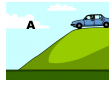
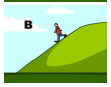
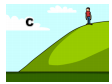
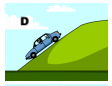
What is kinetic energy?
Energy of motion
Stored energy
Energy of sound
Energy of heat
What is potential energy?
Energy of motion
Stored energy
Energy of light
Energy of heat
Which is NOT a type of energy?
Light
Heat
Water
Chemical
A cyclist has a mass of 55 kg. His bike has a mass of 20 kg. If the cyclist is on his bike and moving at 12.5 m/s, what is his kinetic energy?
11,718 J
938 J
9,188 J
8,594 J
What is the potential energy of a loose brick that is 2.5 kg and is at a height of 125 m?
g = 9.8
3,063 J
313 J
781 J
7,656 J
If the height of an object increases, how would the potential energy change?
Increase
Decrease
Stay the same
Go to zero
If the mass of an object increases, how would the potential energy change?
Increase
Decrease
Stay the same
Go to zero
Efficiency can be calculated using either total energy transfers or power inputs and outputs
true
false
Power depends on speed
True
False
Work done is the same thing as energy transferred
True
False
Is work a scalar or vector quantity?
vector
scalar
both
none of the above
If you exert a force of 10.0 N to lift a box a distance of 3 m, how much work do you do?
30J
300 J
90 J
900 J
Work is defined by _____________.
force times time
force devided by time
force times distance
force divided by distance
the electric filed E surrounds the electrical charge Q1 if the electric force is 10 N and Q2 is 2 coulombs?
20 N.c
5 N.c
5 N/c
20 N/c

Which diagram correctly shows the field lines between two like charges?
A
B
Both
Neither

What is the voltage across the plates of the capacitor if the capacitance is 10 µF and the Charge stored is 30 µC?
0.333 V
3 V
300 V
The capacitance of a parallel-plate capacitor is:
proportional to the plate area
independent of any material inserted between the plates
proportional to the charge stored
proportional to the potential difference of the plates
How much charge must pass by a point in 10 s for the current to be 0.50 A?
0.05C
5.0C
20C
2.0C
What charge do electrons have?
+1
-2
-1
0
A charge of 6C flows in 4s. What is the current?
10A
24A
1.5A
2A
Current can be defined as the _____________ of flow of electric charge
Speed
Time
Rate
Strength
The voltage drop across each resistance of a series combination of resistance is directly proportional to the corresponding resistance
Incorrect
Correct
Sometimes only
Depends on value of voltage
the resultant resistance in series combination of three resistance 1 ohm 2 ohm and 3 ohm is
3 ohm
6 ohm
9 ohm
12 ohm
the resultant resistance in parallel combination of three resistance 1 ohm 2 ohm and 3 ohm is
3/11 ohm
4/11 ohm
5/11 ohm
6/11 ohm
The correct relationship for electric energy is given by
W = I²R t
W= I³ R t
W= I R³ t
W= I R t³
The equivalent capacitance of three capacitors with capacitance C1, C2 and C3 connected in series is
C=C1+C2+C3
C1=C11+C21+C31
C=C11+C21+C31
C1=C11×C21×C31
The equivalent capacitance of three capacitors with capacitance C1, C2 and C3 connected in parallel is
C=C1+C2+C3
C1=C11+C21+C31
C=C11+C21+C31
C=C1C2C3
Three capacitors of 1.0 µF, 1.5 µF, and 2.0 µF are connected in series. Find the combined capacitance.
4.5 µF
4.0 µF
2.2 µF
0.46 µF
If three 4.0 µF capacitors are connected in parallel, what is the combined capacitance?
12 µF
0.75 µF
8.0 µF
0.46 µF
Capacitor stores _______________
Charge
Voltage
Energy
Money.. Lots of money

