
 Worksheets
TYPES OF CHEM REACTIONS SHORT QUIZ
Total questions: 86
Worksheet time: 1hrs 2mins
MgCl2 + Li2CO3 ----> MgCO3 + 2 LiCl
Synthesis (or combination)
Decomposition
Single replacement
Double replacement
CaCO3 ----> CaO + CO2
Synthesis (or combination)
Decomposition
Single replacement
Double replacement
2 NaBr + 1 Ca(OH)2 ----> 1 CaBr2 + 2 NaOH
Synthesis (or combination)
Decomposition
Single replacement
Double replacement
3 Pb + 2 H3PO4 ----> 3 H2 + 1 Pb3(PO4)2
Synthesis (or combination)
Decomposition
Single replacement
Double replacement
Pb(NO3)2 --> PbO + NO2 + O2
Synthesis (combination)
Decomposition
Single replacement
Double replacement
Is the following equation balanced?
4Fe + 3O2 ---> 2Fe2O3
YES
NO
Is the following equation balanced?
Al + O2 ---> 2Al2O3
YES
NO
What type of reaction is the following:
C11H24+17O2−> 11CO2 + 12H2O
Combination
Decomposition
Single Replacement
Double Replacement
Combustion

combustion

synthesis

decomposition

single replacement

double replacement
1 reactant breaks apart into 2 or more smaller products
decomposition
2 or more reactants combine to make 1 product
synthesis
O2 as a reactant & CO2 and water as products
combustion
1 element & 1 compound in products & reactants
single replacement
2 compounds in reactants & products
double replacement
The (a) are on the right side of the arrow and the (b) are on the left side of the arrow.
What will the products of each reaction look like?
Mg + N2 --> (a)
Zn + HCl --> (b)
AlCl3 + Na2SO4 --> (c)
C4H8 + O2 --> (d)
H2O --> (e)
Which type of chemical reaction has the following configuration?
Substance + Substance --> Compound
A + B --> AB
Composition/Synthesis
Decomposition
Single Replacement
Double Replacement
Combustion
Which type of chemical reaction has the following configuration?
Element + Compound --> Element + Compound
A + BC --> B + AC
Composition/Synthesis
Decomposition
Single Replacement
Double Replacement
Combustion
Which type of chemical reaction has the following configuration?
Hydrocarbon + Oxygen --> Carbon Dioxide + Water
CxHy + O2 --> CO2 + H2O
Composition/Synthesis
Decomposition
Single Replacement
Double Replacement
Combustion
What type of chemical reaction has the following configuration?
Ionic Compound(aq) + Ionic Compound(aq) --> Compound + Compound
AB(aq) + CD(aq) --> AD + BC
Composition/Synthesis
Decomposition
Single Replacement
Double Replacement
Combustion
What type of chemical reaction has the following configuration?
Compound --> Substance + Substance
AB --> A + B
Composition/Synthesis
Decomposition
Single Replacement
Double Replacement
Combustion
Select each compound that can be produced by combustion reactions. (more than 1 answer)
Oxygen
Carbon Dioxide
Water
Glucose
Carbon
Classify the following chemical reaction
BaCl2(aq) + K2CrO4(aq) --> BaCrO4(s) + 2KCl(aq)
Composition/Synthesis
Decomposition
Single Replacement
Double Replacement
Combustion
Classify the following chemical reaction.
Si(s) + 2Cl2(g) --> SiCl4(l)
Composition/Synthesis
Decomposition
Single Replacement
Double Replacement
Combustion
Classify the follow chemical reaction.
2C6H6(l) + 15O2 --> 6H2O(l) + 12CO2(g)
Composition/Synthesis
Decomposition
Single Replacement
Double Replacement
Combustion
What type of chemical reaction is when a single compound is broken down into two or more products?
Composition/Synthesis
Decomposition
Single Replacement
Double Replacement
Combustion

Identify the type of chemical reaction pictured above
Composition/Synthesis
Decomposition
Single Replacement
Double Replacement
Combustion

Identify the type of chemical reaction pictured above
Composition/Synthesis
Decomposition
Single Replacement
Double Replacement
Combustion

Identify the type of chemical reaction picture above
Composition/Synthesis
Decomposition
Single Replacement
Double Replacement
Combustion

Identify the type of chemical reaction picture above
Composition/Synthesis
Decomposition
Single Replacement
Double Replacement
Combustion
Identify the type of chemical reaction picture above
Composition/Synthesis
Decomposition
Single Replacement
Double Replacement
Combustion

Identify the type of chemical reaction pictured above
Composition/Synthesis
Decomposition
Single Replacement
Double Replacement
Combustion
compound ---> element + element
synthesis
decomposition
combustion
single replacement
What type of reaction is the following:
2KI −> 2K + I2
Combination
Decomposition
Single Replacement
Double Replacement
Combustion
What type of reaction is the following:
Zn + 2HCl −> ZnCl2+H2
Combination
Decomposition
Single Replacement
Double Replacement
Combustion
What type of reaction is the following:
3CuS +2Al −> Al2S3+3Cu
Combination
Decomposition
Single Replacement
Double Replacement
Combustion
What type of reaction is the following:
2C4H10 +13O2 −> 8CO2+10H2O
Combination
Decomposition
Single Replacement
Double Replacement
Combustion
What type of reaction is the following:
Na2S +2HCl −> H2S+2NaCl
Combination
Decomposition
Single Replacement
Double Replacement
Combustion
Which of the following is a compound?
zinc (Zn)
magnesium (Mg)
sodium chloride (NaCl)
potassium (K)
Which of the following is an element?
potassium chloride (KCl)
water (H2O)
carbon (C)
calcium carbonate (CaCO3)

Identify the type of chemical reaction
Synthesis
Decomposition
Single replacement
Double replacement
Combustion

Identify the type of chemical reaction
Synthesis
Decomposition
Single replacement
Double replacement
Combustion

Identify the type of chemical reaction
Synthesis
Decomposition
Single replacement
Double replacement
Combustion

Identify the type of chemical reaction
Synthesis
Decomposition
Single replacement
Double replacement
Combustion

Identify the type of chemical reaction
Synthesis
Decomposition
Single replacement
Double replacement
Combustion

Identify the type of chemical reaction
Synthesis
Decomposition
Single replacement
Double replacement
Combustion

Identify the type of chemical reaction
Synthesis
Decomposition
Single replacement
Double replacement
Combustion

Identify the type of chemical reaction
Synthesis
Decomposition
Single replacement
Double replacement
Combustion

Identify the type of chemical reaction
Synthesis
Decomposition
Single replacement
Double replacement
Combustion

Identify the type of chemical reaction
Synthesis
Decomposition
Single replacement
Double replacement
Combustion
What reaction has the following general formula:
A + B --> AB
Synthesis
Decomposition
Single Replacement
Double Replacement
Combustion
What is an exothermic reaction?
A reaction that absorbs energy.
A reaction that releases energy.
A reaction that happens by itself.
A reaction that contains energy.
What is an endothermic reaction?
A reaction that absorbs energy.
A reaction that releases energy.
A reaction that happens by itself.
A reaction that contains energy.

What is a combustion reaction?
When chemicals react with fire.
An explosive reaction.
fuel + oxygen --> water + carbon dioxide
fuel + carbon dioxide --> water + oxygen

What type of reaction is this?
a synthesis reaction
a decomposition reaction
a single replacement reaction
a double replacement reaction
a combustion reaction
Which of the following is a single replacement reaction?
2H2O > 2H2 + O2
Fe + CuSO4 > FeSO4 + Cu
Cu + SO4 > CuSO4
Which of the following is always a reactant in a combustion reaction?
CO2
H2O
O2
Both CO2 + H2O
Which of the following are always a product of a combustion reaction?
CO2
H2O
O2
Both CO2 + H2O
Which of the following is a combustion reaction?
C3H8 + 5O2 > 4H2O + 3CO2
Fe + CuSO4 > FeSO4 + Cu
Cu + SO4 > CuSO4


An gel ice pack getting cold after you put it in the freezer for an hour.
Chemical Change
Physical Change
1. How is a chemical change different from a physical change?
there is no difference
a physical change creates a new substance
a chemical change creates a new substance


What type of reaction involves 2 substances combining to form 1 new compound?
Decomposition Reaction
Single Displacement Reaction
Double Displacement Reaction
Synthesis Reaction

H2 + O → H2O
H2 + O → H2O

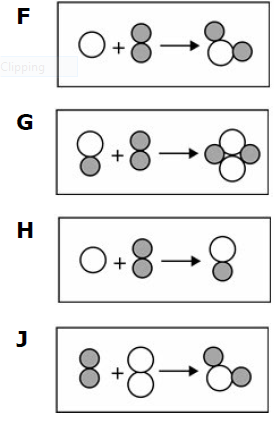
Which type of chemical reaction is the following chemical formula?
combustion
decomposition
double replacement
single replacement
synthesis
This is a decomposition reaction.
H2S(g) → H2(g) + S(s)
True
False
The right side of the equation below is called the
products
reactants

